13 February 2017

#Trump Wins By Accelerating Time – Fight Back By Slowing Down

by
EPA/Andrew Harrer
By Anthony J. Pickles, University of Cambridge and Joel Robbins, University of Cambridge

Ever since the inauguration of Donald Trump, events of jarring magnitude have come tumbling one after another at breakneck pace: 20 executive orders in ten days, the border wall, the “Muslim ban”, rows over voter fraud and crowd sizes, “alternative facts”, intrigue over conflicts of interest, a controversial invitation to the UK, a gag order on government agencies, a contentious Supreme Court nominee, and more.

It feels almost like political life has sped up beyond people’s ability to keep pace. In the US and all over the world, democratic citizens are exhausted. As Laurence Tribe, a constitutional law professor at Harvard University, told MSNBC: “It’s as if history is being collapsed into a black hole and everything is happening faster than the speed of light.

This feeling of draining temporal acceleration isn’t confined to politics. In fact, it’s the tempo of our age. We know the life-shortening effects of jet lag, stress, and occupational burnout in societies increasingly replete with technologies to monitor our time use and performance. We know the trials of conditioning our children to sleep through the night and stay awake during the day so that they experience time in discrete blocks. Making sense of time, in short, can be exhausting.

Anthropologically speaking, we also know that people can perceive time in different ways. For some, time is epochal, a series of discrete states unconnected with one another; others see it as millennial, on the verge of catastrophic collapse or renewal. Still others see it as cyclical, bound to forever repeat itself. Some people’s belief in eternal paradise is so powerful that it dominates their relationship with the present, meaning they understand climate change or even nuclear war as relatively minor episodes in a larger story. But for others, the same phenomena portend that we are living on the edge of decline and potential catastrophe.

At destabilising political moments, these perceptions can change. The fall of the Soviet Union was one such moment. Living in a state of fear and desperation, many on the eastern side of the iron curtain had kept up an absolute pretence that the Soviet Union was forever striving forward while their world crumbled slowly. But as the moment broke, time seemed to speed up, marked by daily leaps in inflation. A few canny men took control of those resources and emerged as oligarchs. (Trump’s refusal to divest his business empire opens the door to similar opportunities.)

A remarkable version of this is happening today. Trump and his aides propagate their venomous nonsense at such speed that they accelerate the news cycle to dizzying pace, too fast for the toxicity to be countered. The force of executive power means the consequences of Trump’s actions are spread so widely and chaotically that one can barely grasp the implications before the next monstrosity hits.

But this is not just a side-effect; it’s a brutally effective political strategy.

Do or die
Historians and anthropologists have both argued that the crisis is the defining political concept of our time. Framing a problem as a crisis compresses all its complexity and contingency into a single moment of truth, one that calls out for quick, decisive action that often oversteps usually-respected boundaries.

Perhaps only an age of perpetual crisis could within eight years produce first the US’s first African-American president, with his sparkling oratory of audacious hope, and then a pathological narcissist running on a platform of “you will be tired of winning”. Even Trump’s evangelical Christian supporters consider our times so pressing that all the president’s moral failings, however utterly incompatible with their beliefs, must be forgotten.


Lie down and be counted. EPA/Justin Lane
Trump’s winning move was to pitch crisis against historical complacency. One of the reasons he was able to defeat Hillary Clinton was that she failed to shake off her association with the bad old days of business as usual – a stagnant era that saw the already wealthy steadily enrich themselves further. Only by engaging with accelerating disaster on its own terms, he argued, can we survive.

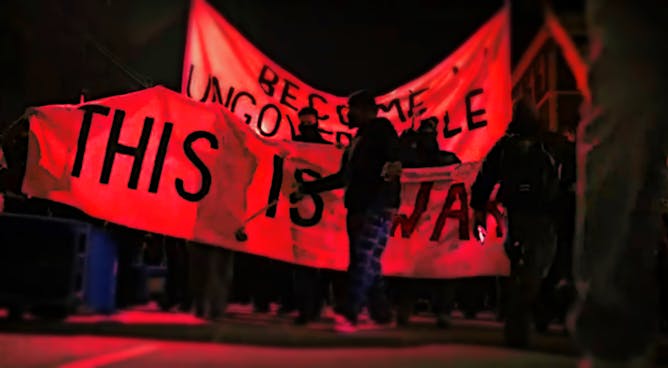
This is a rocky road to fascism, and there needs to be an effective political counter-strategy. Those protesting or resisting Trump must refuse the crisis-peddlers’ diktat to live at a frighteningly fast pace, and instead get back to thinking in terms of the middle distance. Crisis is being used to force people into a do-or-die mentality; if they refuse to think that way, they can retain the distance they need to identify shared goals and the ways to achieve them. They need to make their own time.

Those rallying against Trump need to undercut his projected strength by gumming up the works of the economy and the state, thereby proving that his power to solve problems has its limits and refusing to let him outrun our attention spans.

The best metaphor, and the best activity, is marching, with its steady rhythm and undeniable presence. This must be combined with more and more of the sort of innovative and news-capturing protests that have already begun. They must be packed with people ready to capture and control the political narrative that emerges, and to break the exhausting cycle of perpetual near-disaster.

The politics of crisis and excessive speed are winning, and they are harmful. Slowing things down to a healthy, manageable pace is the way to fight back.

The Conversation
About Today's Contributors:
Anthony J. Pickles, British Academy Research Fellow, University of Cambridge and Joel Robbins, Sigrid Rausing Professor of Social Anthropology, University of Cambridge

This article was originally published on The Conversation.


More Donald Trump Related Stories
Click here for more Donald Trump related stories...

11 February 2017

Katy Perry Honored for Global Sales of 40+ Million Adjusted Albums and 125+ Million Tracks

by
(pictured L-R Steve Barnett; Chairman & CEO Capitol Music Group, Katy Perry, Sir Lucian Grainge; Chairman and CEO Universal Music Group)
Today, Capitol Records celebrated Katy Perry's 10-year anniversary with the label and honored her extraordinary accomplishments, which include a cumulative 18+ billion streams alongside worldwide sales of more than 40+ million adjusted albums and 125+ million tracks. 

The global superstar was awarded a plaque recognizing her "singular artistry, astonishing creative vision and extraordinary global popularity within every realm of recorded music." The ceremony took place during Universal Music Group Chairman and CEO Sir Lucian Grainge's annual pre-GRAMMY showcase at the Ace Hotel in Los Angeles.

Yesterday's release of Katy's new single, "Chained to the Rhythm," set a new Spotify record. With more than three million streams on its first day of release, it marks the best first day of streaming of a single track by a female artist in Spotify history. Katy will perform "Chained to the Rhythm" for the very first time at the 59th Annual GRAMMY Awards, which will air on CBS tomorrow, February 12, at 8:00 p.m. ET/5:00 p.m. PT.

The lyric video, which already has more than eight million views, can be seen HERE. Katy co-wrote "Chained to the Rhythm" with Max Martin, Sia Furler, Ali Payami and Skip Marley. The latter is featured on the track. 
Billboard proclaimed, "Katy Perry Embraces Her Wokeness -- And It Works…one of music's biggest stars is once again dominating conversations."
Katy made her Capitol Records debut with 2008's One of the Boys after signing to the label in 2007. She cemented her status as a global superstar with the follow-up album, Teenage Dream (2010). PRISM, her 2013 album, debuted at No. 1 on iTunes in 100 countries and has sold more than 12.5 million adjusted albums worldwide. 

With the singles "Firework" and "Dark Horse" each surpassing the 10 million threshold including song sales and streams, Katy is the first female artist to earn two RIAA Digital Single Diamond Awards. She is also the most-followed person globally on Twitter. 

Katy played to a total of two million people on the sold-out, 151-date Prismatic World Tour and headlined the Super Bowl XLIX halftime show, which set a record as the most-watched Super Bowl halftime show ever. 

For additional information on Katy Perry, visit:

SOURCE: Capitol Music Group

Bonus Videos:

Tonner Doll Company Introduces Jazz Jennings Doll At 2017 New York International Toyfair

by
Jazz Jennings book cover and Jazz Jennings doll by Tonner Doll Company, Inc., debuting at New York Toyfair February 18, 2017.
Transgender star of TLC's docuseries "I Am Jazz", Jazz Jennings, will take form as the newest Tonner play doll.  The 18" portrait doll was designed and sculpted by renowned doll artist Robert Tonner.

Robert Tonner founded the Tonner Doll Company in 1991 and has continually created the best and most fashionable dolls in the world.  Designers such as Marc Jacobs, Ralph Lauren, Oscar de la Renta, Donna Karan, Betsey Johnson and Anna Sui have dressed Tonner dolls. Tonner has also participated in myriad licensing programs including DC and Marvel, Twilight, Harry Potter, Dr Suess, Peanuts, Gone with the Wind and The Wizard of Oz.

With the Jazz Jennings doll, Tonner continues its history of ground-breaking doll line introductions based on socially transformational heroes, who have included the plus-size model Emme and Carmen Dell 'Orefice, whose first Vogue cover was in 1946 and who remains a working fashion model.  
Robert Tonner, CEO of Tonner Doll, states "Jazz stands for everything I respect from a human nature point of view-she's incredibly brave, intelligent, warm-hearted and creative." 
16 year old Jazz Jennings, is an honorary co-founder of the Transkids Purple Rainbow Foundation.  Jazz speaks at universities, medical schools, conferences, conventions and symposiums all over the country. She's also a Youtube Vlogger, a youth ambassador for the Human Rights Campaign and an advocate for GLAAD.

When she was six, Jazz appeared on 20/20 with Barbara Walters. Since then, she's been featured on a variety of major programs and news outlets, including an Oprah Winfrey Network documentary, "I am Jazz: A family in Transition" and many others. Jazz and her family now have their own GLAAD Media award winning docu-series, "I Am Jazz," now on TLC.

Jazz is the youngest person ever to be recognized in The Advocate Magazine's, "Top Forty Under 40" annual list. She was named as one of TIME Magazine's Most Influential Teens for 2014 and 2015. She is also listed on Huffington Post's 14 Most Fearless Teens of 2014. In 2015 she became one of the faces of Johnson & Johnson's Clean and Clear Campaign: "See the Real" Me


In June of 2015, Jazz was invited to the White House where she met President Obama.  In October of 2015 she was honored as Miss Teen Pride USA.  In August of 2016, Jazz was recognized on Teen Vogue's 21 under 21 list.  Jazz served as Grand Marshall during the 2016 New York City Heritage of Pride March. She is the youngest person to serve as Grand Marshal in the history of the march.

In 2014, Jazz co-wrote a children's picture book with Jessica Herthel titled "I Am Jazz". She and her family continue to participate in many media projects with a goal to educate, and spread the message of tolerance and acceptance for all Transkids.  

Jazz's memoir, "Being Jazz: My Life as a (Transgender) Teen" was released in bookstores and digitally on June 7th, 2016.
The Jazz Jennings dolls will be available in specialty stores and on www.tonnerdoll.com in July, 2017.    

SOURCE: Tonner Doll

Bonus Video:

10 February 2017

Berkeley, #Milo Yiannopoulos And The Lessons Of Free Speech

by
Protestors at the University of California, Berkeley campus oppose the appearance of Breitbart News editor Milo Yiannopoulos. AP Photo/Ben Margot
By Erwin Chemerinsky, University of California, Irvine and Howard Gillman, University of California, Irvine

Recent events at the University of California, Berkeley reflect the enormous difficulties that campuses can face when trying to ensure freedom of speech while, at the same time, meeting their duty to ensure an inclusive learning environment and to protect everyone’s safety. Many, including President Donald Trump, spoke out about these events, but with apparently little understanding of what actually occurred or all that the campus did to try and protect speech.

On Wednesday, Feb. 1, Milo Yiannopoulos, a controversial speaker who prides himself on being inflammatory, was scheduled to speak at the University of California, Berkeley, at the invitation of the College Republicans student group. A demonstration of approximately 1,500 people developed to protest his presence and to stand against what they considered to be “hate speech.”

Masked protestors speak out against Yiannopoulos’ appearance on campus. pietropiupparco/flickr, CC BY-SA

A few hours before the scheduled talk, a group of protesters pulled down police barricades, hurled Molotov cocktails, smashed windows, and threw fireworks and rocks at police, resulting in US$100,000 of property damage. According to the university, the violent protesters were 150 masked agitators who had come to campus to disturb an otherwise peaceful protest.

Perceiving a serious threat to public safety, campus officials called off Yiannopoulos’ talk, while also condemning the violence and reasserting their commitment to free speech principles. As university administrators and professors who teach and write about First Amendment law, we see what happened at Berkeley as enormously important in our current debate over free speech.

Did campus officials infringe Yiannopoulos’ freedom of speech and the rights of the College Republicans to hear his views?

The event has triggered intense debates about the scope and limits of free speech. However, to understand who did the right thing and who did the wrong thing, you must also understand a few basic First Amendment principles.

Basic free speech principles
First, by law campuses must allow all views and ideas to be expressed, no matter how offensive. Above all, the First Amendment means that the government cannot prevent or punish speech based on the viewpoint expressed. This also is a crucial aspect of academic freedom.

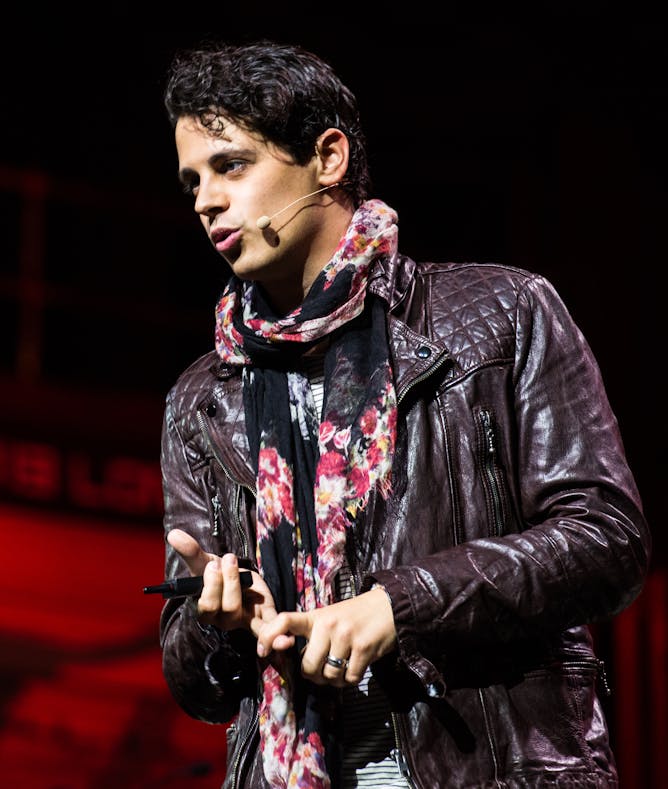
Milo Yiannopoulos speaking at the LeWeb13 Conference in London. LeWeb14/flickr, CC BY

Even the expression of hate is constitutionally protected; court cases have addressed this very issue on college campuses in the past. Although hate speech unquestionably causes harms, it nonetheless is expression that is covered by the First Amendment. We therefore strongly disagree with those who say that campus officials at Berkeley could keep Yiannopoulos from speaking because of his hateful and offensive message.

Campus officials at Berkeley recognized that Yiannopoulos had a First Amendment right to speak. Berkeley Chancellor Nicholas Dirks rightly resisted demands, including from Berkeley faculty, to ban Yiannopoulos’ appearance.

Second, campuses must do all they can to ensure that audience reactions against a speaker are not allowed to silence the speaker. Free speech can be undermined, not only by official censorship and punishment, but also by individuals who seek to disrupt or shut down others when they attempt to exercise their rights. If officials do not work to prevent or punish disruption then there will be a “heckler’s veto” of all unpopular or controversial speakers, and this is not consistent with free speech principles. Campus officials have a duty to protect the free speech rights of protesters, but they must also protect speakers and prevent heckling. Apparently, this, too, occurred at Berkeley. Staff members spent weeks planning extensive security arrangements, including bringing in dozens of police officers from nine other UC campuses.

Third, there may be situations where controlling the audience proves impossible and there is no choice but to prevent a speaker’s presence to ensure public safety. This should be a last resort taken only if there is no other way to prevent a serious imminent threat to public safety. This appears to be exactly what occurred at Berkeley, where the riotous demonstrators could not be controlled. In such cases, authorities should do all they can, after the fact, to identify and punish those who used violence and violated the law, and should assess how different security arrangements might be more effective in preventing future disruptions. Campus officials should also do what they can to reschedule the speaker for another time.

Misguided criticism of Berkeley officials
A number of commentators were outraged that Yiannopoulos was not able to speak, and claimed that free speech was under attack at Berkeley. But the campus itself consistently reaffirmed his right to speak, resisted calls to cancel the event and arranged for extraordinary security at great expense. The vast majority of the demonstrators were also merely exercising their free speech rights. Thus, the campus efforts were consistent with free speech principles. If there is blame to be assigned it should focus on the small number of outsiders who were intent on using violent and unlawful means to disrupt the event.

Nonetheless, President Trump tweeted after the event that federal funds might be withheld from Berkeley unless it allowed freedom of speech.

Putting aside that he lacks the legal authority to do this, Trump ignored the fact that freedom of speech never is absolute. Campuses can punish speech that constitutes true threats or harassment or incitement of illegal activity. Campuses also need to act to protect the safety and welfare of all on campus.

Campus officials at Berkeley faced an enormously difficult situation. They were not insensitive to speech and they did not deserve the disapproval of the president. The campus did not keep Yiannopoulos from speaking because of his views, but because public safety at the time necessitated it.

The Conversation
About Today's Contributors:
Erwin Chemerinsky, Dean of the School of Law, University of California, Irvine and Howard Gillman, Chancellor, University of California, Irvine


This article was originally published on The Conversation


Other Milo Yiannopoulos Related Posts:

Discipline Kellyanne Conway For Violating Federal Ethics Rules [Petition]

by
Another day, another email about the current White House's Administration...

No surprise, really, as it seems that so-called President Donald Trump and the members of  his team keep doing their best (or is it their worst?) to look/sound stupid on a daily basis.

On the bright side, some of the people who didn't care about politics a few months ago are now interested again. Silver lining and all that...

Anyway, today's email is from our friends at the Daily Kos. As usual, feel free to read it and act accordingly.

Thanks in advance

Stay safe!

Loup Dargent


Click here to read recent Guardian's article about Conway

The Email:
"Loup,

On February 9, Kellyanne Conway—counselor to President Trump—went on Fox News, and with the White House seal in the background urged viewers repeatedly to buy Ivanka Trump's clothing line.

This is a blatant violation under federal law.

§ 2635.702 Use of public office for private gain.
An employee shall not use his public office for his own private gain, for the endorsement of any product, service or enterprise, or for the private gain of friends, relatives, or persons with whom the employee is affiliated in a nongovernmental capacity ...
We now have a White House whose publicly paid employees go around promoting the commercial interests of the President's family members. 

Congressman Elijah Cummings called this a "textbook violation" of ethics laws and recommended that it be referred the Office of Government Ethics.

Sign the petition to the Office of Government Ethics and U.S. General Services Administration: Discipline Kellyanne Conway for violating federal ethics rules.

Keep fighting,
Paul Hogarth, Daily Kos"


More Donald Trump Related Stories
Click here for more Donald Trump related stories...

You Might Also Like