28 April 2017

From Bananarama To Boyzone, Here's Why So Many Bands Are Making A Comeback

by
Bananarama // PA/PA Archive/PA Images

By David Beer, University of York


The announcement that 1980s pop trio Bananarama are to reform is the just the latest in a long line of recent comebacks. From Boyzone to Wet Wet Wet, Take That to Jamiroquai, The Jesus and Mary Chain, The Stone Roses, The Verve, Sleeper, These Animal Men, Northern Uproar, S Club 7, 5ive and Cast, musicians of old are intent on trying on their faded stardom for size. Even Menswe@r tried it, albeit with only one original member. The news that Elastica were reuniting, however, disappointingly turned out to be premature.

Comebacks seem to be everywhere. They are not limited to a particular genre, but they do often seem to be bound to a particular era. The success levels might vary somewhat, but we seem to be living in a cultural moment that is defined by the comeback. Of course, there have been plenty of comebacks before, but right now they’re close to being ubiquitous.

It’s tricky to know exactly what is happening here. Music cultures have always had one foot in the past. Classic songs, signature sounds, attachments to older formats like vinyl, intertextual reference points, remastered and reissued albums and the like, have long been a central part of how music is made and consumed. But the comeback is a more material and pronounced version of these tendencies. The comeback represents a more obvious and direct impulse to revisit.

Why come back?
Nostalgia undoubtedly plays a part. Inevitably bands who return for a second innings are driven by a desire to revisit particular moments or to experience again music from more youthful times. The myths and memories are likely to mix together a little here.

Some suggest that the prominence of the comeback is further evidence of culture stalling; that we have reached something of a creative dead end and therefore can only look backwards. The point here, mistakenly, would be to think that an absence of creativity has left a void that the comeback fills. A slightly more positive take on this is that we have seen the emergence, over the last ten years or so, of a new kind of retro culture which looks to the past for its resources and which uses pastiche to enliven culture today. Simon Reynolds has called this mythical revisiting of music’s archives “retromania”.

This may play a part, but I’d suggest that we need look beyond explanations bedded in the music industry if we are to understand the rise of the comeback. We can gain a richer understanding of these comebacks by thinking about how music scenes are deeply rooted in our identities – and about the important role that music takes in shaping how we connect with the social world.


A sociological view
Research has shown that music fans continue to have an attachment to the music of their youth as they move into later life. They might listen to other things and change their style of dress, but the music remains embedded in their identities. We have a strong connection with the music that forms a central part of our own biographies.

Elsewhere it has been found that music plays an important role in how we handle our emotional lives. A classic study by the sociologist Tia DeNora found that we use music in our everyday lives to influence and stimulate our emotions and feelings, to negotiate our moods or to help us to recall or revisit memories and times.

This shows that people are likely to seek out opportunities to engage with that musical past both in terms of reaffirming their identities but also because of the emotions and memories that the music embodies for them. So we need not see these comebacks as a sign of cultural failure. This comeback music will have been central to how generations of people have negotiated their lives, so having a chance to experience it in the live arena is likely to be appealing. Music scenes, are, after all, moments when our personal biographies mix with broader social changes and cultural movements.

The Rolling Stones headline Glastonbury Festival 2013. Anthony Devlin/PA Archive/PA Images
The comeback is hard to explain because those explanations are likely to be based upon a kind of inbuilt nostalgia. When we compare music’s past with its present we are also comparing different moments in our own lives . It is hard to understand changing music cultures when we are basing this understanding on our own changing biographies.

Bananas about Bananarama
Yet Bananarama’s comeback is undoubtedly part of a cultural movement, a comeback culture that is far greater than before. Like vintage and retro clothing, the resurgence of vinyl, retro arcade video gaming, the trend for revisiting and remaking classic films and TV shows (CHIPS being the most recent), and “Keep calm and carry on” style memorabilia, the comeback trend illustrates how complex relations are between yesterday and today.

The comeback is, above all else, fuelled by a desire to access and experience the cultural moments that defined our lives and identities, not the collapse of cultural creativity. It is rooted in the attachments that people form as they live with music and as they recall those times and experiences.

And so the political and social uncertainty that has defined recent years might well provide the backdrop for the comeback to thrive. It is much more likely that people are seeking assurance and security by turning back to the songs that provide an anchor for their identities or which enable them to negotiate the emotional impact of a seemingly uncertain social world, than that they feel alienated or disappointed by the music of today.

About Today's Contributor:
David Beer, Reader in Sociology, University of York

This article was originally published on The Conversation. 

27 April 2017

Donald Trump's 100 Days Of U-Turns, Bombs And Cake

by
EPA/Molly Riley/Polaris Pool

By Todd Landman, University of Nottingham


The hundredth day of an American president’s term traditionally marks the end of the honeymoon period – a time to take stock of early achievements, launch new legislation, and set a new direction. But the score card for Donald Trump’s first 100 days doesn’t read well, and the direction for the next four years is looking so new as to radically contradict the premise of his campaign.

Trump hasn’t commenced the wall along the US-Mexican border, his signature campaign pledge. He has failed (and spectacularly) to repeal and replace the healthcare reforms collectively known as Obamacare, and the courts have thwarted his orders to ban foreign nationals from several mainly Muslim countries from the US. And on a moral front, his compassion for Syrian children killed in a horrific chemical attack was offset by his decision to turn away 10,000 Syrian refugees.


The administration is under intense pressure from investigations into the Trump team’s Russian connections and purported Russian meddling in the 2016 election. The resignation of General Mike Flynn and the hapless antics of the investigating committees in Congress have only made the saga more damaging.


All the while, American opinion remains divided as ever: Trump currently enjoys the approval of roughly 40% of his people.

Trump’s image problem extends well beyond the US’s borders. In the past month, I spent a week in China while President Xi Jinping was visiting Trump’s Florida resort, Mar-a-Lago. I then visited the US, travelling from North Carolina through Virginia and on to Washington, DC. The Chinese are mostly bemused by the new president, who comes in for plenty of criticism in the Chinese media.

In the US, meanwhile, the president is at the centre of a perpetual media frenzy, lurching from one decision to the next while providing byplay via his own tweets. And undoubtedly his most dramatic lurch has been away from isolationism and towards outright military adventurism.


Volte-face
Throughout the 2016 campaign, Trump criticised “crooked Hillary” and Barack Obama for allowing the situation in Syria to deteriorate, but he also declared that he would not get involved. The “America First” philosophy he articulated in his inaugural address combined economic nationalism with international isolationism, and more recently, he reminded an audience of union members that he is “not the president of the world”.

But as the makeup of his National Security Council changed, Trump broke out of his isolationist box. He now appears to favour regime change in Syria, and possibly even a direct confrontation with North Korea.

Between my visits to China and the US, Trump retaliated to the deadly April 4 chemical attack on the Syrian rebel-held city of Khan Sheikhoun by authorising a direct missile strike on Syrian government airfields – this apparently while enjoying a “beautiful chocolate cake” with President Xi.


The attack sharpened the main lines of contention in global politics between Russia and China, who continue to back Bashar al-Assad, and the G7 nations, who oppose him, but who have yet to come up with a coherent suggestion for removing him from power.

Trump also said he’d ordered a US Navy carrier strike group on routine exercises to head from Australia to the waters off North Korea, while Pyongyang held a national day of celebration at which it showed off significant military hardware, some of it not seen before.

In the days between the announced rerouting of the aircraft carrier group (the truth of which is now unclear) and North Korea’s celebrations, the US dropped the largest non-nuclear bomb ever used on a network of tunnels in Afghanistan used by the so-called Islamic State (IS). The blast itself is estimated to have killed more than 90 IS militants, while at the same time sending a clear signal to IS, North Korea and others that Trump is ready to use devastating force.

China’s Xi has since tried to calm tensions between the US and North Korea, but to little effect; the sabre-rattling continues, and a sixth North Korean nuclear test may not be far away.

Empty at the core
Throughout these last 100 days, I have been searching for some sort of signal in all the noise – some core commitment to a programme of change, with a clear set of organising principles and an underlying philosophy. I have struggled to argue that there must be something at the heart of all of this that makes coherent sense and that will genuinely benefit even Trump’s core supporters.

Some of those supporters presumably see their president as a decisive leader using the full power of the presidency to tackle enormous domestic and foreign issues. To them, he’s doing precisely what he promised, and given time and space to act, he will deliver real change to America. Business leaders are waiting for his tax cuts to invigorate markets, while the core voters wait for their promised new jobs and cheaper healthcare.

But if Trump is right that running America really is like running a business, he should be able to produce an income-expenditure model that indicates more is being achieved with less, with a surplus to show as a result. No such model is forthcoming. Yes, the proposed investments in infrastructure and the border wall are meant to be balanced by cuts to public programmes in science, health, welfare, and even the coast guard. But combined with promised tax cuts and increased defence spending, the books simply will not be balanced – especially with expensive new overseas military adventures now on the cards.

In search of a metaphor with which to capture these first 100 days of the Trump presidency, I’ve landed on the Tasmanian devil. The real animal is described as having a “cantankerous disposition”; it will “fly into a maniacal rage when threatened by a predator, fighting for a mate, or defending a meal”. As rendered in cartoon form for Looney Tunes, it’s a swirling vortex of frenzied activity with an empty core.


The thrust and parry of politics is inevitable, as interests and power intersect in complex and contested ways – but actual change is achieved through consensus and compromise. Obamacare was only passed in 2010 after a year of face-to-face encounters, discussions, and compromises forged in committee rooms and caucus meetings. The bill that emerged wasn’t what everyone wanted, but it contained enough of what most of them wanted.

If Trump’s first 100 days prove anything, it’s that politics is not business. CEOs and presidents need very different skills, and commanders-in-chief need to think about more than the bottom line. The self-proclaimed master of the Art of the Deal has much to learn if he is to thrive in his first term.

About Today's Contributor:
Todd Landman, Professor of Political Science, Pro Vice Chancellor of the Social Sciences, University of Nottingham

This article was originally published on The Conversation


  More Donald Trump Related Stories
Click here for more Donald Trump related stories...

Women's Most Desired Super Powers Revealed in thinkThin National Survey

by
(PRNewsfoto/thinkThin)

Today thinkThin announced it is celebrating its partnership with the feature film "Wonder Woman," by revealing unexpected comic book hero statistics and surprising a fan with her super power wish. This is the first of four surprises that will be granted to consumers who enter the thinkThin Super Powers contest by May 5th.

Inspired by the heroic feats of Wonder Woman and in anticipation of the upcoming June 2nd film release, thinkThin commissioned a national survey to uncover women's "must haves" when it comes to super powers.

The survey, which captured insight from women across all ages, revealed some startling results, specifically: 


  • Two is better than one. While women desire invisibility, flight and telepathy, more than two thirds would use their super powers to be in two places at once. 
  • Not a caped crusader. The majority of women, 56 percent, would prefer wielding a shield to a wearing a cape while saving the world. 
  • Millennial mask mindset. Overall, 80 percent of millennial women openly wish for a super power, with 54 percent of them saying they wouldn't wear a mask when fighting crime. 
  • Party of one. When asked to pick Wonder Woman's soul mate, there was universal agreement across all age groups that Wonder Woman does not need anyone to complete her…though maybe they haven't met Steve Trevor! 
  • Truth be told. The majority of women polled wanted Wonder Woman's Golden Lasso of Hestia, over other items, including her bracelets and tiara. 
  • Wonder Woman is wondrous. Wonder Woman is the top hero pick for women, beating out other well-known female heroes old and new. 

To celebrate the highly anticipated release of the Wonder Woman film, thinkThin surprised its social media fan AnnaRose Etra of Santa Cruz, California, who posted on the thinkThin Facebook page that breathing underwater would be the ultimate ability. To bring this super power to life, thinkThin will provide scuba diving certification lessons, enabling her to explore the ocean as if she had that ability.

"We wanted to celebrate a hero film featuring a woman in the leading role," said Michele Kessler, the president of thinkThin. "We love that Wonder Woman has super strength and we're proud to offer delicious products that give women the everyday strength they need to power through their day."
thinkThin will award three additional fans across the country a surprise prize leading up to the movie's release, and four fans have a chance to win a swag bag of thinkThin products and movie gift certificates. To enter between now and May 5, 2017, comment on the thinkThin Super Powers Contest posts on Facebook or Instagram and tell us which super power you wish you had.

Fans also have a chance to win by participating in the thinkThin "Wonder Woman" sweepstakes! Post a comment or photo on Twitter, Instagram or the official thinkThin Facebook page about thinkThin or "Wonder Woman" using the hashtags #thinkWonderWoman and #Sweepstakes.

Enter by May 11th for a chance to win a "Wonder Woman" VIP Experience, including a trip for two to the movie's U.S. premier, and enter by June 8th to win other great prizes, including a replica of Wonder Woman's golden lasso and tiara, gift baskets of "Wonder Woman" memorabilia and thinkThin Products, or movie tickets.

Fans of both "Wonder Woman" and thinkThin can follow all the updates and contest opportunities on thinkThin's Facebook and Instagram pages. 

For more information visit www.thinkproducts.com.

About "Wonder Woman"
Before she was Wonder Woman, she was Diana, princess of the Amazons, trained to be an unconquerable warrior. Raised on a sheltered island paradise, when an American pilot crashes on their shores and tells of a massive conflict raging in the outside world, Diana leaves her home, convinced she can stop the threat. Fighting alongside man in a war to end all wars, Diana will discover her full powers…and her true destiny.

Patty Jenkins directs "Wonder Woman" from a screenplay by Allan Heinberg, story by Zack Snyder & Allan Heinberg and Jason Fuchs, based on characters from DC. Wonder Woman was created by William Moulton Marston.

The film stars Gal Gadot, Chris Pine, Robin Wright, Danny Huston, David Thewlis, Connie Nielsen and Elena Anaya. It is produced by Charles Roven, Deborah Snyder, Zack Snyder and Richard Suckle, with Stephen Jones, Geoff Johns, Jon Berg, Wesley Coller and Rebecca Steel Roven serving as executive producers.

Warner Bros. Pictures presents, an Atlas Entertainment/Cruel and Unusual production, "Wonder Woman." The film is scheduled for release on June 2, 2017, and will be distributed worldwide by Warner Bros. Pictures, a Warner Bros. Entertainment Company. www.wonderwomanfilm.com.

Wonder Woman and all related characters and elements © & ™ DC Comics and Warner Bros. Entertainment Inc. All Rights Reserved.

About the thinkThin Super Powers Contest
No Purchase Necessary to Enter. Must be U.S. resident 21 or over. Promotion begins 4/4/17 at 12:00:00 a.m. PT and ends 5/5/17 at 11:59:59 p.m. PT. Void where prohibited and outside U.S. Total ARV of all prizes is $2400. Winners selected based on feasibility, thoughtfulness and creativity. Subject to Official Rules (including full entry and prize restrictions) at thinkproducts.com/superpowers.

Sponsor: Glanbia Performance Nutrition, Inc. Not sponsored by Facebook or Twitter.

About the thinkThin-Wonder Woman Sweepstakes
No Purchase Necessary to Enter. Must be U.S. resident 21 or over. Promotion begins 4/21/17 at 12:00:00 a.m. PT and ends 6/8/17 at 11:59:59 p.m. PT. Deadline for Grand Prize drawing is 5/11/17 at 11:59:59 p.m. PT. If entering via mobile device, message & data rates may apply. Winners selected by random drawing. Total ARV of all prizes: $4,000. Grand Prize trip must be taken to attend Wonder Woman premiere screening on 5/25/17. Void where prohibited and outside U.S. Subject to Official Rules (including full entry and prize restrictions as well as odds) at thinkWonderWomanMovieSweeps.com.

Sponsor: National CineMedia, LLC, Centennial, CO 80112. Not sponsored by Facebook, Instagram or Twitter.


SOURCE: thinkThin

25 April 2017

Documentary Exposes Threat to Humans' "Innocently Violent" Ways

by
Innocently Violent Movie Poster

Korey Rowe
, Producer of "Loose Change 9/11" and veteran of Iraq and Afghanistan engagements has released a new documentary, "Innocently Violent", concerning the future of our food supply as affected by climate change. Korey Rowe, an upstate New York native, travels from the glaciers of Iceland, to the labs of UCLA and the kitchens of Vancouver to understand what will happen in the years to come if the drastic changes we are witnessing can't be reversed. "A problem properly stated is half-solved," says Jordan Perry, farmer and conservationist in the mountains of the Sierra Nevada who is featured in the film. Jordan and his family are taking active measures in their own lives to educate themselves and others in sustainable living practices.

Individuals can make a difference, and this documentary focuses on the trajectory of that change. Filmed over the course of three years by one man with one camera, this story of humans is one that will make you think while forcing you to ask the question: "Is this the best society we can create?"

Currently, the movie is free to Amazon Prime members and will be on other platforms such as Hulu, iTunes, YouTube and more soon. "Innocently Violent" is produced by Prism Pictures, a Los Angeles, California, production company and distributed by Indie Rights Movies, who is handling global distribution for the film.
For more information about the movie and the director, Korey Rowe, go to www.innocentlyviolent.com.

The Trailer:


24 April 2017

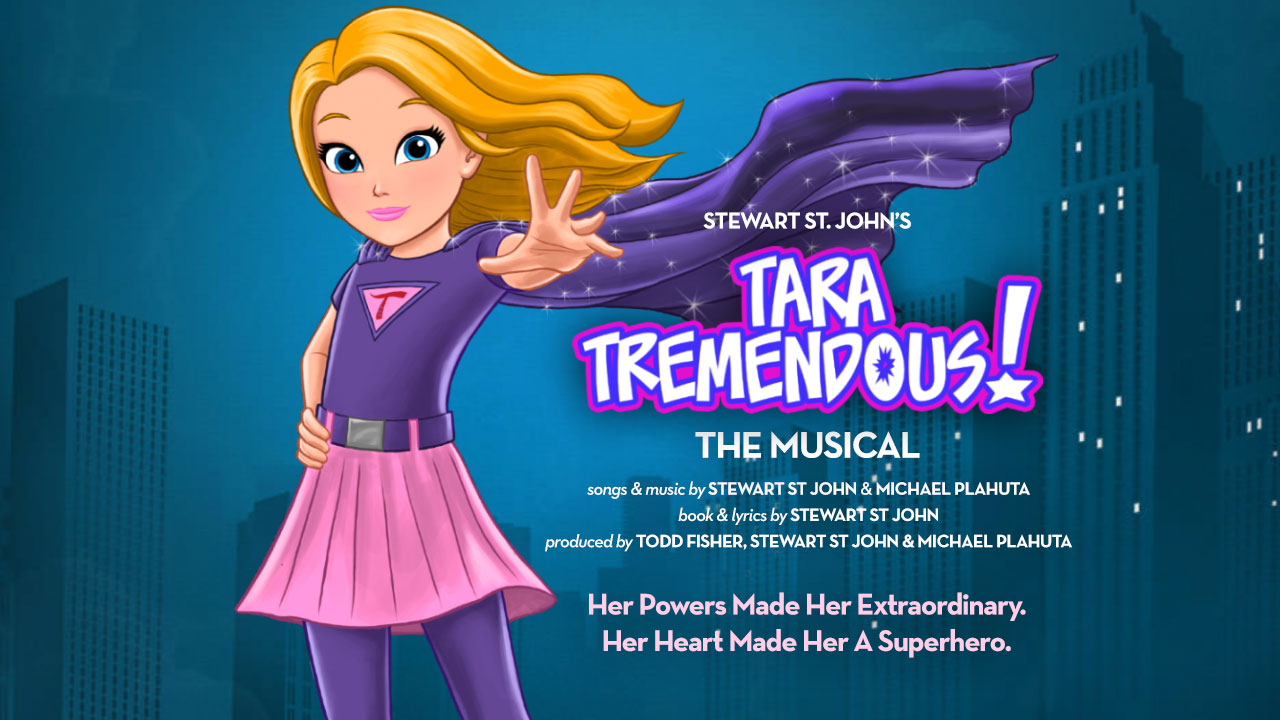
Superhero Musical 'Tara Tremendous' Gets Docuseries Leading to Launch of Cast Album

by
Image via wonkybot.com
Wonkybot Studios has released the trailer, key art and confirmed a May 3rd launch date for its new original documentary web series Tara Tremendous: Making Of A Musical.
The series, which will air in short segments exclusively on Wonkybot.com, follows company founders Stewart St John, Todd Fisher and Michael Plahuta — who are also the creative forces behind the Tara Tremendous brand — as they take their #1 iTunes kids and family podcast to New York and prepare to launch it as a musical concert premiering at world-famous Feinstein's/54 Below.
Says St John, "Getting this show up and in front of a real audience is the first step toward our goal of bringing Tara to Broadway. We were blessed with some amazing talent along the way, from Micky Dolenz, MiMi Ryder and Kecia Lewis to Annie Golden, Brian Charles Rooney, Ramsey Whitney, Mary Stout… so many wonderful, talented souls came on board to make this happen and we are eternally grateful."
Tara Tremendous is the story of an 11-year-old girl who goes from ordinary to extraordinary overnight after she accidentally inherits all the powers of every superhero in the world. St John created the concept in 2015 and the company launched it as a musical podcast series in 2016, where it quickly became a #1 kids and family series.

Tara Tremendous: Making Of A Musical chronicles the funny and frantic weeks leading up to the New York City stage debut, offering a behind-the-scenes glimpse at the blood, sweat and tunes that goes into launching something like a new musical.

"We were newbies at the whole musical thing," says Fisher, "And it was challenging because we were primarily working out of our LA office. There was a lot of frustration trying to wrangle this project from across the country."
They were aided along the way by key folks in New York, among them Van Dean, CEO of Broadway Records and a producer of Anastasia The Musical, and Mia Moravis, also part of the Anastasia team and a cast member of Tara Tremendous. "They were incredibly generous in helping us navigate the New York theater scene and offered a solid net whenever we started to become a little anxious," adds St John.

St John, who created, wrote and directed the podcast series, adapted the project for the stage. He wrote the book, lyrics and co-composed twenty songs with musical partner Michael Plahuta.

"We literally finished the last song two hours before our plane left from LA to New York," says Plahuta. "It 's been an exhilarating ride to say the least, maybe the best time of my life. And it's far from over. Actually, it feels like the journey has just begun."
Tara Tremendous: Making Of A Musical will air on Wednesdays beginning in May, building toward the release of the Official Tara Tremendous Cast Album, which was also recorded in New York and will be released in July.
"We see this docuseries as an excellent way to showcase our new musical," adds Fisher. "The series will be filled with exclusive sneak peeks at all the wonderful new songs and music from the show. At this point, we're just trying to get as much exposure as we can because it's all about raising awareness and getting investors on board who believe in the project enough to help get it funded and on stage."


SOURCE: Wonkybot Studios

You Might Also Like