23 May 2017

The So-Called Islamic State Group Has Weaponized Children

by
A girl leaves flowers for victims of an attack at Manchester Arena
A girl leaves flowers for victims of an attack at Manchester Arena. REUTERS/Peter Nicholls
By Mia Bloom, Georgia State University

In claiming responsibility for the attack in Manchester at an Ariana Grande concert on May 22, the so-called Islamic State group has sunk to a new low. The Conversation

We have seen terrorists target venues where young people congregate before – shopping malls, discos and schools. If IS was indeed involved, they have now deliberately targeted young children, tweens and teens and their parents in a horrific attack that has killed 22 as of this writing and wounded 59. The attacker used a nail bomb to maximize the carnage.

Through my research I have gained access to the Islamic State’s encrypted online propaganda platform, Telegram, where last night in the aftermath of the attack, IS supporters disseminated images of dead children from Mosul, saying, “The West’s children would not be safe if their (children) were not.”

This echoed a sentiment I heard many years ago when writing my book “Dying to Kill” about suicide attackers. In August 2001, a Jordanian woman named Ahlam al Tamimi researched a Sbarro pizzeria in Jerusalem to select a time in which the maximum number of families were present. In her attack on the restaurant, 15 people were killed, including seven children and a pregnant woman. Palestinians justified the attack, saying: “If our children are not sacrosanct, neither are theirs.”

As shocking as this attack was, it follows a tradition in which terrorists target children or venues specifically to maximize killing the greatest number of young people.

Children in IS propaganda
The IS propaganda machine uses graphic images of dead children to whip up their base and motivate people from around the world to join their so-called caliphate. These images of children are intended to persuade people that moving to the IS strongholds of Raqqa, Syria or Mosul, Iraq is the only way to halt Syrian President Bashar al-Assad’s slaughter of children.

During the course of research for my forthcoming book, “Small Arms: Children and Terror,” I have found that the group has also increasingly been using children as terrorist operatives, on the battlefield in mixed commando units they call Inghimasi, as propaganda disseminators, building munitions and, since December 2014, as suicide bombers.
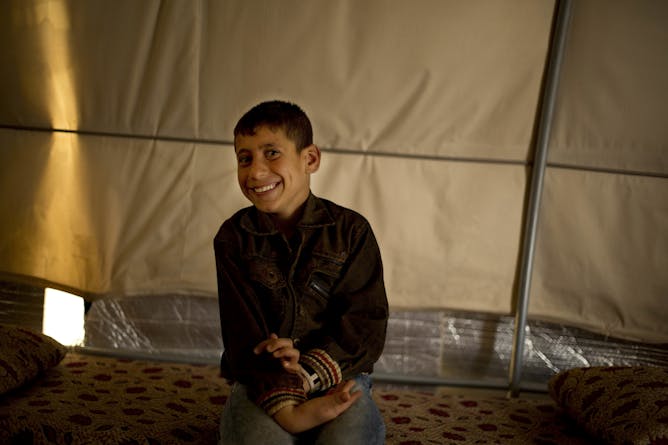
Akram Rasho Khalaf, 10, was captured at the age of 7, trained and sold into servitude by Islamic State militants. AP Photo/Maya Alleruzzo

According to a report on children and armed conflict, “In rural Aleppo, Dayr al-Zawr and rural Raqqa, the U.N. found military training of at least 124 boys between 10 and 15 years of age. The use of children as child executioners was reported and appeared in video footage in Palmyra and specific executions.”
IS has used children as young as four to execute prisoners using a remote control, and recently disseminated a video of a four-year-old shooting a prisoner in the head.

One cannot emphasize enough that there is no childhood in IS. The terrorists do not recognize the innocence of the victims at the Ariana Grande concert. The terrorists likewise do not subscribe to the notion that children have, need or deserve an idyllic period of their life in which they are to be protected and cherished.

In fact, Ali Akhbar Mahdi, a professor of religion at California State University at Northridge, argues that the word “teen” has no equivalent in Middle Eastern languages. Instead, they refer to pre-puberty, pre-youth or pre-adult. In most contexts, childhood is simply understood to be a period of time characterized by the absence of reason (‘aql).

Killing children: New norm
Terrorist targeting of children has been more common than most people realize.

For example, from Sept. 1-3, 2004, Chechen terrorists held School Number One in Beslan, Russia hostage for three days. There were 1,100 hostages in the school, including 777 children. By the end of the crisis, 384 people were dead, among them the terrorists and more than 350 civilians.
This is not exclusively a Jihadi tactic. The Oklahoma City bombing of the FBI Murrah building included a day care center. “Of the 21 children who were inside the day-care center on the morning of April 19, the morning of the bombing, 15 died, including all four of the infants by the window.
While IS has opportunistically taken credit for the attack, we do not yet have evidence to determine whether it was a directed or inspired attack. We do know, however, that the terrorist group has manipulated, brainwashed and exploited children for their own purposes and will continue to do so.

The average age for IS suicide bombers and executioners is skewing younger and younger, and they appear to be normalizing the use of children across its affiliates. For example, the terrorist group Boko Haram has used children against soft targets, civilians and marketplaces.

IS has gone from using children to inspire adults, to manipulating children and their parents to fight alongside adults, to targeting children instead of adults. They do not consider what they have done to be truly evil, although we know it to be.

About Today's Contributor:
Mia Bloom, Professor of Communication, Georgia State University


This article was originally published on The Conversation. 

Millennials Petition Trump to Give Them Their Own Day

by
Millennial leaders Ryan Avery and James Goodnow ask President Trump to recognize June 19 as "National Millennials Day."
"Millennials are entitled, disloyal, selfie-talking narcissists that need participation trophies." Sound familiar?  In popular culture, these types of sentiments are often used to describe the Millennial generation. Millennial leaders James Goodnow and Ryan Avery believe these stereotypes are "fake news," and they have launched an online petition to help set the record straight.
Starting today, Goodnow and Avery are asking the public to sign their Millennials Day Petition, which calls on President Trump and lawmakers to declare June 19 as National Millennials Day, correcting stifling stereotypes about Millennials.
But isn't this petition the ultimate example of out-of-control Millennial egotism? Now Millennials want a day named after them? Not so fast. Rather than being a day about celebrating themselves, National Millennials Day will be one of service – one where Millennials give back to their communities directly.
"As a Millennial, I cringe when I hear people write-off Millennials because of stereotypes" notes attorney James Goodnow. "For me, these are the worst kind of 'alternative facts.' Contrary to popular misconceptions, Millennials as a group are outward-focused and purpose-driven. My hope is that, by encouraging Millennials to give back on National Millennials Day, June 19 will be a turning point in upending many pervasive Millennial myths."
Avery and Goodnow note that Millennials are actually socially-conscious and passionate about improving their communities – and the world. According to research group Achieve, in 2015, 84 percent of Millennials made a charitable donation to a nonprofit, and 72 percent of Millennials spent part of their time volunteering. Goodnow and Avery also point to a Deloitte study that found six in 10 Millennials say that their current employer's "sense of purpose" is part of the reason they chose to work there.
"I couldn't be more proud to be a part of this initiative that affirms everything that is truly great about my generation – choosing your own path, pursuing your passions, and using your unique skills in the service of others," says motivational keynote speaker Ryan Avery. "Our main goal is to change the Millennial dialogue starting on June 19. How can Millennials participate? Mentor a child, become involved with a refugee organization in your community, volunteer at a homeless shelter – whatever inspires you to foster hope for a better future."
Goodnow and Avery have also recently collaborated on Motivating Millennialsa forthcoming book that teaches what companies can be doing to find, keep and motivate their next generation of leaders.
Image via millennialsday.org


22 May 2017

'The Angry Birds Movie 2' Takes Flight As Release Date Is Now Set

by
'The Angry Birds Movie 2'  launches September 20, 2019
Sequel to animated blockbuster launches September 20, 2019
Following the success of The Angry Birds Movie, which slingshot to nearly $350 million in worldwide box office and launched a global movie brand, Columbia Pictures in association with Rovio Entertainment Ltd. are once again joining forces on the next high-velocity adventure as the flightless birds and scheming green piggies take their beef to the next level in The Angry Birds Movie 2; Sony Pictures will distribute the sequel.
The sequel is planned to hit theaters on September 20, 2019, coinciding with the 10th anniversary of the original Angry Birds game.
The Angry Birds Movie 2 will be directed by Thurop Van Orman (The Marvelous Misadventures of Flapjack, Adventure Time). Van Orman recently worked at Disney and Sony Pictures Animation.  
The film will be co-directed by John Rice (King of the Hill, Rick and Morty), who served as lead storyboard artist on The Angry Birds Movie and directed the popular Angry Birds Hatchlings shorts.
The film will be produced by John Cohen (Despicable Me, The Angry Birds Movie). Peter Ackerman (FX's "The Americans," Ice Age) is writing the screenplay.
The talented team at Sony Pictures Imageworks will once again be handling the animation for the film, which will be with the collaboration of Sony Pictures Animation. Also returning from The Angry Birds Movie will be production designer Pete Oswald and character art director Francesca Natale.
"We are thrilled to be teaming up again with Sony Pictures after the fantastic cooperation in the first movie and I can't wait to experience the new journey in the upcoming film," commented Kati Levoranta, CEO of Rovio Entertainment. "Rovio is continuing to focus on creating exciting new stories and experiences around our games and we're eager to take fans back into the vibrant Angry Birds world on the big screen."
"The Angry Birds Movie took the world by storm last year, creating a whole new legion of fans worldwide," said Sanford Panitch, President of Columbia Pictures. "We had an incredible experience working with our friends and creative partners at Rovio, and now we – including our team at Sony Pictures Imageworks – are ready to launch into this next adventure."

19 May 2017

Hag, Temptress or Feminist Icon? The Witch In Popular Culture

by
Child dressed as a witch for Halloween
Child dressed as a witch/ EPA/Filip Singer
By Chloe Germaine Buckley, Manchester Metropolitan University

You would have thought that Western society might have grown out of the habit of portraying powerful women as witches, but a trope that usually ended badly for women in the Middle Ages is still being used in the 21st century. Those who portrayed Hillary Clinton as a witch during the 2016 presidential campaign, or have given Theresa May a pointy hat and broomstick in Britain’s general election, may not be calling for them to be burned at the stake, but they do call down political destruction on their heads. The Conversation


Witches have featured in fairy tales and fiction for centuries. In her earliest incarnations, the witch served as a warning. Stories about the witch-as-hag demonised and punished women for attempting to exert power outside the bounds of the domestic sphere. Beyond the fairy tale, women with “occult” knowledge (of folk medicine, for example), or simply poor, social outcasts (such as the infamous Pendle Witches hanged at Lancaster castle in 1612), were the victims of persecution and prosecution in 16th and 17th-century Britain.

Nowadays, though, the witch is often praised as a feminist figure, who pushes boundaries, breaks the rules and punishes patriarchal authority. Buffy the Vampire Slayer’s Willow Rosenberg (Alyson Hannigan) and Disney’s Maleficant (Angelina Jolie) (2014) are two oft-cited examples of the feminist witch.

In preparation for an upcoming academic conference on “Gothic feminism”, I have been researching these contrasting representations of the witch. Which witch (sorry!) does our popular culture currently favour? And can stories about the witch really be reclaimed as feminist parables?
The witch was a recurring feature of horror film in the 1960s and 1970s. British folk horror films such as The Blood on Satan’s Claw (1971) and The Wicker Man (1973) offer deeply ambivalent representations of the witch. In The Blood on Satan’s Claw, teenage temptress, Angel Blake (Linda Hayden) seems to be an anti-authoritarian heroine – the 1960s flower power movement transported to 17th-century England. But in the end she is killed by male authority figures after she oversees the rape and murder of one of her school friends. In contrast, The Wicker Man’s siren, Willow MacGregor (Britt Eckland), gleefully triumphs over the stern Christian policeman, Sergeant Howie (Edward Woodward).

Wildly feminist
The way witches are portrayed on screen has been refashioned many times over the decades. From 1964 to 1972, ABC’s Bewitched turned the witch into the subject of a suburban sitcom as domesticated Samantha (Elizabeth Montgomery) used her magic to serve her try-hard husband. The late 20th century favoured soft focus, “white” witchcraft, epitomised by the popular American television series, Charmed (1998 - 2006). More recently, the witch has taken on an explicitly Gothic guise. The big-budget TV series, American Horror Story: Coven (2013), Penny Dreadful (2015), and Game of Thrones (2011-) represent witches as glamorous and beautiful, but also suggest that their sexuality is deadly.
In cinema, Robert Eggers’ award-winning feature, The Witch (2016), returned to the folk horror genre in its stark portrayal of a Puritan family struggling to survive in 17th-century New England. The film’s bare aesthetic slips into nightmarish horror as it restages the American folk tale of the witch in the woods to a particularly gruesome conclusion.

The film received a lot of plaudits, particularly from feminist cultural commentators. A recent article on film website Little White Lies praises The Witch as a “feminist horror fantasy” that “celebrate[s] the inherent power of femininity”. Likewise, Wired magazine called the film “wildly feminist”.

Disempowering women
However, there is another side to the witch. Mary Beard, in a recent lecture, Women in Power, argued that stories of monstrous women and witches dating back to antiquity, such as the tale of the Medusa, are parables aimed at disempowering women.

Over and again, such stories seek to reinforce the male right to defeat female (ab)users of power, suggesting that women are not entitled to power in the first place – and there’s been much of that in the way both Clinton and May have been portrayed as witches.

The Witch acknowledges this history in its return to the folk horror tradition. Early in the film, a witch pounds the flesh of a dead baby into a paste. Yet at the end of the film, the teenage heroine, Tomasin, agrees to join the witches who had so gruesomely murdered her baby brother. Even though these hags cause the deaths of the rest of Tomasin’s family, their offer of “some butter” and a “pretty dress” seems far preferable to the harsh strictures of Puritan life.
What freedom and power is there in becoming a witch? Joining the witches is Tomasin’s last, desperate resort and it places her forever on the outside of a patriarchal social system in need of reform by and for its female members. More than this, Tomasin becomes one of the gruesome hags who have murdered her baby brother. In this respect, The Witch echoes old misogynist fairy tales, which often feature actual or attempted infanticide, as much as it revels in the witch’s power to destroy an authoritarian patriarch.

Eggers’ complex depiction is not a roadmap to female empowerment. A glimpsed-at moment of freedom (an aerial broomstick ride) for Tomasin occurs on the outside of acceptable social spaces – deep in the woods and far from civilisation. At the same time, the murderous witches continue to communicate centuries-old patriarchal fears about female power.

As scholars, it’s tempting to see our favourite genres and cultural products as proof texts for our politics – but Gothic horror, in particular, has always refused that role. Its monsters do not act as representatives for either the right or the left of politics, but instead slide troublingly between the poles. Given the current lurch to the right in Western politics – and the rise of anti-feminist sentiments – the ambiguity of the witch is perhaps even something to be wary of rather than to celebrate. Though she seems to be a powerful figure for feminists, we cannot forget the witch’s origins as a figure used to delegitimise powerful women and locate them on the outside of society.

About Today's Contributor:
Chloe Germaine Buckley, Senior lecturer in English, Manchester Metropolitan University

This article was originally published on The Conversation. 

Darkest Taboos: How Fleabag Busted Unrealistic Portrayals Of Women On TV

by
File 20170519 12266 19zl3rt
Fleabag - BBCCC BY-NC-SA
By Helena Bassil-Mozorow, Glasgow Caledonian University


Cringeworthy moments, eye-watering sex scenes, gleeful swearing, naked vulnerability and vulgarity of every stripe: groundbreaking BBC sitcom Fleabag fully deserved its recent BAFTA award. The Conversation

Fleabag (2016-) is part of an extraordinary new trend in television that kicked off a few years ago with Netflix prison drama Orange is the New Black (2013-). Both are shockingly stark and deliberately vulgar when it comes to exposing the taboo corners of female psychology, biology and anatomy. Both are realistic to the extent of being naturalistic in terms of visuals, dialogue and narrative.

This is writing by women which promises to show female characters as they really are, and not through society’s obligatory filters that exist to pigeonhole women.

Fleabag’s titular protagonist, played by its writer Phoebe Waller-Bridge and adapted for the screen from her one-woman play Touch, is a twenty-something Londoner struggling to find meaning in life. She is a promiscuous, pornography-watching sex-addict juggling a string of grotesque relationships and random encounters with managing a failing cafĆ© business.

She is also trying to come to terms with the death of her best friend who committed suicide after her boyfriend cheated on her. Halfway through the first season, we learn he cheated with Fleabag herself.

Defying expectations
Waller-Bridge’s character comes from an upper-middle class family, but defies all expectations that normally come with this kind of background. For example, she is a compulsive liar and a thief. The stealing bit comes from a deep sense of insecurity and the need to attract the attention of her emotionally unavailable father.

Fleabag’s entire life is a series of shameful mishaps, ranging from taking her top off at a bank interview to stealing a statuette of a naked woman, made by her infuriating stepmother (wonderfully played by Broadchurch actress Olivia Colman) who considers herself to be an artist. Fleabag’s unpolished “neglected orphan” image (the opposite of what a young woman is expected to be) is partly the result of her mother’s death from breast cancer.

Traditionally, female protagonists in TV dramas have been “presented” to us rather than speaking for themselves. We can’t hear their real voices as they are obscured by various societal roles and expectations collectively reflected in narratives: passive, objectified sexuality, longing for a partner and a family, looking elegant and groomed, emotional maturity, readiness to provide emotional support, sacrificial motherhood, and so on. They are “clean” characters.

This “cleanliness” is both internal and external – the purity of character and body. A “proper” woman does not steal, or lie to your face, or swear, or talk about inappropriate things at the table. Likewise, she does not sweat or smell, does not have hairy legs, is not seen to have periods, or use the toilet.

Nudity on screen has become so common that it no longer shocks. Yet filmmakers are still reluctant to show a female character who wakes up looking terrible; who has spots or rolls of fat (particularly outside comedic settings). Fleabag offers true naturalism; this is what is truly groundbreaking – not the increasingly dull sex scenes involving toned bodies to which film and TV audiences are treated to every day.

Of course, there were the four heroines of Sex and the City who candidly discussed sex and the perils of modern dating, but they were beautifully made up, successful, and fashionable. None of them evoked associations with a “fleabag”. Waller-Bridge’s creation is much closer to Lena Dunham’s series Girls (2012-1017), but still deliberately avoids HBO’s polish. Everything about Fleabag is rough and raw, from the music and camerawork to the POV (point of view) and monologues.

The Sex and the City girls
The Sex and the City girls: candid but glossy. Shutterstock
In fact, cinema and TV are generally still operating along the lines of these stereotypes for both female protagonists and secondary characters, making any deviation from the norm look refreshingly gritty. A “proper” woman is therefore so sterile she practically smells of chlorine.

Blundering and failing
It is this sense of blank sterility that Waller-Bridge defies with her depiction of a blundering, failing young woman. Her hilarious asides to the camera, often including candid, uncensored remarks on uncomfortable subjects such as anal sex, masturbation and survivor guilt, show that not only she is not ashamed of her behaviour – she is proud of it.

The hyper-naturalism, which is the hallmark of the series, is the result of this pride. After all, male protagonists in TV and film have been allowed to be make mistakes for decades. Men on screen are allowed to be funny, ridiculous, ugly, promiscuous and terrified of settling down. Why can’t women?

When asked what constitutes the “female journey” (that is, the difficulties the female protagonists have to overcome on their path in narratives), the American mythologist and author Joseph Campbell allegedly replied that there was no such thing as a female journey as a woman didn’t have anywhere to go in the first place.

In his books Campbell explored the path of the male hero in world mythology. The path consists of multiple steps, and is full of problems to be dealt with, puzzles to be solved and monsters to be killed. A woman need not bother to activate her agency like a man would: she is already “there”, already perfect. She is born at peace with herself, whereas the man has to endure trials and tribulations to become the true hero of his own story.

Fleabag in a superhero costume
Fleabag is imperfect and unhappy and aching to go on her own journey to fight her demons. Soho Theatre, CC BY

This view implies that a woman does not have to face the journey of finding who she is, blundering and looking for meaning through trial and error, let alone looking stupid in the process. Her chlorine perfection stays unchanged through her life and guarantees happiness – particularly if she finds the right man with whom to start a family.

Fleabag’s rebellious naturalism successfully challenges this vision of the female protagonist (of whom we still have very few, although their number is growing – particularly on TV). Fleabag the woman is imperfect, unhappy, itching to go on her journey and fight all sorts of internal and external monsters: addictions; insecurities; the neglectful father; the dead mother; the chilly sister; the fake pompous stepmother; the weird arsehole guy; the rude bank manager. This is her way of becoming herself, of finding her own voice.

At last there is a trend that frees women from the bland stereotyped portrayals of feminine perfection and the need to conform to good girl expectations. We should be grateful to Fleabag for showing female characters who are not ashamed of being imperfect and real.

About Today's Contributor:
Helena Bassil-Mozorow, Lecturer in Media and Journalism, Glasgow Caledonian University

This article was originally published on The Conversation


Bonus Video:

You Might Also Like