2 October 2017

Nightmare at Beaver Lake Opens Friday the 13th!

by
Nightmare at Beaver Lake - poster
Nightmare at Beaver Lake
Currently in its 14th year, the Nightmare at Beaver Lake is the Sammamish Rotary's main fundraiser and community service project. It is produced in affiliation with Scare Productions and the City of Sammamish

Patrons walk approximately ¾ of a mile along the trails of Beaver Lake Park and are entertained by 23 separate theatrical sets filled with actors in full makeup and costumes. 
Over 125 volunteers are required each night to scare 13,000 patrons during the 11 night run of the show. Approximately 70% of the actors are local high school students.  
This all volunteer charity haunt enables the Sammamish Rotary to support local and international charities, and award college scholarships to students from the three Sammamish High Schools.


About The Nightmare:
(Excerpt from the Nightmare's site)

In early 2004 the Rotary Club of Sammamish decided to create a unique haunted adventure. The goal was to create a project that would involve the city's teenagers both as constructors and customers. 

They gathered help from Scare Productions, Valour Designs, the Sammamish Youth Board, the Skyline High School Key Club, Eastlake High School DECA, the City of Sammamish, and people from our community.


Several things make our haunt unique. Visitors wind their way through both outdoor and indoor scenes. Each set provides a theatrical experience including live actors. From construction to acting to security, Nightmare at Beaver Lake is run by hundreds of volunteers.

That first year nearly 4000 people screamed their way through Beaver Lake Park in just four nights. In 2005 we saw more scenes and an even larger attendance. By 2006 we had extended the trail to nearly 3/4 of a mile and attendance had swelled to over 8,000. By 2011 we had nearly 12,000 visitors to our asylum over 10 nights who donated over 2,500 pounds of food!

Nightmare at Beaver Lake - logo
Nightmare at Beaver Lake Opens Friday the 13th!
  • 2017 Dates to Remember:
    • Opening Night: Friday, October 13, 2017
    • Running dates: Friday, October 13, 2017 – HalloweenOctober 31, 2017
      • Open Friday, Saturday and Sunday nights plus Monday Oct. 30th and Halloween
    • Ribbon Cutting - Mayor of Sammamish6pmThursday, October 12, 2017
    • Press Night (dress rehearsal); 7pmThursday, October 12, 2017
  • Hours: Family Scare: 7pm-7:45pm
    • Full Scare: 8pm-11pm Fri/Sat and 8pm-10pm Sun/Mon
  • Admission: Online sales at NightmareAtBeaverLake.com (Skip the ticket lines)
    • Family Scare: $12 per person
    • Full Scare: $20 per person
    • Fast Pass (Fri-Sat Full Scare Only)$10 additional (skip the entrance line)
  • Discounts: Bring a can of food for Lifewire and receive $1 off
For tickets, volunteer info, inquiries, and general info about the show, please visit NightmareAtBeaverLake.com

Sammamish Rotary: "We scare, because we care" 
Every year it's different! Every year its better!
The Video:


Art Of Villalpando Will Bring Together Philanthropists In New York To Support Mexican Culture

by
Cristóbal de Villalpando (ca. 1649–1714). Moses and the Brazen Serpent and the Transfiguration of Jesus (detail), 1683
On the occasion of the exhibition Cristóbal de Villalpando: Mexican Painter of the Baroque at The Metropolitan Museum of New York, currently running through October 15, the Mexican Cultural Institute of New York (MCINY) will host a benefit evening with a private tour of the exhibition on October 3. The event will be chaired by Mexico's Ambassador to the United States, Gerónimo GutiĆ©rrez FernĆ”ndez and Diego Gómez Pickering, Consul General of Mexico in New York, and co-chaired by Claudia (Gonzalez) Romo Edelman.
The benefit reception, organized by MCINY, pays homage to the work of Estrellita B. Brodsky, a well-known curator and philanthropist, who has promoted Mexican art throughout the globe, especially in the United States. Part of the ticket sales will be donated to the relief efforts in Mexico.
"With this event, we seek to strengthen the promotion of Mexico, specifically of our culture, in one of the most important art institutions in the United States," said Gómez Pickering. "We also aim to channel collective efforts to aid the victims of the tragic earthquakes that shook Mexico," he added.
"The exhibition is the first major Mexican art project at The Met since 1990. For over 25 years the MCINY has worked to foster a better understanding of Mexico through the promotion of its vibrant culture. Now is a particularly important moment to support the Institute's mission and with it, our Mexican fellow citizens," commented Claudia Romo Edelman.
The MCINY, currently directed by Caterina Toscano, is a non-profit organization committed to promoting the richness, dynamism and cultural diversity of Mexico, a plural and creative nation. It is also the cultural division of the Consulate General of Mexico in New York.
The work of Cristóbal de Villalpando is recognized as emblematic of the art of viceregal Mexico. The collection exhibited at The Met was first presented this year at the Citibanamex Palacio de Cultura-Palacio de Iturbide in Mexico City, from March 9 to June 4
The exhibition includes the painting Moses and the Brazen Serpent and the Transfiguration of Jesus, a 28-foot-tall canvas finished in 1683, which has never been exhibited outside Mexico.
The exhibition is organized by The Metropolitan Museum of Art and Fomento Cultural Banamex, A.C. It is made possible by Citibanamex and Fundación Diez Morodo.

Additional support is provided by the Ministry of Foreign Affairs of Mexico (SRE), AMEXCID, and the Consulate General of Mexico in New York.

SOURCE: Mexican Cultural Institute of New York

With Honour Announces New Modern Modest Sportswear With Active Cooling Technology

by
The SnapJab by With Honour
U.S. based product developer, With Honour, is unveiling a range of stylish yet amazingly functional active fashion wear for modest women and athletes. With Honour noticed the need for modest clothing that suits modern women, so they decided to create it themselves.
The With Honour range consisting of self-cooling "SnapJab" and "Aurora hoodie" will be pre-selling their products through the crowdfunding platform, Kickstarter. During a 30-day sale the range will be selling at a discount.
The Aurora Hoodie by With Honour
Having spotted a gap in the market for a fashionable, comfortable and practical modest active wear. The team went out and spoke to female athletes in over five countries, lots and lots of athletes. So, the quest was to create the ultimate clothing range for these women. The result is the With Honour range.
First designed to be functional. Easy access non-snag snaps, snug fitting yet comfortable with amazing built in active-cooling tech – that keeps you cool no matter what the sport.
They then took that functionality and made it beautiful. "We wanted to create a range of active wear – that is ideal for serious female athletes but can be worn by anyone," says founder Kamal Kalifa.
The SnapJab
The SnapJab  
The founder, Kamal Kalifa, firmly believes that "What you wear should never limit what you can achieve."
With Honour is now ready to launch their product to the public. 

The Videos:
The Aurora Hoodie Promo

The SnapJab Promo

SOURCE: With Honour

1 October 2017

Dear Elon Musk: Your Dazzling Mars Plan Overlooks Some Big Nontechnical Hurdles

by

File 20171001 13542 15sjp1f
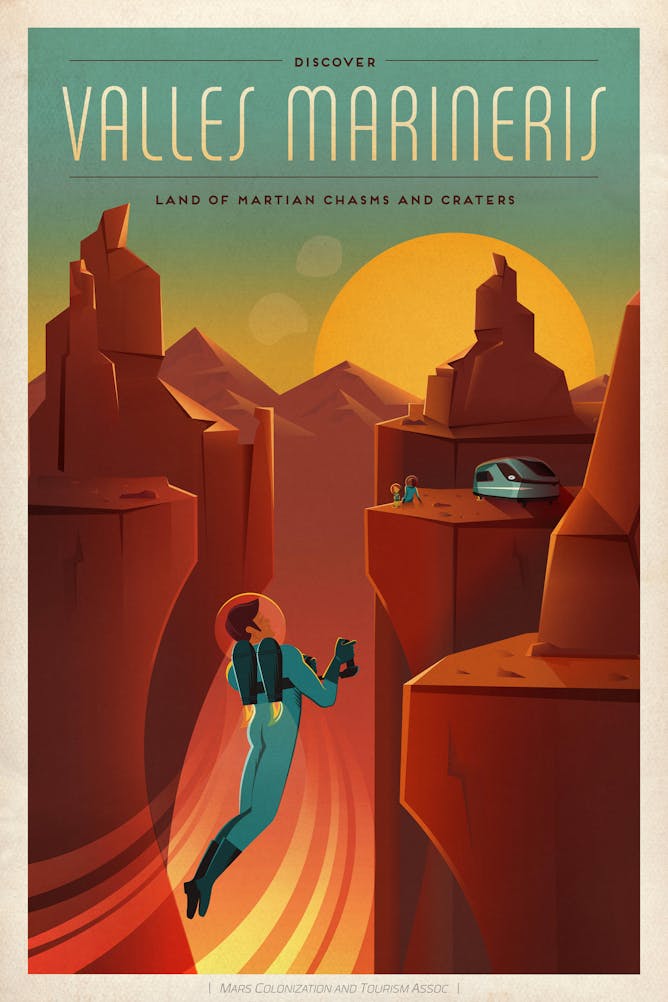
Will it be only a few decades before Mars tourism is a reality? (SpaceX, CC BY)
By Andrew Maynard, Arizona State University

Elon Musk has a plan, and it’s about as audacious as they come. Not content with living on our pale blue dot, Musk and his company SpaceX want to colonize Mars, fast. They say they’ll send a duo of supply ships to the red planet within five years. By 2024, they’re aiming to send the first humans. From there they have visions of building a space port, a city and, ultimately, a planet they’d like to “geoengineer” to be as welcoming as a second Earth.

If he succeeds, Musk could thoroughly transform our relationship with our solar system, inspiring a new generation of scientists and engineers along the way. But between here and success, Musk and SpaceX will need to traverse an unbelievably complex risk landscape.

Many will be technical. The rocket that’s going to take Musk’s colonizers to Mars (code named the “BFR” – no prizes for guessing what that stands for) hasn’t even been built yet. No one knows what hidden hurdles will emerge as testing begins. Musk does have a habit of successfully solving complex engineering problems though; and despite the mountainous technical challenges SpaceX faces, there’s a fair chance they’ll succeed.

As a scholar of risk innovation, what I’m not sure about is how SpaceX will handle some of the less obvious social and political hurdles they face. To give Elon Musk a bit of a head start, here are some of the obstacles I think he should have on his mission-to-Mars checklist.

Musk typically drives hard toward his goals – in this case, Mars. (AP Photo/Refugio Ruiz)

Planetary protection
Imagine there was once life on Mars, but in our haste to set up shop there, we obliterate any trace of its existence. Or imagine that harmful organisms exist on Mars and spacecraft inadvertently bring them back to Earth.

These are scenarios that keep astrobiologists and planetary protection specialists awake at night. They’ve led to unbelievably stringent international policies around what can and cannot be done on government-sponsored space missions.

Yet Musk’s plans threaten to throw the rule book on planetary protection out the window. As a private company SpaceX isn’t directly bound by international planetary protection policies. And while some governments could wrap the company up in space bureaucracy, they’ll find it hard to impose the same levels of hoop-jumping that NASA missions, for instance, currently need to navigate.

It’s conceivable (but extremely unlikely) that a laissez-faire attitude toward interplanetary contamination could lead to Martian bugs invading Earth. The bigger risk is stymying our chances of ever discovering whether life existed on Mars before human beings and their grubby microbiomes get there. And the last thing Musk needs is a whole community of disgruntled astrobiologists baying for his blood as he tramples over their turf and robs them of their dreams.

Ecoterrorism
Musk’s long-term vision is to terraform Mars – reengineer our neighboring planet as “a nice place to be” – and allow humans to become a multi-planetary species. Sounds awesome – but not to everyone. I’d wager there will be some people sufficiently appalled by the idea that they decide to take illegal action to interfere with it.

Ecoterrorists claimed responsibility in 1998 for burning part of a Colorado ski resort they said threatened animal habitats. (Vail Fire Department)

The mythology surrounding ecoterrorism makes it hard to pin down how much of it actually happens. But there certainly are individuals and groups like the Earth Liberation Front willing to flout the law in their quest to preserve pristine wildernesses. It’s a fair bet there will be people similarly willing to take extreme action to stop the pristine wilderness of Mars being desecrated by humans.

How this might play out is anyone’s guess, although science fiction novels like Kim Stanley Robinson’s “Mars Trilogy” give an interesting glimpse into what could transpire once we get there. More likely, SpaceX will need to be on the lookout for saboteurs crippling their operations before leaving Earth.

Space politics
Back in the days before private companies were allowed to send rockets into space, international agreements were signed that set out who could do what outside the Earth’s atmosphere. Under the United Nations Treaty on Principles Governing the Activities of States in the Exploration and Use of Outer Space, including the Moon and Other Celestial Bodies, for instance, states agreed to explore space for the benefit of all humankind, not place weapons of mass destruction on celestial bodies and avoid harmful contamination.

That was back in 1967, four years before Elon Musk was born. With the emergence of ambitious private space companies like SpaceX, Blue Origin and others, though, who’s allowed to do what in the solar system is less clear. It’s good news for companies like SpaceX – at least in the short term. But this uncertainty is eventually going to crystallize into enforceable space policies, laws and regulations that apply to everyone. And when it does, Musk needs to make sure he’s not left out in the cold.

This is of course policy, not politics. But there are powerful players in the global space policy arena. If they’re rubbed the wrong way, it’ll be politics that determines how resulting policies affect SpaceX.

Climate change
Perhaps the biggest danger is that Musk’s vision of colonizing Mars looks too much like a disposable Earth philosophy – we’ve messed up this planet, so time to move on to the next. Of course, this idea may not factor into Musk’s motivation, but in the world of climate change mitigation and adaptation, perceptions matter. The optics of moving to a new planet to escape the mess we’ve made here is not a scenario that’s likely to win too many friends amongst those trying to ensure Earth remains habitable. And these factions wield considerable social and economic power – enough to cause problems for SpaceX if they decide to mobilize over this.

There is another risk here too, thanks to a proposed terrestrial use of SpaceX’s BFR as a hyperfast transport between cities on Earth. Musk has recently titillated tech watchers with plans to use commercial rocket flights to make any city on Earth less than an hour’s travel from any other. This is part of a larger plan to make the BFR profitable, and help cover the costs of planetary exploration. It’s a crazy idea – that just might work. But what about the environmental impact?

Even though the BFR will spew out tons of the greenhouse gas carbon dioxide, the impacts may not be much greater than current global air travel (depending how many flights end up happening). And there’s always the dream of creating the fuel – methane and oxygen – using solar power and atmospheric gases. The BFR could even conceivably be carbon-neutral one day.

But at a time when humanity should be doing everything in our power to reduce carbon dioxide emissions, the optics aren’t great. And this could well lead to a damaging backlash before rocket-commuting even gets off the ground.

When the USSR launched Sputnik on Oct. 4, 1957, it also launched the space race.( AP Photo)

Inspiring – or infuriating?
Sixty years ago, the Soviet Union launched Sputnik, the world’s first artificial satellite – and changed the world. It was the dawn of the space age, forcing nations to rethink their technical education programs and inspiring a generation of scientists and engineers.

We may well be standing at a similar technological tipping point as researchers develop the vision and technologies that could launch humanity into the solar system. But for this to be a new generation’s Sputnik moment, we’ll need to be smart in navigating the many social and political hurdles between where we are now and where we could be.

Imagine the possibilities…. (SpaceX, CC BY)

These nontechnical hurdles come down to whether society writ large grants SpaceX and Elon Musk the freedom to boldly go where no one has gone before. It’s tempting to think of planetary entrepreneurialism as simply getting the technology right and finding a way to pay for it. But if enough people feel SpaceX is threatening what they value (such as the environment – here or there), or disadvantaging them in some way (for example, by allowing rich people to move to another planet and abandoning the rest of us here), they’ll make life difficult for the company.

The ConversationThis is where Musk and SpaceX need to be as socially adept as they are technically talented. Discounting these hidden hurdles could spell disaster for Elon Musk’s Mars in the long run. Engaging with them up front could lead to the first people living and thriving on another planet in my lifetime.

About Today's Contributor:
Andrew Maynard, Director, Risk Innovation Lab, Arizona State University


This article was originally published on The Conversation. 

29 September 2017

Freedom Colony, a Texan Family - Beyond 40 Acres and a Mule

by
The Upshaws of County Line
The Lost Pines Art League is proud to present an educational and uplifting photography show about the exhibition The Upshaws of County Line follows one family from everyday events, such as a game of dominos, to important milestones such as births and funerals.
But what makes the Upshaws unique is where they lived — County Line, a freedom colony in East Texasformed in the 1870s by newly freed slaves on land that they owned.
The photographs, taken by University of North Texas alumnus Richard Orton, will be on display through the end of October 2017 in Studio B at the Lost Pines Art Center.
The show is brought to you by a partnership of the Lost Pines Art Center and through a grant provided by the City of Bastrop.  The City of Bastrop has earned the title of the most historic small town in Texas.
The Upshaws of County Line - Book
The exhibition, which covers 25 years, is based on his 2014 book of the same name published by UNT Press. "I watched family members being born and grow up," he said. "I watched people die. I took photographs of funerals. It was a very rare gift that I was able to do what I did there."
Orton was a music major at UNT who took up photography while living in Austin after college. During a visit to his parents' home in Nacogdoches, he discovered the existence of freedom colonies and became curious about the impact that their relative autonomy had on their families.
He found the Upshaw family, which had 13 children, and told them he was interested in photographing them. The family agreed, and he began taking the documentary-style, black-and-white photographs the day after Thanksgiving in 1988.
In one memorable photo, the patriarch Edward Monel Upshaw is being introduced to his great-granddaughter, Reya, less than a year old, who is crying. Other photos include the annual homecoming celebration that brings in family members from all over the country in August.
"What I hope that it does is convey some sense of what it was like to be raised in a community like that," Orton said. "The children were not subject to all the negative aspects of the Jim Crow reality of the day. By virtue of fact they owned their own land, they automatically had their own independence."

  • The Lost Pines Art League (Lost Pines Art Center) is a 501(c)(3) nonprofit organization and runs the Lost Pines Art Center. Its membership includes a diverse set of artists and supporters of the fine arts.
  • The City of Bastrop is a historically significant city and the county seat of Bastrop County, TexasUnited States.
To learn more about the Lost Pines Art Center visit the website at www.lostpinesartcenter.org

SOURCE: Lost Pines Art League


You Might Also Like