13 October 2017

New Star Trek Klingons Are Rooted In Our Own Distant Past – Ancient History Expert

by

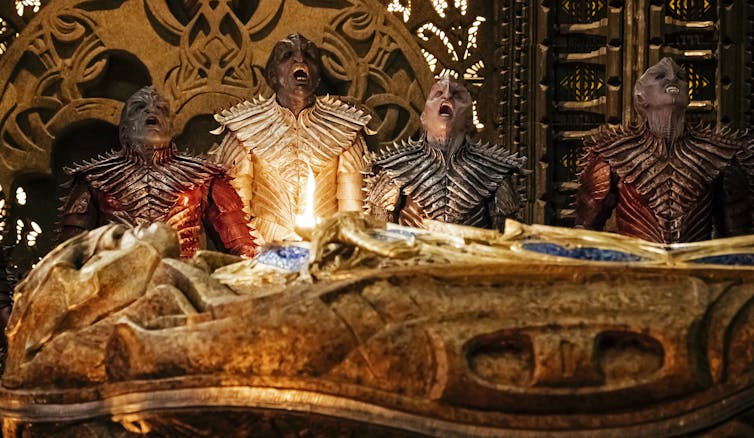
A ship of klingons
A ship of klingons. (Netflix/Jan Thijs)
By Eve MacDonald, Cardiff University


Star Trek has always reflected the contemporary political atmosphere and ideologies in which it is created. From the original series in the 1960s with its peace, love and interracial kiss, to the 1990’s post-Cold War Next Generation, the world-view of progressive western ideology has featured strongly in the stories of everyone’s favourite group of space explorers.
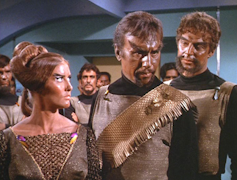
The original Klingons of the 1960s
The original Klingons of the 1960s. © 1969 Paramount Pictures

Across each new iteration, the Klingons – a humanoid warrior species – have often been the alien of choice. The 1960s Klingons were bad, untrustworthy, duplicitous enemies, but visually they looked pretty close to the sapiens on the Starship Enterprise. They were the “other”, but that “other” was also us. They were the Cold War Soviets mixed with a bit of the Japanese from World War II (another enemy, the Romulans, also wore that hat).

In Star Trek: The Next Generation, the Klingons were more physically differentiated by exo-skeletal additions but they were friends now, not enemies any more, and although slightly erratic allies they fought on the same side as the Federation. It was the post-Cold War world.

Us and them
So what to make of the new Netflix series Discovery and its version of the Klingons? Set further in the past than the other series, watchers have been given a race of new/old Klingons which is physically extraordinary, kitted out like badass Egyptian warriors. Gone are progressive views of understanding the commonalities of our existence. The classical “us” and the space age “other” has been reborn.
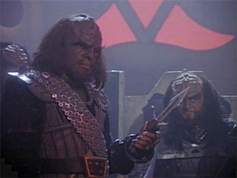
Klingons, the next generation
Klingons, the next generation. © 1991 Paramount Pictures

What is so intriguing about these new Klingons is that they exhibit all the extremes of real-life exotic enemies from timeless representations going back to the ancient Greeks. They are portrayed as incomprehensible beasts to the federation: the Klingons participate in self-harm, believe in rebirth in flames, and have a physical appearance that has extended their exo-skeleton to make them look more like wild animals than anthropomorphic beings. They appear like beasts, as exotic as Durer’s famous drawing of a rhinoceros was to his 16th-century audience.

The new Klingon uniform was clearly inspired by ancient Egyptian breastplates, wired like ribs across their shoulders and upper chest. Even more Egyptianising is the death practice of the Klingons that sees the corpse being wrapped as a mummy, and placed in a beautifully decorated space sarcophagus. These sarcophagi are then stuck to the outside of their space ships. The way that the Klingon dead and their death cult travel together through space and time removes any previous common “humanity” that had existed in the other Star Trek series. The Klingons are now so far from the “us” who reside in the opposite ship as to be almost incomprehensible.
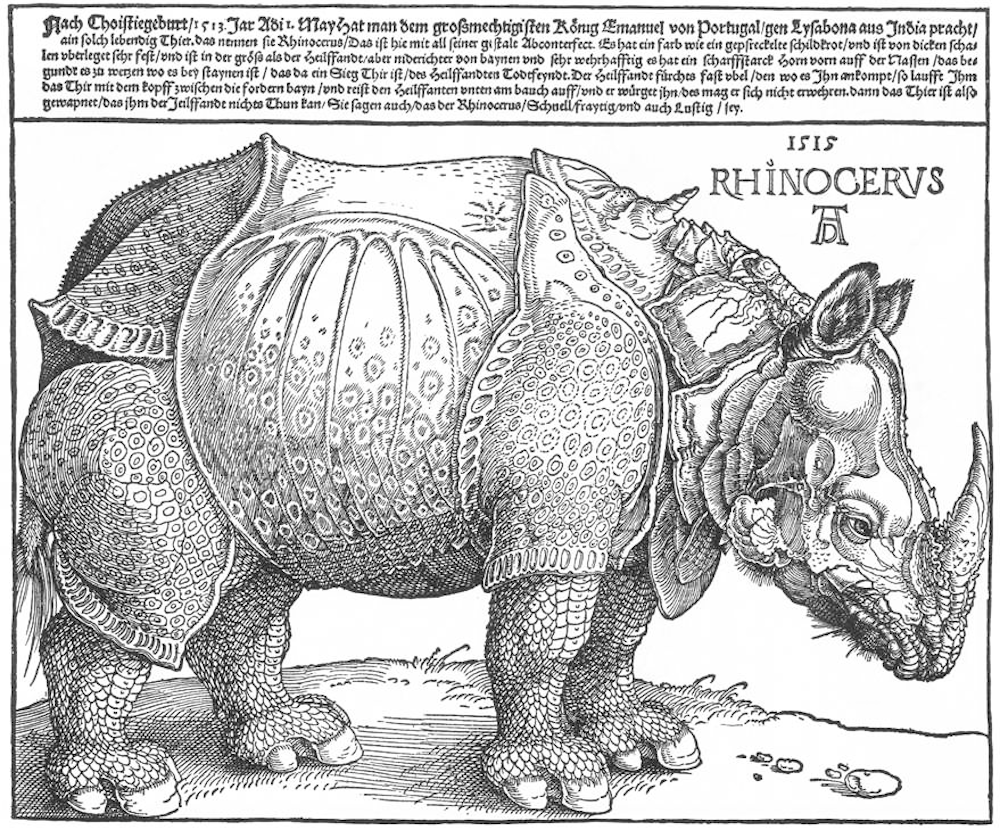
Albrecht Durer’s rhinoceros, 1515
Albrecht Durer’s rhinoceros, 1515. Wikimedia

Ancient monsters
Though their appearance may be drawn from history, these new, hostile Klingons are base zealots and unrelentingly evil – with an obvious comparison to be made with Islamic State. They are simply our enemy: we possess no shared values, they lie in ambush and react with unremitting violence across the first episodes. The federation officers of the Discovery series are conflicted about reacting to the aggression – and as such are depicted at first as wishy-washy and weak. The ideals of the previous series, including the “prime directive” – that crews must not interfere with the development of civilisations – have disappeared and are replaced by sneering Klingons who seek martyrdom and mock the concept of “coming in peace”.

I wonder what Star Trek’s creator Gene Roddenberry would have felt about this easy dismissal of the ideals of peaceful inter-species cooperation? In the new Star Trek, violence is the only means to counter violence. For the creators it makes it much easier to accept this by physically placing the Klingons further back in our human past. Their representation in costume like exotic, alien ancients, and practice of a cult of death, further distances them from our so-called “western” humanity. By physically animalising the Klingons this becomes an easy retreat to the mythical beasts of old. As the monstrous Gorgon sisters were to the ancient Greeks these Klingons are to the Federation.

The ConversationThis new form of Klingon enemy seems to be reflecting shifting attitudes towards peace and war in today’s world. More than anything this only serves to confirm how far our society has shifted away from hope and idealism for the future. It will be interesting to see how this new Klingon war is resolved in the next chapter of the first season, and whether hopeful aspiration will return or fear of the other is all we can aspire to.

About Today's Contributor:
Eve MacDonald, Lecturer in Ancient History, Cardiff University


This article was originally published on The Conversation

Epic Records & Sony Pictures Animation Announce The Star Official Soundtrack Album Available October 27

by
The Star Official Soundtrack Album - Cover
The Star Official Soundtrack Album
In anticipation of the worldwide release of Sony Pictures Animation's animated motion picture The Star, in theaters November 17, 2017, Epic Records and Sony Pictures Animation will release The Star: Original Motion Picture Soundtrack in stores and online October 27, 2017. 

  • The album, featuring new music from Mariah Carey, is available for pre-order here
The soundtrack assembles new music from a bevy of powerhouse superstars befitting of the cast's blockbuster pedigree. Leading the tracklisting, Mariah Carey performs the film's theme song "The Star."

  • The first track for instant grat is "Life is Good" by A Great Big World. 
  • Following that, on October 17th, Fifth Harmony will release "Can You See".

In addition, Kirk Franklin, Kelsea Ballerini, Zara Larsson, and more serve up new tracks recorded specifically for The Star. Each artist got into the spirit with show-stopping and standout performances.
Spring Aspers, Head of Music for Sony Pictures, commented, "The filmmakers of The Star have delivered a funny but faithful turn on the nativity story, and Mariah Carey's soulful performance of the film's theme song adds a layer of depth and emotion that will have audiences feeling the spirit. This compilation is full of covers of Christmas classics old and new that not only perfectly fit the film, but make the perfect soundtrack for the season."
  • Check out the full tracklisting below.
  • Get ready for The Star to shine on stereos and big screens everywhere this year.

Tracklisting:
  • Mariah Carey – "The Star"
  • Kelsea Ballerini – "Children Go Where I Send You"
  • Kirk Franklin – "We Three Kings"
  • Fifth Harmony – "Can You See"
  • A Great Big World – "Life Is Good"
  • Zara Larsson – "Mary, Did You Know"
  • Yolanda Adams – "O Holy Night"
  • Saving Forever – "What Christmas Means to Me"
  • Jessie James Decker – "Breath of Heaven (Mary's Song)"
  • Casting Crowns – "His Eye Is on the Sparrow"
  • Jake Owen – "What Child Is This?"
  • Pentatonix – "Carol of the Bells"*
*digital-only bonus track


The Star - Poster
The Star - Poster

In Sony Pictures Animation's The Star, a small but brave donkey named Bo yearns for a life beyond his daily grind at the village mill. One day he finds the courage to break free, and finally goes on the adventure of his dreams. On his journey, he teams up with Ruth, a loveable sheep who has lost her flock and Dave, a dove with lofty aspirations. Along with three wisecracking camels and some eccentric stable animals, Bo and his new friends follow the Star and become unlikely heroes in the greatest story ever told – the first Christmas. 

The film stars the voices of Steven Yeun, Gina Rodriguez, Zachary Levi, Keegan-Michael Key, Kelly Clarkson, Anthony Anderson, Aidy Bryant, Ving Rhames, Gabriel Iglesias, Patricia Heaton, Kristin Chenoweth, Christopher Plummer, and Tracy Morgan and Tyler Perry and Oprah Winfrey. Directed by Timothy Reckart, the screenplay is by Carlos Kotkin, with a story by Simon Moore and Carlos Kotkin. The film is executive produced by DeVon Franklin, Brian Henson, and Lisa Henson, and produced by Jennifer Magee-Cook.


SOURCE: Epic Records
Bonus Video:

Tears For Fears Still Rule The World With Their Greatest Hits Album Out November 10

by
Tears For Fears Still Rule The World
Everybody still wants to rule the world…
Following a sold-out summer arena tour highlighted by their triumphant UK return in front of 65,000-plus fans as special guests of The Killers during British Summer Time Festival at Hyde Park, Tears For Fears – Roland Orzabal [vocals, guitar, keyboards] and Curt Smith [vocals, bass, keyboards] – close out 2017 with the release of their first career-spanning Greatest Hits album, Rule The World. The collection arrives everywhere November 10, 2017 on UMe. It's available for pre-order at the band's official site now. 

  • Check out the full tracklisting below.

Not only does Rule The World feature classics such as "Everybody Wants To Rule The World," "Shout," "Mad World," "Head Over Heels," "Woman In Chains," and more, but it also boasts the first original music from the duo since 2004. This year, they recorded two new tracks—"I Love You But I'm Lost" and "Stay"—for inclusion on the collection. 

The single "I Love You But I'm Lost" bristles with the enigmatic energy of classic Tears For Fears, while the subtle acoustic "Stay" ranks among their most emotional fare. Both fit comfortably alongside the anthems that have defined three generations.

It's just the beginning though. The new music hints at very big plans for Tears For Fears in 2018 and beyond!

TRACKLISTING:
  • Everybody Wants To Rule The World
  • Shout
  • I Love You But I'm Lost*
  • Mad World
  • Sowing The Seeds Of Love
  • Advice For The Young At Heart
  • Head Over Heels
  • Woman In Chains
  • Change
  • Stay*
  • Pale Shelter
  • Mothers Talk
  • Break It Down Again
  • I Believe
  • Raoul And The Kings Of Spain
  • Closest Thing To Heaven
*/new for 2017

About Tears for Fears
Beyond selling 30 million albums worldwide, performing to countless sold out audiences, and winning various awards, the DNA of Tears For Fears — Roland Orzabal [vocals, guitar, keyboards] and Curt Smith[vocals, bass, keyboards] — remains embedded within three generations of artists. Quietly casting a shadow over rock, hip-hop, electronic dance music, indie, and beyond, their music has been sampled by Kanye West, The Weeknd, David Guetta, Drake, and more, while getting covered by Lorde, Adam Lambert, Ally Brooke Hernandez, Gary Jules, and Disturbed, to name a few. Meanwhile, classic songs figure prominently everywhere from The Wire and Donnie Darko to Straight Outta Compton and Mr. Robot.

Representing an inimitable intersection of pop palatability, clever and cognizant lyricism, guitar bombast, and new wave innovation, their catalog spans a string of classic album, namely the gold-certified debut The Hurting [1983], quintuple-platinum BRIT Award-winning Songs from the Big Chair[1985], and Seeds of Love [1989]. The latter proved to be Roland and Curt's last collaboration together until Everybody Loves A Happy Ending in 2004, which rekindled the creative fire between them. Breaking another quiet spell, the boys engaged in a three-year touring whirlwind across North America, Japan, South Korea, Manila, and South America beginning in 2010. 


 2013 saw them return with their first recorded music in a decade: a cover of Arcade Fire's "Ready to Start." It proved to be a welcome addition to their three-decade discography of immortal hits ranging from "Mad World," "Change," and "Pale Shelter" to "Everybody Wants To Rule The World," "Shout," "Sowing The Seeds of Love," and "Everybody Loves A Happy Ending." 

Following a sold-out 2017 co-headline tour with Hall & Oates and standout sets at Rock In Rio and "British Summer Time" in Hyde Park, they release their first official career-spanning Greatest Hits collection, Rule The World. It features the first new original compositions between Roland and Curt together since 2004: "I Love You But I'm Lost" and "Stay."

TearsForFears.com | Facebook.com/TearsForFearsInstagram: @TearsForFearsMusic | Twitter: @TearsForFears


SOURCE: UMe


Bonus Video:

Hologrin Studios Teams Up with Marie Curie and George Washington Carver to Change the Game

by
STEM: Epic Heroes
STEM: Epic Heroes
Hologrin Studios, a squad of artists, software developers, designers, and game players, has developed a silver bullet in the fight against modern-day educational boredom. It's called STEM: Epic Heroes and it features superheroes of science, champions of chemistry, exemplars of engineering and many more in an artistically brilliant strategy game that can be played virtually endlessly to teach, engage and inspire.

The Origin Story
STEM: Epic Heroes' creation begins in a world where superheroes wear capes and jerseys and are worshipped for strength of muscle over strength of mind. That may be acceptable to some, but the creators of STEM: Epic Heroes set out to uncover and celebrate an entirely different breed of hero; those pillars of Science, Technology, Engineering and Math (or STEM). They did this by creating a game, but not just any game. STEM: Epic Heroes is a genius card game with incomparable illustrations, vivid educational worth and engaging gameplay.


STEM: Epic Heroes features superheroes of science, champions of chemistry, exemplars of engineering and many more in an artistically brilliant strategy game that can be played virtually endlessly to teach, engage and inspire.
Faster Than a Speeding Bullet
In a matter of hours – 12 to be exact – STEM: Epic Heroes was fully funded on Kickstarter. That's a quick $10,000 worth of backer support for a game sure to ignite young minds and make learning both addictive and fun. Now at almost seven times that amount pledged with a few days left in the campaign, it's clear that this game has struck a chord with many who are anxious to see what's next, and willing to put their money where their computer mouses are.

A Hero in Our Time
Speaking of money, top secret intel on the latest hero card still in development has just been released by Hologrin Studios. We can now share that the newest card is modern-day technology hero Satoshi Nakamoto, creator of the cryptocurrency bitcoin. Learn all about his epic journey, and that of fellow heroes like Isaac Newton, Ada Lovelace, Thomas Edison and many more.


Bonus Video-Clip:

12 October 2017

From Chaucer To Trump, Sexist Banter Has Been Defended As Entertainment For 600 Years

by

US President Donald Trump
US President Donald Trump. (Mark Reinstein/Shutterstock)
By Natalie Hanna, University of Liverpool


As we approach the end of 2017, one might expect language and attitudes to be very different to those of the Middle Ages. And yet, there are some very prominent figures who seem to be stuck in the past.

Donald Trump, the US president, has once again dismissed his own infamous “grab them by the pussy” comments, one year after the 2005 Access Hollywood tape that revealed them came to light.

When his words first came to public attention, Trump then brushed them off as “locker room banter”, insisting that the public should focus instead on war and terrorism that were making the world “like medieval times”.

Numerous athletes came forward at the time to say that these are not the type of conversations that take place in their locker rooms. The debate continues to this day, with some supporting Trump’s comments, while women’s rights campaign groups refuse to let him brush it “under the rug.

Though Trump tried to deflect attention onto historical horrors of war, this dispute has far more in common with medieval times than he might think. This very dispute mirrors the quarrel of the Roman de la Rose, which happened in the 15th Century – in which a female writer fought vehemently against depictions of sexual assault and “loose” women in entertainment.

Medieval attitudes

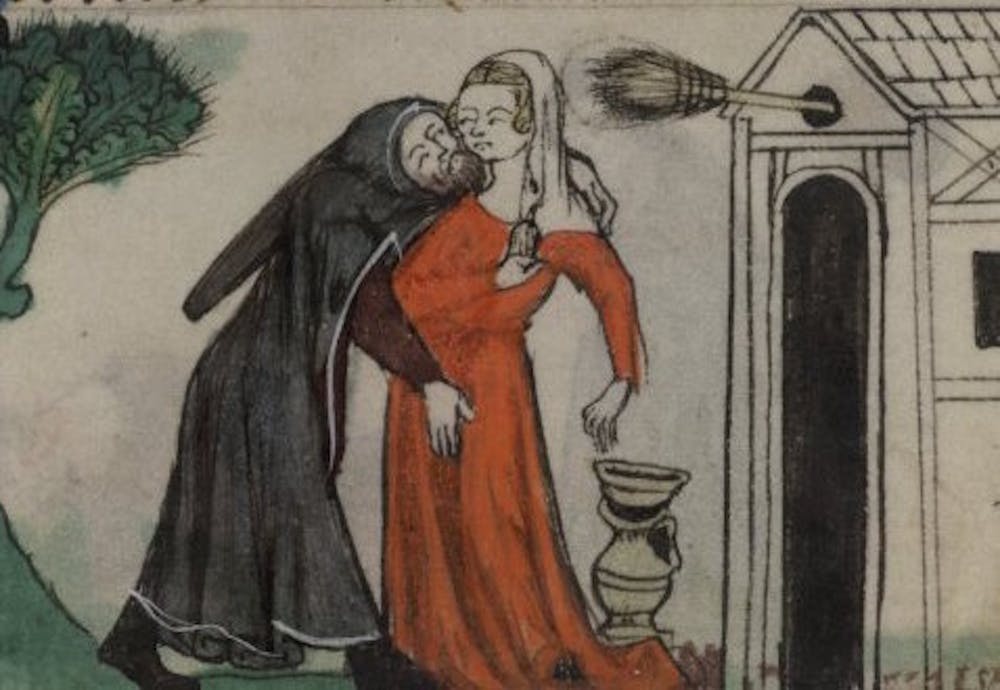
A hermit lewdly embraces a miller’s wife
A hermit lewdly embraces a miller’s wife. (British Library)

In medieval literature, women were commonly depicted as “easy”, particularly in the context of bawdy satire. Take, for example, Geoffrey Chaucer’s poems The Miller’s Tale and The Reeve’s Tale. In both of these texts women are depicted as enjoying, or easily recovering from sexual assault.

In The Miller’s Tale, when a clerk, Nicholas, decides he wants to have sex with his host’s wife Alison he grabs her “by the queynte [crotch]” and holds her hard “by the haunchebones [thighs]”. Although Alison initially tells Nicholas to get his hands off her, within three lines she has been won round and begins to conspire with her new lover against her husband.
In The Reeve’s Tale, two clerks take revenge upon a miller, who has duped them out of their money’s worth of flour, by raping his daughter and his wife. But by the end of the poem it is the miller who is battered and humiliated, while the women are not depicted as particularly bothered at being raped.

A jealous husband beats his wife in a manuscript of Le Roman de la Rose
A jealous husband beats his wife in a manuscript of Le Roman de la Rose.(British Library)

One of the most popular poems of the medieval period was Jean de Meun’s satirical, Le Roman de la Rose, which took a cynical view of the pursuit of love. In one scene a “jealous husband” gives an in-depth account of the vices of loose women: “Toutes estes, serĆ©s, ou futes, / De fait ou de volentĆ© putes!” (All you women are, will be, and have been whores in deed or desire!). The poem was championed by many influential men of the period, and writers such as Chaucer drew upon it time and again in their own works.

However, just as Trump’s comments have prompted protest today, back then it was down to Christine de Pizan – possibly the first European woman to make a living from writing, composing poetry and prose works in the late 1300s/early 1400s – to fight the patriarchy.

Fighting back

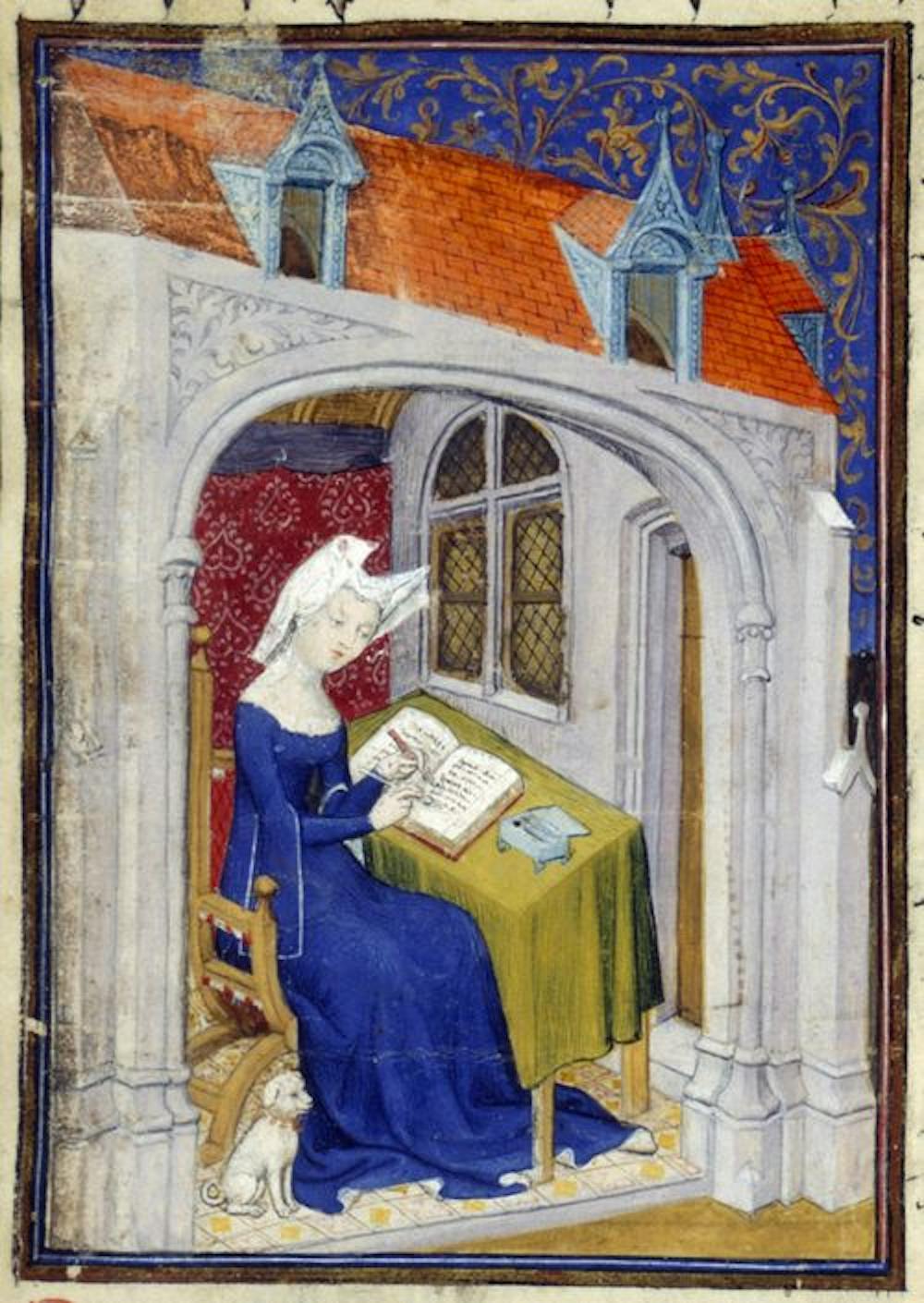
Christine de Pizan in her study
Christine de Pizan in her study. (British Library)

Born in Italy, De Pizan moved to France as a child when her father Thomas took up an appointment as the astrologer of King Charles V. De Pizan made use of the library available to her at the court, teaching herself to read and write in many languages. When she was suddenly widowed at the age of 24 she turned to writing as a way to make money to support her family. This was exceptional for a medieval woman, but the court paid her because they enjoyed her writing and the novelty of a woman’s works.

De Pizan’s writings were unique in providing a public voice for women at a time when they were not allowed to have one. She argued against the established tradition of women as “frail, unserious, and easily influenced” in medieval texts. She was a force to be reckoned with, and took particular objection to Le Roman de la Rose and its presentation of women.
In her campaign against the poem, De Pizan wrote letters to Jean de Montreuil (Provost of Lille) and Gontier Col (secretary to King Charles V), who publicly supported the poem. Detailing her concerns, she told them “I cannot remain silent”. They, however, dismissed her as a “femme passionĆ©e” – an emotional woman – who didn’t understand satire. De Pizan had a point, though. Even if words are not meant to be taken seriously, perpetuating negative stereotypes and normalising them as entertainment is harmful.

De Pizan did not remain silent. Her response was to compose literature that countered the male tradition, defending women and their place in society. In The Book of the City of Ladies, she wrote that she is “troubled and grieved” with men’s depictions of women as enjoying rape or not being bothered by rape even when they verbally object. And she makes further references to the visibility of domestic violence in her own neighbourhood.

In doing so, De Pizan brought to light the problem of trivialising abuse that was, and still is, prevalent in our society, and she encouraged early discussions of gender equality.

The ConversationSix hundred years on, however, and women are still striving against the likes of Trump to leave sexist banter in the past. Until it is, it won’t be brushed under the rug.

About Today's Contributor:
Natalie Hanna, Lecturer in English, University of Liverpool


This article was originally published on The Conversation

You Might Also Like