20 October 2017

Book Cover Created by 99designs Designer Honored at Prestigious 31st Annual New York Book Show

by
"Havenwood" - Cover
"Havenwood"
99designs, the world's largest online graphic design marketplace, today announced that a book cover created by a designer from its global design community was named a winner in the prestigious 31st Annual New York Book Show Awards.

"Havenwood," a self-published novel by Eric Slade whose cover was created by 99designs designer Andrei Bat, received first place honors in the "Self-Published Cover" category in the "Young Adult" genre of the awards, which were presented at a ceremony in New York City last week.

According to Slade, who commissioned designer Andrei Bat to work on the cover design through the 99designs online graphic design platform, "Havenwood's cover included 19th century decorative elements to convey a sense of history to prospective readers. Andrei Bat's digital painting style is both luminous and moody."
Hosted by the Book Industry Guild of New York (BIGNY), the New York Book Show is an annual event that offers publishing and printing professionals an opportunity to mingle while honoring the best examples of quality book design and production from the previous year. The show's aim is to showcase the best books as judged by a panel of industry professionals who evaluate manufacturing, production, and design qualities of entries in six main and a myriad of subcategories. The winners (which are featured in an online gallery here) are selected from hundreds of entries sent in by publishers and suppliers from around the country.
"This award is further validation of the creativity and high quality of our designer community," said 99designs CEO Patrick Llewellyn. "99designs has from its earliest origins been a champion for great design from talented individuals around the world. In recent years, we've dedicated even greater resources in tools and processes to further help our community to produce their best work. We commend Andrei on this award and for his contributions to 99designs." 

  • For more information on the winning design and winning designer, Andrei Bat, visit here.

SOURCE: 99designs


Eric Slade (Image via eric-slade.com)

More About Havenwood:
(via Eric Slade's Site)
Chattanooga, Tennessee, 1914 — Tanna Cravens boards an airship bound for a colony in Fairyland… But a magical frontier ruled like the Old South isn’t the best home for a woman ahead of her time.

Abandoned by her husband on a failing farm atop an ancient fairy hill, Tanna finds herself in the middle of a war between the human plantation owners and the indigenous elven tribes who want them gone.

With her farm in flames and a dark fairy hoard descending on the colony, Tanna must secure a safe place for those she loves before the paths between the worlds are closed forever.

In an alternate history where Shades of Milk & Honey and Jonathan Strange & Mr Norrell might have taken place in England, Havenwood is found just beyond the door between Fairyland and the American South.

Bonus Video:

The Thing: Dread Fears And The 'Other' In The Polar Environment

by

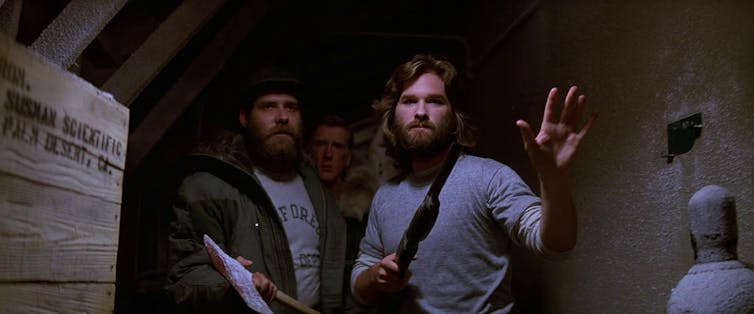
A scene from John Carpenter’s The Thing from 1982
A scene from John Carpenter’s The Thing from 1982 (IMDB/Universal/JohnCarpenter)
By John Ash, University of Cambridge

John Carpenter’s celebrated 1982 film The Thing is a science fiction classic. Although not an initial commercial success, it has achieved cult status and traditionally is screened (with its 1951 and 2011 counterparts) on the first full night of winter by crews staying at the Scott-Amundsen Base in Antarctica. It may seem a strange choice at first, yet the links between the polar regions and science fiction are strong.

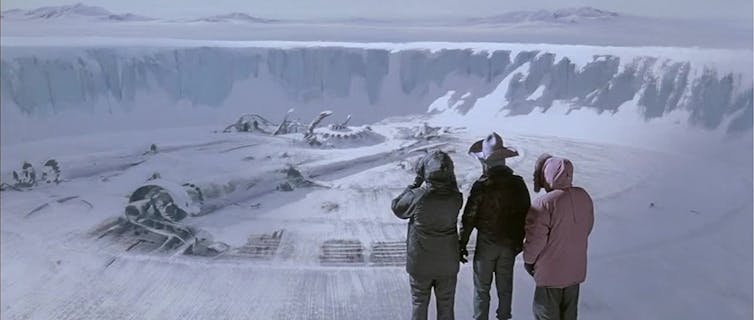
From the pursuit by Mary Shelley’s Frankenstein of his creation into the frozen north, to Ripley’s fruitless call to Antarctica traffic control in Alien, writers have used the remoteness and novelty of the poles to enhance the menace and drama of their work. Carpenter capitalises on the dark polar nights and the claustrophobic confines of an Antarctic base to ratchet up the tension and paranoia as an alien infiltrates the outpost.

Inspired by John Campbell’s 1938 novella, Who Goes There?, The Thing follows the crew of an Antarctic base who discover an alien life form that can assimilate and perfectly mimic the appearance of other organisms. Operating at the cellular level, the alien tissue invades by gradually supplanting the original cells until what remains is an exact copy of the now consumed host.

The station personnel fight a desperate battle against the invader, devising a technique for testing blood samples for infection and struggling against the distrust that grows up in the group when they realise its ability to copy and replace their colleagues.
The Thing is a polar film. Not only is it set in a polar environment, but its characters exemplify the strains of living in extended close proximity in the isolation and climatic extremes of an Antarctic base. It is also a film that speaks to the subject of “The Other” – a theme in the humanities that examines how a society identifies itself, not by defining the laudable characteristics to which it aspires, but by reviling others as exemplars of that which it rejects.

The eponymous alien constitutes an iconic Other. It defies description and therefore order. Having no fixed form other than the organisms it assimilates, it morphs – like a deceitful trickster god – into different shapes. Sometimes that shape is an incomplete transition phase, a chaotic mismatch of biological structures that affronts the logical processes of evolution (in one famous shot we see a detached human head that becomes mobile by growing arthropod legs). The assimilation process both frightens and disgusts, and the subversion of the base personnel’s own bodies into instruments of human destruction adds an extra touch of terror to the whole invasion process.

Kurt Russell, Richard Masur, and Donald Moffat in The Thing.
Kurt Russell, Richard Masur, and Donald Moffat in The Thing.(IMDB/Universal/JohnCarpenter)

Why planet Earth?
But why would an alien come to our planet in the first place? The problem receives consideration in the work of Dr Lewis Dartnell, an astrobiologist who argues persuasively that Earth possesses no property or resource that an advanced civilisation would want to acquire. Reassuring though these arguments are, there remain nagging doubts.

The alien may be a survivor of a convict group condemned to exile on a distant planet. Recalling the First Fleet expedition to establish a colony in Australia in 1788, Commodore Arthur Phillip was under instruction as commander to maintain good relations with the indigenous people. Nonetheless, the effects of colonisation on the first nations living in Australia were devastating.

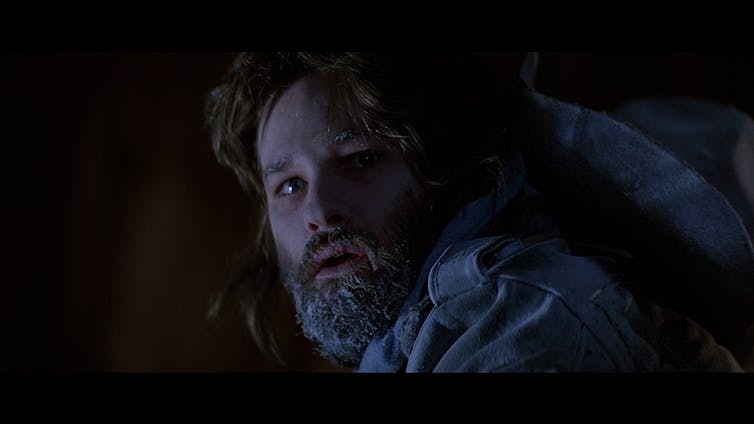
Kurt Russell in The Thing
Kurt Russell in The Thing. (IMDB/Universal/JohnCarpenter)

Stephen Hawking has made similar observations on the meeting of alien and Earth cultures and the lessons of history. And HG Wells famously made the same point in The War of the Worlds. They may be understating the case. In terms of existential risk, subjugation by an alien race may expose humanity to cruelty and misery that exceeds even annihilation.

The second reason why a seemingly illogical alien visit might not be comforting is the unexpected. The alien might simply have developed engine failure and made a forced landing. (Perhaps it was shot down). But in any event, improbability does not provide the same degree of comfort as impossibility, and that mathematical certainty eludes us.
Carpenter’s alien is an imaginative analogue of the many creatures in the natural world with the ability to change appearance for competitive advantage – from cephalopods that adapt skin cells to the colours of the seabed to insects that undergo the widespread process of metamorphosis.

The ConversationIts lack of fixed form and its physical pollution of human tissue exemplify Otherness, as its calculating ruthlessness epitomises its inhumanity. In the end, the humanity of the base personnel is defined not so much by their difference from the alien as their willingness to sacrifice themselves to defeat it – which is perhaps why the movie remains so popular among crew members who have to rely on each other every single day as they live through their own polar adventures.

About Today's Contributor:
John Ash, Associate at the Scott Polar Research Institute, University of Cambridge

This article was originally published on The Conversation.

19 October 2017

Are Dogs Trying To Tell Us Something With Their Expressions?

by

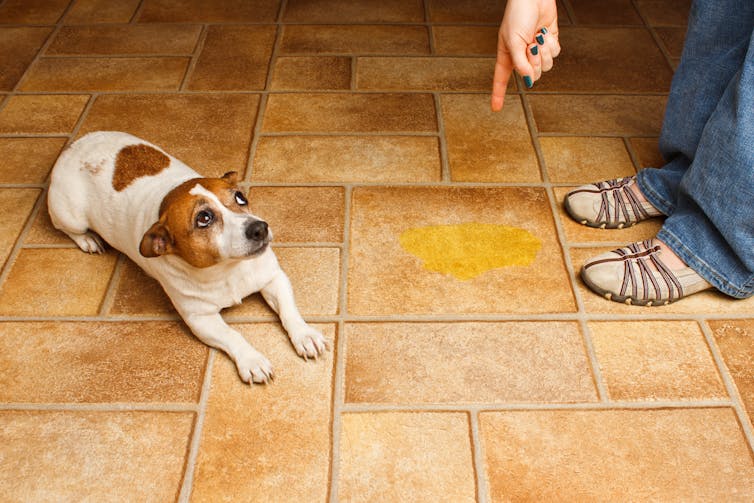
A dog
Image via Shutterstock
By Jan Hoole, Keele University


Dogs have been part of human social groups for at least 30,000 years. So it’s not unreasonable to suppose that we might have had some influence on their behaviour, and perhaps their understanding, during that time. We certainly know that dogs have developed ways to communicate with us, for example by whining when they are distressed or barking to alert us to intruders.

Many dog owners would probably say their pets can even tell us things using facial expressions, just like humans do. But is that really true? Perhaps they are just showing emotion without meaning to communicate (just like humans also sometimes do). New research published in the journal Scientific Reports suggests it might be, but there are still reasons to be sceptical.

In a rather elegant experiment, the researchers set up four scenarios. They offered a dog food (a guaranteed way to get their interest) while the human handler was facing towards and also away from the dog. They also had the handler face towards and away from the dog without offering food. They found that the animals showed facial expressions more often when the handler was facing towards them than away, regardless of whether or not food was involved.

Until now, there has been little work on whether or not facial expressions in dogs are involuntary. You might be able to see when a dog’s happy, angry or sad from their face, but that doesn’t mean they are purposefully trying to tell you how they felt.

The new paper suggests that the expressions may be a means of communicating something to the person. It is certain that the expression is more frequently displayed when the human is facing towards the dog, even though the handler did not look directly at the dog during the trial, and that humans respond to that expression.

A dog
If I make this face, will you stop shouting? (Shutterstock)

That dogs are able to understand when a person is paying attention to their behaviour is well documented. We also know that dogs show different facial expressions when in the presence of humans, especially in the case of that guilty” look that every dog owner knows. That particular expression doesn’t actually mean they are feeling guilty. It’s more an attempt to appease the owner who is angry for some, to the dog, unknown reason.

But there are some questions about the particular facial expressions the dogs made in the new study that mean the evidence isn’t conclusive. For example, one of the expressions the authors noticed was the raising of the inner end of the eyebrows. This increases the size of the eyes and makes the dog look more puppy-like.

Studies have shown that humans prefer animals that look like infants. This explains the popularity of breeds with short noses and large eyes, such as boxers and pugs. Dogs that raise their eyebrows more frequently seem to be more popular with people than those that don’t. This could have led to the breeding of dogs that are more likely to show these more attractive expressions alongside those that have childlike anatomical features.

Tongue wagging
Another important indicator that the authors noted was when the dogs showed their tongues. Unfortunately, the researchers didn’t separate tongue movements that indicate stress, such as licking the nose or lips, which can be an appeasing signal, from those that indicate pleasure, anticipation or excitement, such as panting or hanging the tongue out of the mouth. Without this distinction it is difficult to draw conclusions about the emotional state of the dogs.

Previous research also suggests that dogs are aware of when a human is paying attention to them and may change their behaviour accordingly. It is possible that these dogs, aware that the human is facing them felt a level of anticipation, excitement and possibly some anxiety which affected their facial expression. The fact that the food produced no extra interest when the person was turned towards the dog or away from them, could be influenced by the fact that the dog was not actually given the food.

The authors suggest that the dog’s facial expressions may be partly a result of their emotional state and partly an attempt to actively communicate with the handler. Without any evidence about the effect of the expression on the behaviour of the handler, it is difficult to say if that is true.

The ConversationIf further research could make distinctions between the type of tongue movements involved in these expressions, as well as the raising of the eyebrows, we might be able to say with more certainty. But whatever the outcome, many dog owners will probably continue to swear their pets are trying to tell them something.

About Today's Contributor:
Jan Hoole, Lecturer in Biology, Keele University


This article was originally published on The Conversation. 

Queen Takes The Reigns at Medieval Times Castles Starting October 19

by
Knights jousting (image via Medieval Times' Facebook Page)
In a major break from Medieval Times' 34-year tradition of casting a king as the show's lead role, the company announces today that a queen is now in charge and sole ruler of the land. She is cast as a firm but kind ruler respected throughout the kingdom who inherited the throne at the passing of her father, the previous king.

The company's leadership developed the idea to cast a matriarch, based in part on guest feedback that they would like to see women having more significant roles.

"Where previously our female characters played in more supportive roles, we are now showing a woman fully in charge, a woman whose authority is sometimes challenged, but she quickly rises to the occasion as a strong leader, squelching opposition," says Jon Speier, Medieval Times senior vice president and general manager.
The Queen
The Queen (image via Medieval Times)
Jousting, fighting, horsemanship, swordplay and a fresh, hot, four-course feast remain central elements of the dinner attraction. 

With the cast and script change come a series of other significant changes to the show:
  • More than 700 new costumes for all nine castles' performers including horses, all of which are custom-designed and hand-made at a dedicated costume shop near Dallas Design District.
  • 200 new suits of armor, shields, and helmets, all of which are custom-designed and hand-made at a dedicated armory in Florida.
  • More than 350 team members and 225 horses train and rehearse new lines and fight scenes for three months while still presenting the current show. 
  • It takes two months to teach a queen to ride an Andalusian stallion. 
  • New music was composed by Dr. Daniel May, composer and jazz pianist who scored "Everest" and other films and who worked with Sting, The Moody Blues and others. He directed and recorded Medieval Times' new show composition in Kiev with the National Symphony Orchestra of Ukraine. He directed the choir in Ukraine with lyrics written by poet and choir member Solomia Gorokhivska, and a solo cellist and violin player from Pittsburgh, PA. 
  • The audience experiences a live action film score that is precisely synchronized with every element of the show, from lights to fights; jousts to jabs; the Queen's entry to curtain closings; and more.
  • The sound and light team spends 120 hours programming 300 new music cues and 500 new lighting cues. Several castles are installing and programming a new LED lighting system that offers 256 colors versus the old 14-color system. The system is powered by 10 miles of cable and an estimated million-dollar upgrade.

Medieval Times owns and operates nine castles in the U.S. and Toronto, Canada. The new show opens October 19, 2017 in Dallas, TX where more than six million guests have been entertained in the castle's 25 years.

About Medieval Times

Medieval Times Dinner & Tournament was founded in 1977 in Spain. It launched in North America in 1983 and has since opened nine castles across the United States and in Toronto, Canada. It has been performed for 65 million guests in its 34 years. 


SOURCE: Medieval Times Dinner and Tournament


Bonus Video:

Legacy Recordings to Release "Stranger Things" Soundtrack

by
"Stranger Things - Music From The Netflix Original Series" - Album Artwork
"Stranger Things - Music From The Netflix Original Series" - Album Artwork
 Legacy Recordings, a division of Sony Music Entertainment, today announced it will release Stranger Things - Music From The Netflix Original Series on Friday, October 27, timed to the launch of Season 2. 


Available for digital streaming or downloading and on CD, the 30 track compilation album includes a range of beloved 1980s hits and classic tracks featured in "Stranger Things" and the highly-anticipated second season, "Stranger Things 2." The album features nineteen songs and eleven audio clips from the show. 


  • A 12" vinyl edition of Stranger Things - Music From The Netflix Original Series will be released later this year.
Artists and original hit recordings appearing on Stranger Things - Music From The Netflix Original Series include Toto ("Africa"), the Bangles ("Hazy Shade of Winter"), Corey Hart ("Sunglasses at Night"), and more, along with unannounced titles from Season 2.

The multi-award-winning "Stranger Things" was most recently nominated for 18 Emmy Awards, including Music Supervision—the first year ever the category was recognized by the Academy of Television Arts & Sciences.


“Stranger Things”
“Stranger Things” (image via Netflix)
"Stranger Things 2" returns globally to Netflix October 27th. 
Set in 1984, the citizens of Hawkins, Indiana are still reeling from the horrors of the Demogorgon and the secrets of Hawkins Lab. Will Byers (Noah Schnapp) has been rescued from the Upside Down but a bigger, sinister entity still threatens those who survived. 

The second installment of the series also features Winona Ryder (Joyce), David Harbour (Chief Hopper), Millie Bobby Brown (Eleven), Natalia Dyer (Nancy), Charlie Heaton (Jonathan), Joe Keery (Steve), Gaten Matarazzo (Dustin), Caleb McLaughlin (Lucas), Finn Wolfhard (Mike), and Season 2 newcomers Sean Astin (Bob Newby), Dacre Montgomery (Billy), Paul Reiser (Dr. Owens), and Sadie Sink (Max), among other stars.
Created by Matt and Ross Duffer, "Stranger Things" is a Netflix original series, directed and executive produced by the Duffer brothers and Shawn Levy of 21 Laps. Iain Patterson and 21 Laps' Dan Cohen executive produce. 


Bonus Videos:


You Might Also Like