26 November 2017

Why 'Judeo-Christian Values' Are A Dog-Whistle Myth Peddled By The Far Right

by

President Trump recently stated his support for ‘Judeo-Christian values’ … but what does that phrase really mean?
President Trump recently stated his support for ‘Judeo-Christian values’ … but what does that phrase really mean? (Pixabay, CC BY-SA)
By M J C Warren, University of Sheffield


The phrase “Judeo-Christianhas been around since the 1930s but US President Donald Trump recently resurrected it in a deeply problematic speech on October 13, 2017 in which he said: “We are stopping cold the attacks on Judeo-Christian values … We’re saying ‘Merry Christmas’ again.”
It might seem neighbourly, even pluralistic, to include Judaism in a declaration of purported Western values. But in reality this isn’t how the term has functioned, either historically or more recently. Instead, the phrase is used to exclude rather than include. Despite implying that Jews are part of this resurrection of Judeo-Christian values, Trump in no way intends a campaign to Make Hanukkah Great Again. His “Judeo-Christian values” are about protecting Christmas, and about protecting Christians – at the exclusion of others.

Christian-majority nations such as the UK and US often lay claim to laws and ethics based on “Judeo-Christian values”. But it is important to remember that Jews have been systematically excluded from and terrorised by states that claim this Judeo-Christian foundation.

From the 1290 expulsion of Jews from England to Jewish refugees being turned away by Canada, the US and the UK during World War II, Jews have been excluded more often than welcomed.

For centuries, Jews have been made to feel unwelcome in the Christian world and it seems that it is only now that a new demographic of (often Muslim) immigrants fleeing war and economic hardship have reached the West that Jews are being included – and even then only on someone else’s terms.

A right wing slogan
Judeo-Christian” is now most often used to draw a line between imagined Christian values and a perceived (but false) threat of Muslim immigration. It’s in this context, that right wing figures such as Nigel Farage use the phrase. Talking about radical Muslim clerics such as Anjem Choudary, he said for example:
My country is a Judeo-Christian country. So we’ve got to actually start standing up for our values.
But in this statement, Farage connects his fears of radical Islam with the idea of “Judeo-Christian values”. It appears that it isn’t so much about including Jews as it is about excluding Muslims. And since Farage has also come under attack for anti-Semitic comments, including being called on to apologise after recent comments about the threat of “the Jewish lobby” to American politics, it seems hard to view the “Judeo-” in his “Judeo-Christian” as actually valuing Jewish people or Judaism as a religion.
Farage’s statement even prompted the Campaign Against Anti-Semitism to demand an apology.

Time and again, when Farage and Trump use the term, what they really imply is an “us-versus-them” division between the West and Islam. This is not about the inclusion of Jews in the values of these nations, then, but about the xenophobic exclusion of an “other”.

Invoked in anti-immigration rhetoric with the goal of excluding Muslims, this phrase is actually used to scaffold a false narrative about Christians being persecuted, threatened or besieged, which gives motivation for the protection of “Judeo-Christian values”. In fact, Christians are not persecuted in the countries where Farage and Trump make their homes.

Supersessionism
A quick search on Twitter for the phrase “Judeo-Christian” illustrates that white supremacists have embraced the term – and that Jews reject it.

It’s not surprising that many Jews are not falling for this dog-whistle phrase, especially since the myth of a Judeo-Christian society rests on the false – and dangerous – idea that Judaism and Christianity hold the same ideas and values.


There are many fundamental differences between these two religions – and that’s OK. To respect and value Judaism means to do so on its own terms, and not only if it conforms to Christian ideas about what religion should be. Ignoring these differences (and to pretend that Jews and Christians believe the same things) risks subsuming Judaism into Christianity. It risks viewing Judaism as an archaic precursor to Christianity rather than a continuing unique and vibrant tradition. There is nothing “Judeo” about saying Merry Christmas.

Indeed, the phrase “Judeo-Christian” erases Judaism by implying that Christian values are Jewish values. Erasing Judaism by subsuming it into Christianity is called supersessionism, a tactic of Christian polemicists for centuries, and one that is currently in use by the Christian religious right.

The ConversationIt seems, then, that the idea of Judeo-Christian values excludes both Jews and Muslims. The phrase tacitly excludes Jews by subsuming Judaism into Christianity, and it explicitly excludes Muslims in its use in anti-immigration rhetoric. In reality, “Judeo-Christian values” actually point to a particular type of right-wing Christian values. Continuing to use this phrase only contributes to exclusionary and divisive political rhetoric. When we hear it, we should call it out for what it is.

About Today's Contributor:
M J C Warren, Lecturer in Biblical and Religious Studies, University of Sheffield


This article was originally published on The Conversation.


25 November 2017

The Statement from Broadcasting Board of Governors CEO John F. Lansing Regarding the Russian Federation's Media Law

by
BBG CEO and Director John F. Lansing
"President Putin has signed a law under which foreign media organizations can be classified as "foreign agents." Russian officials have indicated that, under this law, even more restrictions may be placed on the BBG's networks, including Radio Free Europe/Radio Liberty (RFE/RL) and Voice of America (VOA), and their services, including the Current Time television and digital network.

RFE/RL, VOA, and the other networks of U.S. international media will remain committed to our mission, stipulated by U.S. law, to provide accurate, objective, and comprehensive journalism and other content to our global audiences, including in the Russian Federation.

We will study carefully all communications we may receive from Russian authorities concerning our operations. While we will not speculate as to the effect that any new steps by the Russian government will have on our journalistic work, any characterization of such steps as reciprocity for U.S. actions severely distorts reality. Russian media, including RT and Sputnik, are free to operate in the United States and can be, and are, carried by U.S. cable television outlets and FM radio stations. However, U.S international media, including VOA and RFE/RL, are banned from television and radio in Russia.

In addition, our journalists on assignment are harassed by Russian authorities and face extensive restrictions on their work. RFE/RL contributor Mykola Semena recently was sentenced by a Russian court for an article he wrote, and contributor Stanislav Asayev is being held by Russia-backed separatists in Ukraine. RFE/RL journalists were knocked down and kicked while on assignment in Russia's southern region of Krasnodar in March, and VOA correspondent Daniel Schearf has been denied a visa to re-enter Russia. 

The BBG would be pleased if the current focus on reciprocity between Russian and American media ends by giving U.S. outlets – including U.S. international media such as VOA and RFE/RL – the same rights and opportunities in Russia that Russian networks have in the United States."


Broadcasting Board of Governors Logo
Broadcasting Board of Governors Logo (PRNewsFoto/Broadcasting Board of Governors)


Bonus Videos:


23 November 2017

"Stranger Things" and Neon Cinematography

by
⏩ The following is the translation of an article originally published in French. If you would like to read this article in its glorious original version (with all its own pics, links, video-clips included,) just scroll down and you will find it just below the translated one... 

Enjoy this bi-lingual journeyšŸ‘
Loup Dargent
Stranger Things 2 - Eleven Fanart
Stranger Things 2 - Eleven Fanart (via DeviantArt)
Begun in 2016, the Stranger Things series is the surprise hit of the Netflix platform. Oscillating work between fantasy, science fiction and slice of life - the name of these drawer intrigues focusing on the everyday lives of characters living in the same place like Twin Peaks - the series of Matt and Ross Duffer pays tribute to the popular culture of the 1980s by resuscitating some of his past glories such as Winona Ryder (Beetlejuice), Sean Astin (the Goonies) or Matthew Modine (Full Metal Jacket).

In its second season, the series is more ambitious in terms of intrigues and themes but also more referential to the era of his diegetic universe. Yet for many years now, many works have challenged themselves to resurrect the 80s with much tribute but also subterfuges sometimes easy. How then can a series like Stranger Things happen almost after the battle and embark on such a venture without necessarily falling into the pitfalls inherent in our time?


The 1980s seen by the years 2000 and 2010  

It is no coincidence that we are talking about the decade of American media, art and cultural overproduction as "Reagan years". The fortieth president of the United States, former actor, is the very symbol of this excess whose color specters still haunt the minds when we pronounce the fateful expression of the 80s. From furious clips of Cyndi Lauper to Steven Spielberg's adventure films to the escapades of the various rockstars of the time, this maelstrom of popular culture is an inexhaustible reservoir for anyone who today would like to represent these ten orgiastic years. At the moment Denis Villeneuve finally offers a sequel to Blade Runner and where those who made the luster of these years disappear gradually, like George Michael or David Bowie, a series like Stranger Things comes at the right time, offering a different vision of the clichƩs ginned in recent years in different media artistic.

Because the 80s and 80s are often used. The ingredients often used to define an "eighties" atmosphere are generally reduced to colored lighting, music synthesizer, some standards of the time and obsolete gadgets like huge mobile phones, shoes that blink or the hilarious walkman.
Mike and Eleven (via DeviantArt
Do we want to represent the real 80s? What did the films of the day leave us in memory of? Or simply a fantasy version of this decade seen by current artists? Implied who did not know the 80s? For a work, whatever the period of which it speaks, says more about that of its production. David Sandberg's short film Kung Fury is the perfect example: released in 2015, this pastiche of 80s action and sci-fi movies uses the extreme of what we call the "Neon cinematography", representing the Reagan years by misusing its motives, even its clichƩs. With an avalanche of digital effects, Kung Fury do not deceive and the Canada Dry effect is inevitable: it smells of the 80s, it tastes of the 80s, but it is not the 80s, simply an imitation by the year 2010. It does not remove anything that the film remains a true homage not to the cinema of the time but more to the arcade games like Streets of Rage or Double Dragon.

Other audiovisual productions have abandoned digital effects - a real anachronism for the 80's purists - to focus on other elements. Even if the ever-present neon are almost every David Leitch's Atomic Blonde sequence or Owen Harris's "San Junipero" TV movie, fourth episode of Black Mirror season 3 , this is another process that is used to that the spectator feels immediately transported thirty years back: the music.

If the synthesizer instrument-totem of the decade is actually present, it is often the additional tracks taken here and there in various compilations that feed the general atmosphere of these two works: "Atomic Blonde" opens on "Blue Monday" by New wave band New Order and concludes with "Under Pressure" by David Bowie and Freddie Mercury, while "San Junipero" is "Heaven Is a Place on Earth" by Belinda Carlisle. All these reasons so 80s working diegetic placing these works in a particular context: the fall of the Berlin Wall for the film Leitch and a nostalgic utopia populated by nightclubs and arcades, places to neon obviously, for the episode of Black Mirror.
MAD MAX - Stranger Things (via DeviantArt)
Light, color, frenzied rhythms: everything borders on the spatio-temporal journey to the Reagan years. Yet this decade rich in mass cultural successes can be represented much less frontally, more referenced and ultimately much more faithful to reality.

The 80s as at the time  
For Stranger Things, the Duffer brothers and their directors are going to appeal more to the process of happy few, these references resonating with attentive viewers feeling both nostalgic and rewarded for recognizing them: a looser club reminiscent of Stephen King's It released in 1986, these kids going on an adventure on bikes like in The Goonies by Richard Donner in 1985 or the presence of Sean Astin in the cast of season 2 to support a little more the link with the previous work.

Netflix's new flagship series is a melting pot of references sometimes hidden within the narrative construction or themes sometimes openly assumed as evidenced by the episode "Trick or Treat Freak" in which the festivities of Halloween serve as a pretext for showrunners to loudly shout their love of the Ghostbusters franchise, right down to the final twist. Stranger Things does not play the card of the neon colorimetry to anchor itself in a reality fantasized by dint of clichƩs but prefers to pay tribute to the culture of the time which amounts, in other words, to assume its fictional dimension and to claim oneself as such. After all, except the Blade Runner from Ridley Scott and Roger Donaldson's Cocktail poster, neon lights are not so present in the 80s.
Stranger Things 2 x Ghost Busters Mashup Poster (via DeviantArt)
Like Andres Muschietti's new adaptation of It, Matt and Ross Duffer's series gives pride of place to naturalistic images, with the exception of purely science-fiction sequences, focusing more on everyday life. a small American city in 1984 between bike rides, Dungeons and Dragons evenings and tasting Eggo waffles. Everything is in the detail and not in the bidding of visual effects as is the case for the parody clip "Through the Night" Grum electro group.
Stranger Things Alternative Poster (via DeviantArt)
Everything happens at the production level, in the choice of accessories, costumes and sets, and not in post-production, with a lot of color filters and musical pieces chosen according to their place in the billboard. If some typical sounds ranging from Cyndi Lauper's "Time After Time" to The Police's "Every Breath You Take" sporadically get the characters to dance, so does Anthrax's "Trust" revival in It , Stranger Things abandon the quasi-systematic reflex of the vintage jukebox proper to productions that anchor their diegesis in a predefined time. The two creators will also admit in the second episode of the making-of series "Beyond Stranger Things" that the bulk of the musical budget of the second season focuses on the final scene of the Snowball.

Yet, although particularly naturalistic in its desire to represent, resurrect the popular culture of the 80s, Stranger Things, like the new adaptation of It, do not go to the end of his intentions. Digital is always very present, either in the sequences around the portal leading to the lair of the Mind Flayer, the representations of this creature or even the Demogorgon of the first season. In the 1980s, studio sets and animatronic puppets would have replaced this deluge of special effects generated by computers, as can still be witnessed by Joe Dante's Gremlins or ET from Steven Spielberg, these cocoon works that will soon be resurfacing on our screens as the smoke slowly rises from the cups of hot chocolate and the snow falls peacefully into the night lit by the Christmas lights. Usually neon lights.
Stranger Things' 11 (Eleven)
11 (Eleven) (via DeviantArt)


« Stranger Things » et la CinĆ©matographie des NĆ©ons


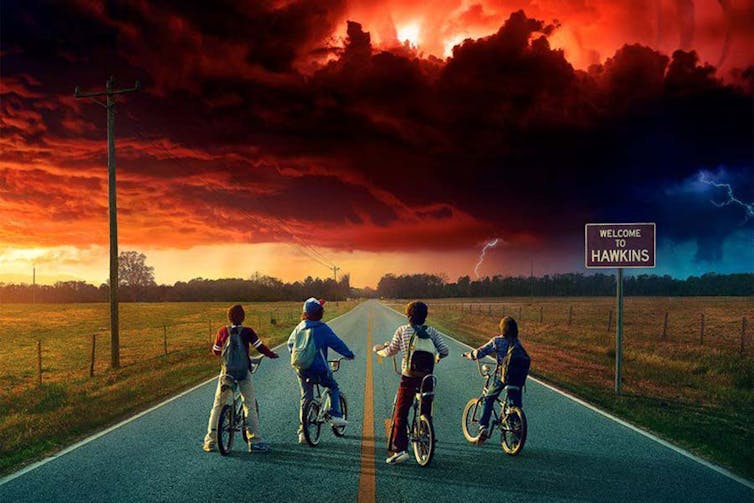
Affiche promotionnelle de « Stranger Things » saison 2
Affiche promotionnelle de « Stranger Things » saison 2 (Netflix).
DĆ©butĆ©e en 2016, la sĆ©rie Stranger Things est le succĆØs-surprise de la plateforme Netflix. Œuvre oscillant entre le fantastique, la science-fiction et le slice of life – du nom de ces intrigues Ć  tiroir se focalisant sur le quotidien de personnages vivant dans un mĆŖme lieu Ć  l’instar de Twin Peaks – la sĆ©rie de Matt et Ross Duffer rend hommage Ć  la culture populaire des annĆ©es 1980 en ressuscitant notamment quelques-unes de ses gloires passĆ©es comme Winona Ryder (Beetlejuice), Sean Astin (les Goonies) ou encore Matthew Modine (Full Metal Jacket).

Dans sa deuxiĆØme saison, la sĆ©rie se veut plus ambitieuse en terme d’intrigues et de thĆ©matiques mais Ć©galement plus rĆ©fĆ©rentielle concernant l’Ć©poque de son univers diĆ©gĆ©tique. Pourtant, depuis bien des annĆ©es maintenant, de nombreuses œuvres se sont lancĆ© pour dĆ©fi de ressusciter la dĆ©cennie 80 Ć  grand renfort d’hommages mais aussi de subterfuges parfois faciles. Comment alors une sĆ©rie comme Stranger Things peut-elle arriver presque aprĆØs la bataille et se lancer dans une telle entreprise sans nĆ©cessairement tomber dans les piĆØges inhĆ©rents Ć  notre Ć©poque ?

Les annĆ©es 1980 vues par les annĆ©es 2000 et 2010
Ce n’est pas un hasard si on parle de la dĆ©cennie de la surproduction mĆ©diatique, artistique et culturelle amĆ©ricaine comme des « annĆ©es Reagan ». Le quarantiĆØme prĆ©sident des Ɖtats-Unis, ancien acteur, est le symbole mĆŖme de cette outrance dont les spectres colorĆ©s hantent encore les esprits dĆØs lors que l’on prononce l’expression fatidique d’annĆ©es 80. Des clips endiablĆ©s de Cyndi Lauper aux films d’aventure de Steven Spielberg en passant par les frasques des diffĆ©rentes rockstars de l’Ć©poque, ce maelstrƶm de culture populaire est un rĆ©servoir inĆ©puisable pour quiconque voudrait aujourd’hui reprĆ©senter ces dix annĆ©es orgiaques. ƀ l’heure ou Denis Villeneuve offre enfin une suite Ć  Blade Runner et où ceux qui ont fait le lustre de ces annĆ©es disparaissent progressivement, Ć  l’instar de George Michael ou de David Bowie, une sĆ©rie comme Stranger Things arrive Ć  point nommĆ©, proposant une vision diffĆ©rente des poncifs Ć©grenĆ©s ces derniĆØres annĆ©es dans les diffĆ©rents mĆ©dias artistiques.

Car il y a annĆ©es 80 et annĆ©es 80. Les ingrĆ©dients souvent employĆ©s pour dĆ©finir une ambiance « eighties » se rĆ©duisent gĆ©nĆ©ralement Ć  des Ć©clairages colorĆ©s, une musique au synthĆ©tiseur, quelques standards de l’Ć©poque et des gadgets dĆ©suets comme d’Ć©normes tĆ©lĆ©phones portables, des chaussures qui clignotent ou encore l’inĆ©narrable walkman.


Veut-on reprĆ©senter les annĆ©es 80 rĆ©elles ? Celles que les films de l’Ć©poque nous ont laissĆ© en mĆ©moire ? Ou simplement une version fantasmĆ©e de cette dĆ©cennie vue par les artistes actuels ? Sous-entendu qui n’ont pas connu les annĆ©es 80 ? Car une œuvre, quelle que soit l’Ć©poque dont elle parle, en dit davantage sur celle de sa production. Le court-mĆ©trage Kung Fury de David Sandberg en est le parfait exemple: sorti en 2015, ce pastiche des films et animĆ©s d’action et de science-fiction des annĆ©es 80 use Ć  l’extrĆŖme de ce que l’on dĆ©signera comme la « cinĆ©matographie des nĆ©ons », soit le fait de reprĆ©senter les annĆ©es Reagan en abusant de ses motifs, voire de ses clichĆ©s. Avec une avalanche d’effets numĆ©riques, Kung Fury ne trompe pas et l’effet Canada Dry est inĆ©vitable: Ƨa sent les annĆ©es 80, Ƨa a le goĆ»t des annĆ©es 80, mais Ƨa n’est pas les annĆ©es 80, simplement une imitation par les annĆ©es 2010. Cela n’enlĆØve en rien que le film demeure un vĆ©ritable hommage non pas au cinĆ©ma de l’Ć©poque mais davantage aux jeux d’arcade comme Streets of Rage ou encore Double Dragon.

D’autres productions audiovisuelles ont su dĆ©laisser les effets numĆ©riques – vĆ©ritable anachronisme pour les puristes des 80’s – pour se focaliser sur d’autres Ć©lĆ©ments. MĆŖme si les sempiternels nĆ©ons se retrouvent presque Ć  chaque sĆ©quence d’Atomic Blonde de David Leitch ou du tĆ©lĆ©film « San Junipero » d’Owen Harris, quatriĆØme Ć©pisode de la saison 3 de Black Mirror, c’est un autre procĆ©dĆ© qui est employĆ© pour que le spectateur se sente aussitĆ“t transportĆ© une trentaine d’annĆ©es en arriĆØre : la musique.

Si le synthĆ©tiseur, instrument-totem de la dĆ©cennie, est effectivement prĆ©sent, ce sont bien souvent les pistes additionnelles piochĆ©es ƧƠ et lĆ  dans des compilations diverses qui alimentent l’ambiance gĆ©nĆ©rale de ces deux œuvres : « Atomic Blonde » s’ouvre sur « Blue Monday » du groupe new wave New Order et se conclue sur « Under Pressure » de David Bowie et Freddie Mercury, tandis que l’hymne de « San Junipero » est « Heaven Is a Place on Earth » de Belinda Carlisle. Tous ces motifs so 80s travaillent Ć  placer la diĆ©gĆØse de ces œuvres dans un contexte particulier : la chute du mur de Berlin pour le film de Leitch et une utopie nostalgique peuplĆ© de discothĆØques et de salles d’arcade, des lieux Ć  nĆ©ons Ć©videmment, pour l’Ć©pisode de Black Mirror.

Lumière, couleur, rythmes endiablés: tout confine au voyage spatio-temporel à destination des années Reagan. Pourtant, cette décennie riche en succès culturels de masse peut être représentée de façon bien moins frontale, plus référencée et, finalement bien plus fidèle à la réalité.

Les annĆ©es 80 comme Ć  l’Ć©poque

Black Mirror, saison 3, Ć©pisode 4 : « San Junipero »
Black Mirror, saison 3, Ć©pisode 4 : « San Junipero » (Netflix).

Pour Stranger Things, les frĆØres Duffer et leurs rĆ©alisateurs vont davantage faire appel au processus de happy few, ces rĆ©fĆ©rences qui rĆ©sonnent face aux tĆ©lĆ©spectateurs attentifs se sentant Ć  la fois nostalgiques et rĆ©compensĆ©s de les reconnaĆ®tre : un club des loosers rappelant celui du It de Stephen King sorti en 1986, ces gamins partant Ć  l’aventure en vĆ©los comme dans The Goonies de Richard Donner en 1985 ou encore la prĆ©sence de Sean Astin au casting de la saison 2 pour appuyer un peu plus le lien avec l’œuvre prĆ©cĆ©dente.

La nouvelle sĆ©rie phare de Netflix est un melting pot de rĆ©fĆ©rences tantĆ“t cachĆ©es au sein de la construction narrative ou des thĆØmes abordĆ©s tantĆ“t ouvertement assumĆ©es comme en tĆ©moigne l’Ć©pisode « Trick or Treat Freak » dans lequel les festivitĆ©s d’Halloween servent de prĆ©texte aux showrunners pour crier haut et fort leur amour de la franchise Ghostbusters, et ce jusque dans le twist final. Stranger Things ne joue pas la carte de la colorimĆ©trie au nĆ©on pour s’ancrer dans une rĆ©alitĆ© fantasmĆ©e Ć  force de clichĆ©s mais prĆ©fĆØre rendre hommage Ć  la culture de l’Ć©poque ce qui revient, en d’autres termes, Ć  assumer sa dimension fictionnelle et Ć  se revendiquer comme telle. AprĆØs tout, hormis le Blade Runner de Ridley Scott et l’affiche de Cocktail de Roger Donaldson, les nĆ©ons ne sont pas si prĆ©sents dans les annĆ©es 80.


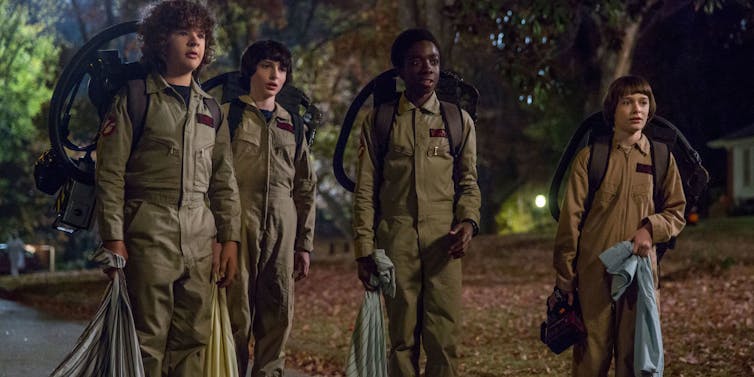
Stranger Things, saison 2, Ć©pisode 2 : « Trick or Treat Freak »
Stranger Things, saison 2, Ć©pisode 2 : « Trick or Treat Freak » (Netflix).

ƀ l’instar de la nouvelle adaptation de It par AndrĆ©s Muschietti, la sĆ©rie de Matt et Ross Duffer fait la part belle aux images naturalistes, si l’on excepte les sĆ©quences purement science-fictionnelles, s’attardant davantage sur le quotidien d’une petite ville amĆ©ricaine en 1984 entre balades Ć  vĆ©lo, soirĆ©es Donjons et Dragons et dĆ©gustation de gaufres Eggo. Tout est dans le dĆ©tail et non dans la surenchĆØre d’effets visuels comme c’est le cas pour le clip parodique « Through the Night » du groupe Ć©lectro Grum.
Tout se passe au niveau de la production, dans le choix des accessoires, des costumes et des dĆ©cors, et non en post-production, Ć  grand renfort de filtres de couleur et de morceaux musicaux choisis selon leur place dans le billboard. Si quelques sons typiques allant de « Time After Time » de Cyndi Lauper Ć  « Every Breath You Take » de The Police viennent sporadiquement faire danser les personnages, tout comme la reprise de « Trust » par Anthrax dans It, Stranger Things dĆ©laisse ce rĆ©flexe quasiment systĆ©matique du juke-box vintage propre aux productions qui ancrent leur diĆ©gĆØse dans une Ć©poque prĆ©dĆ©finie. Les deux crĆ©ateurs avoueront d’ailleurs dans le second Ć©pisode de la sĆ©rie making-of « Beyond Stranger Things » que l’essentiel du budget musical de la seconde saison se concentre sur la scĆØne finale du Snowball.

The ConversationPourtant, bien que particuliĆØrement naturaliste dans sa volontĆ© de reprĆ©senter, de ressusciter la culture populaire des annĆ©es 80, Stranger Things, Ć  l’instar de la nouvelle adaptation de It, ne vas pas au bout de ses intentions. Le numĆ©rique est toujours trĆØs prĆ©sent, que ce soit dans les sĆ©quences aux abords du portail menant Ć  l’antre du Mind Flayer, les reprĆ©sentations de cette crĆ©ature ou mĆŖme du DĆ©mogorgon de la premiĆØre saison. Dans les annĆ©es 80, des dĆ©cors de studios et des marionnettes animatroniques auraient remplacĆ© ce dĆ©luge d’effet spĆ©ciaux gĆ©nĆ©rĆ©s par ordinateurs, comme peuvent encore en tĆ©moigner Gremlins de Joe Dante ou encore E.T. de Steven Spielberg, ces œuvres cocons qui bientĆ“t ressurgiront sur nos Ć©crans alors que la fumĆ©e s’Ć©lĆØvera doucement des tasses de chocolat chaud et que la neige tombera paisiblement dans la nuit Ć©clairĆ©e par les lumiĆØres de NoĆ«l. GĆ©nĆ©ralement des nĆ©ons.


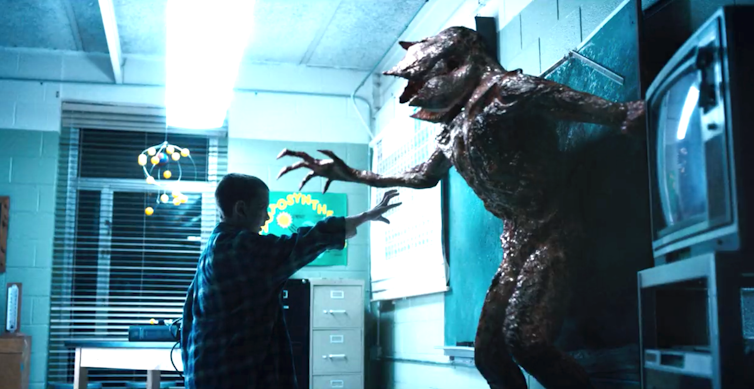
Le duel final de la saison 1 : Eleven face au DƩmogorgon (Stranger Things)
Le duel final de la saison 1 : Eleven face au DĆ©mogorgon (Netflix). L’utilisation de stroboscopes, justifiĆ©e dans la diĆ©gĆØse par le clignotement des ampoules provoquĆ© en prĆ©sence du monstre, sert Ć©galement Ć  masquer les Ć©ventuels dĆ©fauts plastiques de la crĆ©ature en images de synthĆØse.

About Today's Contributor:
Guillaume Labrude, Doctorant en Ʃtudes culturelles, UniversitƩ de Lorraine


This article was originally published on The Conversation

Other "Stranger Things" Related Articles:

22 November 2017

14 Year Fox News Contributor Tobin Smith and Filmmaker Jen Senko Launch "FIGHT BACK AGAINST FOX NEWS" Crowdfunding Campaign to Publish Book "Fear & UnBalanced" & Distribute "The Brainwashing of My Dad" Documentary

by
Fight Back Against Fox News
Tobin Smith, a 14 year weekly Fox News on-air veteran contributor, and filmmaker Jen Senko, the writer/director of the acclaimed documentary film "The Brainwashing of My Dad" have joined forces to launch the "Fight Back Against Fox News NOW" public awareness and crowdfunding campaign to:
"Fair & Unbalanced: Confessions of a Fox News Hitman" - Book cover
Mr. Smith and Ms. Senko's current Fight Back Against Fox News campaign crowdfunding on Indiegogo has raised nearly $7,000 from 130+ backers since November 2 to finance the publication and pre-sell Mr. Smith's tell-all book "Fair & Unbalanced: Confessions of a Fox News Hitman" which will reveal untold and irrefutable evidence that pulls the curtain back on Fox News' promise of "fair and balanced" opinion programming that Mr. Smith participated in that was in fact a rigged outcome production in favor of the conservative partisan commentators.

The campaign will also widely distribute to campaign donors the acclaimed Fox News addiction documentary "The Brainwashing of My Dad" written/directed by Jen Senko and produced by Matthew Modine and Adam Rackoff which details the family damage caused by her elderly father's addiction to Fox News and his hyper-partisan radicalization that resulted from watching 40-50 hours of Fox News programming per week.

Said Mr. Smith, "I didn't understand the scope and magnitude of what I have come to call "Fox News Derangement Syndrome" until I saw Jen Senko's powerful eye-opening documentary "The Brainwashing of My Dad" in early 2017. Later I published my own "Fear & Unbalanced: Confessions of a Fox News Hitman" book preview on Medium.com which received over 120,000 visitors in May 2017. That viral traffic proved to me how extensive concern is over Fox News based hyper-partisan radicalization that has grown exponentially since the launch of Fox News in 1996."
He continued "But it was only after I read hundreds of emails from estranged sons and daughters, brothers and sisters of radicalized parent(s) or family members addicted to Fox News that I really understood the poisonous effect on previously healthy families that results from Fox News Derangement Syndrome."


➧Part of the funds raised for Fight Back Against Fox News crowdfunding campaign will be allocated to launch a public health research project to measure the degree of direct correlation between senior aged family/friend estrangement and lethal rates of chronic loneliness in 60+ aged seniors who watch more than 20 hours of Fox News a week.

"The Brainwashing of My Dad" - Poster
About "The Brainwashing of My Dad" :
(via thebrainwashingofmydad.com)
WAS HILLARY CLINTON CRAZY WHEN SHE SPOKE OF THE “VAST RIGHT-WING CONSPIRACY,” RESPONSIBLE FOR THE RELENTLESS AND COSTLY ATTACKS AGAINST HER HUSBAND, PRESIDENT BILL CLINTON?

As filmmaker, Jen Senko, tries to understand the transformation of her father from a non political, life-long Democrat to an angry, right-wing fanatic, she uncovers the forces behind the media that changed him completely: a plan by Roger Ailes under Nixon for a media takeover by the GOP, The Powell Memo urging business leaders to influence institutions of public opinion -especially the universities, the media and the courts, and under Reagan, the dismantling of the Fairness Doctrine, and The Telecommunications 'Reform' Act signed by Bill Clinton.

As her journey continues, we discover that her father is part of a much broader demographic, and that the story is one that affects us all.

Through interviews with media luminaries, cognitive linguists, grassroots activist groups such as: Noam Chomsky, Steve Rendall, Jeff Cohen, Eric Boehlert, George Lakoff, Carol Wallin from STOP RUSH, HearYourselfThink, Claire Conner and others, “Brainwashing” unravels the plan to shift the country to the Right over the last 30 years, largely through media manipulation. The result has lead to fewer voices, less diversity of opinion, massive intentional misinformation and greater division of our country.

This documentary shines a light on how it happened (and is still happening) and leads to questions about who owns the airwaves, what rights we have as listeners/watchers and what responsibility does our government have to keep the airwaves truly fair, accurate and accountable to the truth.

SOURCE: Fight Back Against Fox News

Bonus Videos:


New Book for 25th Anniversary of X-Men: The Animated Series Reveals Struggle Which Launched One of TV's Most Successful Saturday Morning Superhero Shows.

by
'Previously On X-Men' - book cover.
X-Men, which ran five seasons on Fox-TV (1992-95), garnered exceptionally high ratings for a Saturday morning cartoon, and earned worldwide critical praise for its dark, serious nature. 

➧The new book Previously on X-Men celebrates the 25th anniversary of the show. 

Co-developer and head writer Eric Lewald provides an in-depth, behind-the-scenes look at the struggles to launch the series and maintain both the quality and themes of the comic books.
X-Men: The Animated Series -  promotional image.
X-Men: The Animated Series -  promotional image.
According to Lewald, X-Men: TAS was "the single most successful animated action-adventure series of the last 25 years," both in America and throughout the world. 
He adds, "The series has played in syndication nearly non-stop over the 20 years since it finished its network run, and all five [seasons] of its DVDs are Amazon bestsellers."
But it was not an easy sell to television. "Even a modest-budgeted 'kids show' is a multi-million-dollar risk," Lewald explains. "Network executives must believe they can get a large audience to be profitable, or their jobs – or even the existence of a smaller network – could be in jeopardy. From 1966 to 1989, there had been 11 attempts at Marvel TV series; none were hits. On top of that, the networks' recent successes had been young, light, and funny. X-Men: TAS was older, dark, and intense."
The X-Men Reading 'Previously on X-Men'
The X-Men Reading 'Previously on X-Men' (Image via xmentas.com)
➧Despite this, Fox-TV decided to take a chance with X-Men. The creative staff's biggest challenge was to remain faithful to the comic books. 
According to Lewald, "For a century, Hollywood told heroic comic-book stories as cheap, short kiddie diversions. As comics evolved in the '70s and '80s into a far more serious storytelling form, Hollywood hadn't noticed. Like Star Trek or Sherlock Holmes, the X-Men had millions of fans, so Mark Edens – who laid out the first 26 stories with me – and I felt a duty to the world of the X-Men to retain its spirit. Luckily, the people with the most say on the project backed us, allowing us to keep the integrity of our vision. Without their support, X-Men could have ended up being X-Babies!

We showed superheroes as realistic adult characters in serious dramas. This was a risk, but the resulting worldwide success helped expand the audience who appreciated the comic books into the hundreds of millions who watched our show.

There were no Marvel movies before our series, despite their success as comics. In the 20 years since we finished our network run in 1997, 'Marvel superhero' has become the most successful category of movies in the world – jumpstarted, appropriately, by the first X-Men movie in 2000. Much as westerns, musicals, and crime dramas had been for decades, 'superhero' is now its own movie and TV genre. X-Men: TAS blazed that trail."

  • The new 450-page hardback, Previously on X-Men, is published by Jacobs/Brown Press.


The 'Previously on X-Men' Matching Bookmarkers
The 'Previously on X-Men' Matching Bookmarkers (image via jacobsbrownmediagroup.com)


Bonus Video:


You Might Also Like