14 May 2018

Why Bullshit Hurts Democracy More Than Lies

by

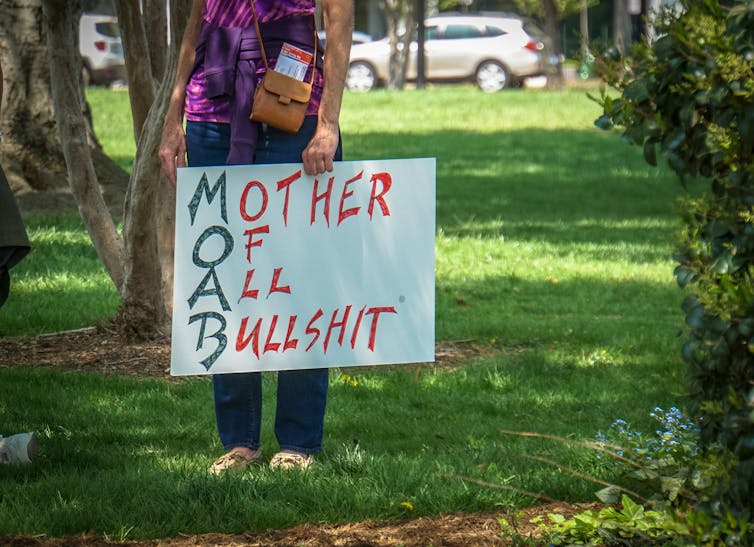
Why is bullshit so harmful?
Why is bullshit so harmful? (Ted Eytan, CC BY-SA)

Since the inauguration of Donald Trump as president, members of his administration have made many statements best described as misleading. During the administration’s first week, then-press secretary Sean Spicer claimed that Trump’s inauguration was the most well attended ever. More recently, Scott Pruitt claimed falsely to have received death threats as a result of his tenure at the Environmental Protection Agency. President Trump himself has frequently been accused of telling falsehoods – including, on the campaign trail, the claim that 35 percent of Americans are unemployed.
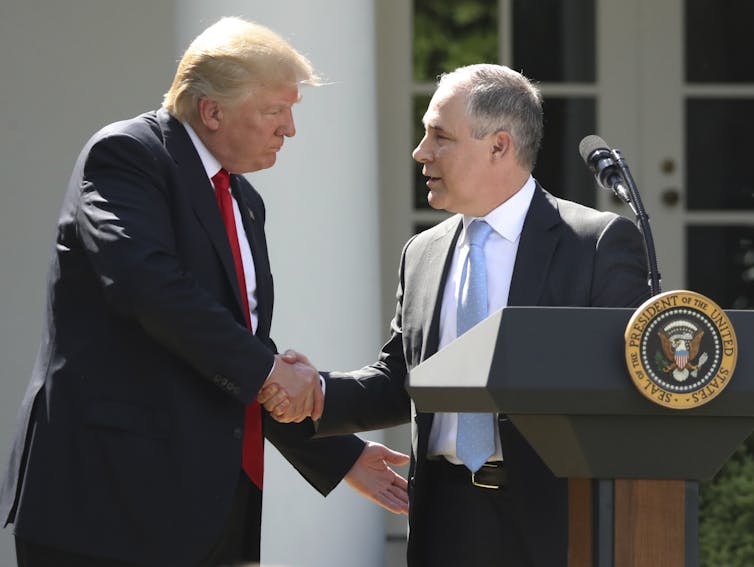
President Trump with EPA Administrator Scott Pruitt.
President Trump with EPA Administrator Scott Pruitt. (AP Photo/Andrew Harnik, File)

What is extraordinary about these statements is not that that they are false; it is that they are so obviously false. The function of these statements, it seems, is not to describe real events or facts. It is instead to do something more complex: to mark the political identity of the one telling the falsehood, or to express or elicit a particular emotion. The philosopher Harry Frankfurt uses the idea of bullshit as a way of understanding what’s distinctive about this sort of deception.

As a political philosopher, whose work involves trying to understand how democratic communities negotiate complex topics, I am dismayed by the extent to which bullshit is a part of modern life. And what bothers me the most is the fact that the bullshitter may do even more damage than the liar to our ability to reach across the political aisle.

Bullshit does not need facts
Democracy requires us to work together, despite our disagreements about values. This is easiest when we agree about a great many other things – including what evidence for and against our chosen policies would look like.

You and I might disagree about a tax, say; we disagree about what that tax would do and about whether it is fair. But we both acknowledge that eventually there will be evidence about what that tax does and that this evidence will be available to both of us.

The case I have made about that tax may well be undermined by some new fact. Biologist Thomas Huxley noted this in connection with science: A beautiful hypothesis may be slain by an “ugly fact.”

The same is true, though, for democratic deliberation. I accept that if my predictions about the tax prove wrong, that counts against my argument. Facts matter, even if they are unwelcome ones.

If we are allowed to bullshit without consequence, though, we lose sight of the possibility of unwelcome facts. We can instead rely upon whatever facts offer us the most reassurance.

Why this hurts society
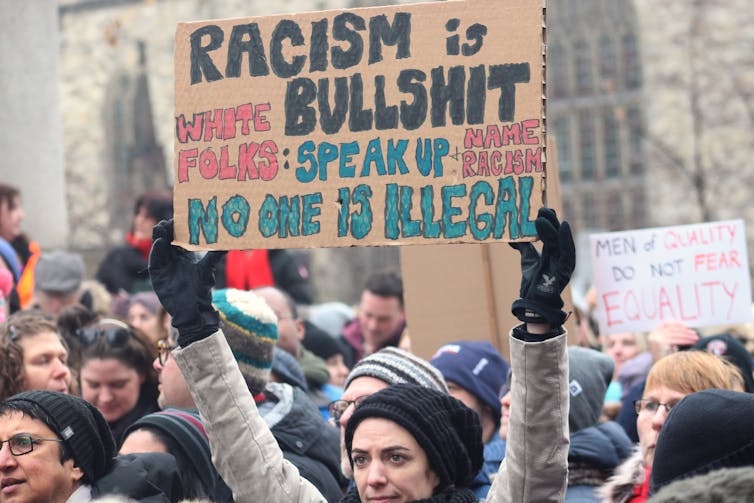
In the absence of a shared standard for evidence, bullshit prevents us from engaging with others
In the absence of a shared standard for evidence, bullshit prevents us from engaging with others. (Mike Gifford, CC BY-NC)

This bullshit, in my view, affects democratic disagreement – but it also affects how we understand the people with whom we are disagreeing.

When there is no shared standard for evidence, then people who disagree with us are not really making claims about a shared world of evidence. They are doing something else entirely; they are declaring their political allegiance or moral worldview.

Take, for instance, President Trump’s claim that he witnessed thousands of American Muslims cheering the fall of the World Trade Center on Sept. 11. The claim has been thoroughly debunked. President Trump has, nonetheless, frequently repeated the claim – and has relied upon a handful of supporters who also claim to have witnessed an event that did not, in fact, occur.

The false assertion here serves primarily to indicate a moral worldview, in which Muslims are suspect Americans. President Trump, in defending his comments, begins with the assumption of disloyalty: the question to be asked, he insisted, is why “wouldn’t” such cheering have taken place?

Facts, in short, can be adjusted, until they match up with our chosen view of the world. This has the bad effect, though, of transforming all political disputes into disagreements about moral worldview. This sort of disagreement, though, has historically been the source of our most violent and intractable conflicts.

When our disagreements aren’t about facts, but our identities and our moral commitments, it is more difficult for us to come together with the mutual respect required by democratic deliberation. As philosopher Jean-Jacques Rousseau pithily put it, it is impossible for us to live at peace with those we regard as damned.

It is small wonder that we are now more likely to discriminate on the basis of party affiliation than on racial identity. Political identity is increasingly starting to take on a tribal element, in which our opponents have nothing to teach us.

The liar, in knowingly denying the truth, at least acknowledges that the truth is special. The bullshitter denies that fact – and it is a denial that makes the process of democratic deliberation more difficult.

Speaking back to bullshit
These thoughts are worrying – and it is reasonable to ask what how we might respond.

One natural response is to learn how to identify bullshit. My colleagues Jevin West and Carl Bergstrom have developed a class on precisely this topic. The syllabus of this class has now been taught at over 60 colleges and high schools.

Another natural response is to become mindful of our own complicity with bullshit and to find means by which we might avoid rebroadcasting it in our social media use.

The ConversationNeither of these responses, of course, is entirely adequate, given the insidious and seductive power of bullshit. These small tools, though, may be all we have, and the success of American democracy may depend upon our using them well.

About Today's Contributor:
Michael Blake, Professor of Philosophy, Public Policy, and Governance, University of Washington


This article was originally published on The Conversation

11 May 2018

Holy S***, Balls!: The Deadpool 2 Original Motion Picture Score Is Out Now

by
Deadpool 2 Original Motion Picture Score
Deadpool 2 Original Motion Picture Score (PRNewsfoto/Sony Music Masterworks)
The official Deadpool 2 (Original Motion Picture Score) is now available everywhere digitally to stream / download. Fans can now hear the first-ever "parental guidance" tagged score album from award-winning composer, Tyler Bates (John Wick, Guardians of the Galaxy, Watchmen) and look forward to explicit numbers such as "Holy S*** Balls" and "Make the Whole World our B****."  Billboard says "the score…matches the smart-ass spirit of the franchise." 

⏩ Stream or download the album now ahead of the film's release on May 18, 2018.
"We're thrilled to receive a 'parental guidance' tag on the score album!" says Tyler Bates.

Deadpool
Deadpool
About Deadpool 2:
After surviving a near-fatal bovine attack, a disfigured cafeteria chef (Wade Wilson) struggles to fulfill his dream of becoming Mayberry's hottest bartender while also learning to cope with his lost sense of taste. Searching to regain his spice for life, as well as a flux capacitor, Wade must battle ninjas, the yakuza, and a pack of sexually aggressive canines, as he journeys around the world to discover the importance of family, friendship, and flavor – finding a new taste for adventure and earning the coveted coffee mug title of World's Best Lover.
Directed David Leitch and written by Rhett Reese & Paul Wernick & Ryan Reynolds. The movie stars Ryan ReynoldsJosh BrolinMorena BaccarinJulian Dennison, Zazie Beetz, T.J. Miller, Brianna Hildebrand and Jack Kesy.

The Trailer:


About Tyler Bates:
With an innate understanding of an environment's power, perhaps it's no coincidence that Tyler Bateshas become not only an artisan at architecting music for film, television, and video games, but an in-demand multi-instrumentalist, writer, and producer. Through the nineties, he logged 1,200-plus live shows in his bands, including Pet, released on Igloo/Atlantic Records, under the guidance of Tori Amos, before segueing into the world of film score. He started to make waves by creating the audio backdrop for the popular Zack Snyder Dawn of the Dead reboot in 2004 followed by his soundtrack for the filmmaker's 300.
By 2017, he worked on the most successful franchises in recent memory: Marvel's Guardians of the Galaxy and John Wick. In addition to composing for Guardians of the Galaxy Vol. 1 & Vol. 2 and winning a BMI Film Music Award for the first, he co-wrote and produced a fan favorite "disco version" of "Guardians Inferno" [feat. David Hasselhoff], performed the second installment's score at the 2017 MOSMA Festival in Spain, and crafted the music for the Disney California Adventure attraction Guardians of the Galaxy – Mission Breakout!
Meanwhile, John Wick: Chapter 2 represents the nexus of his work as a composer, performer, and songwriter. He penned the closing credits tune "A Job To Do" alongside legendary Alice In Chains guitarist and vocalist Jerry Cantrell and performed on-screen during the climactic "Rock Opera" sequence, rocking a guitar-viol on stage with Le Castle Vania and Nostalghia. Samurai Jack offered a similar experience. After overseeing score production for Samurai Jack with composers, Joanne Higginbottom and Dieter Hartmann, he took the stage to perform a suite of the score at a sold-out Ace Theatre concert.
Samurai Jack just one of his many TV credits. His sonic presence can also be felt throughout Netflix's The Punisher, Showtime's Californication, Audience Network's Kingdom, WGN America's Salem, and more as well as video games such as Killzone: Shadow FallGod of War: AscensionArmy of Two: The 40th Day, and most recently Crossfire.
2014 saw the birth of a powerful partnership with Marilyn Manson, touring the world. After meeting on a Californication performance, Bates went on to co-write and produce the 2015 epic, The Pale Emperorand the follow up in 2017, Heaven Upside Down. A runaway worldwide success, it achieved the Top 10 of the Billboard Top 200 at #6 and earned widespread critical acclaim with Rolling Stone hailing it as the "#1 Metal Album of 2015."
Bates handled music for the blockbuster Atomic Blonde starring Academy Award® winner Charlize Theron. For the project, he also produced Health's cover of "Blue Monday" and re-invigorated and revitalized Ministry's "Stigmata" with Manson for key sequences in the film. On the big screen, he can be heard in the critically acclaimed The Belko Experiment as well as Public and 24 Hours to Live, while his voice permeates NETFLIX's The Punisher and Season 2 of The Exorcist.

Deadpool 2 (Original Motion Picture Score) Tracklist:
1. X-Men Arrive
12. Ice Box
2. Fighting Dirty
13. Docking
3. Hello Super Powers
14. Make the Whole World our B****
4. Escape
15. Pity D***
5. Vanessa
16. Knock Knock
6. Weasel Interrogation
17. Let Me In
7. Holy S*** Balls
18. Maximum Effort
8. Mutant Convoy
19. The Orphanage
9. The Name is Cable
20. Cable Flashback
10. Sorry for Your Loss
21. Genuine High Grade Lead
11. You Can't Stop this Mother F*****
22. Courage Mother F*****

10 May 2018

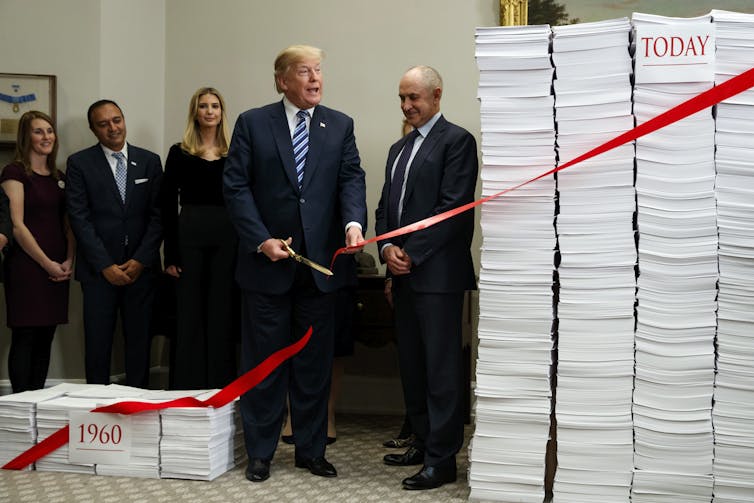
Trump's Deregulatory Record Doesn't Include Much Actual Deregulation

by

Cutting red tape is a high priority, but the execution hasn’t always led to results
Cutting red tape is a high priority, but the execution hasn’t always led to results. (AP Photo/Evan Vucci)

One year ago, the Trump administration’s deregulatory push was in full swing. The administration was preparing a proposed rule to repeal the Waters of the United States (WOTUS) regulation, and to delay and repeal the restriction of methane emissions from oil and gas extraction on public lands.

Surely these well-publicized deregulatory initiatives which the Trump administration has made a big show of taking credit for have taken effect by now.

Well, not exactly. The WOTUS proposal has not been finalized, and the methane extraction rule is tied up in a thicket of court cases.

President Trump’s record on deregulation has gotten a great deal of attention. He brags about it regularly. It is often placed alongside the tax cuts passed by Congress when his chief accomplishments are recounted. To listen to the president (or the media), one would think that thousands of regulations were repealed.

But as the WOTUS and Bureau of Land Management extraction rules indicate, the actual extent of deregulation is much more limited. At the same time, other moves to dismantle the “administrative state” have quietly been more effective.

No more easy routes
Early in the Trump administration, Congress used the Congressional Review Act, a statute that allows the Senate to bypass the filibuster to repeal recently issued regulations. By May 17, 2017, Congress had repealed 14 Obama regulations using the CRA in a wide array of policy areas. They would add one more regulation from the Consumer Protection Financial Bureau by the end of 2017.

But these repeals are largely the work of Congress and frequent punching bag for President Trump, Senate Majority Leader Mitch McConnell. And now, most Obama-era regulations are off limits for the CRA (although Congress has explored expanding its use). That leaves President Trump and his administration to rely on the typical route for writing and revising regulations – the executive branch – if they want to repeal any more of the thousands of regulations issued during the Obama administration.


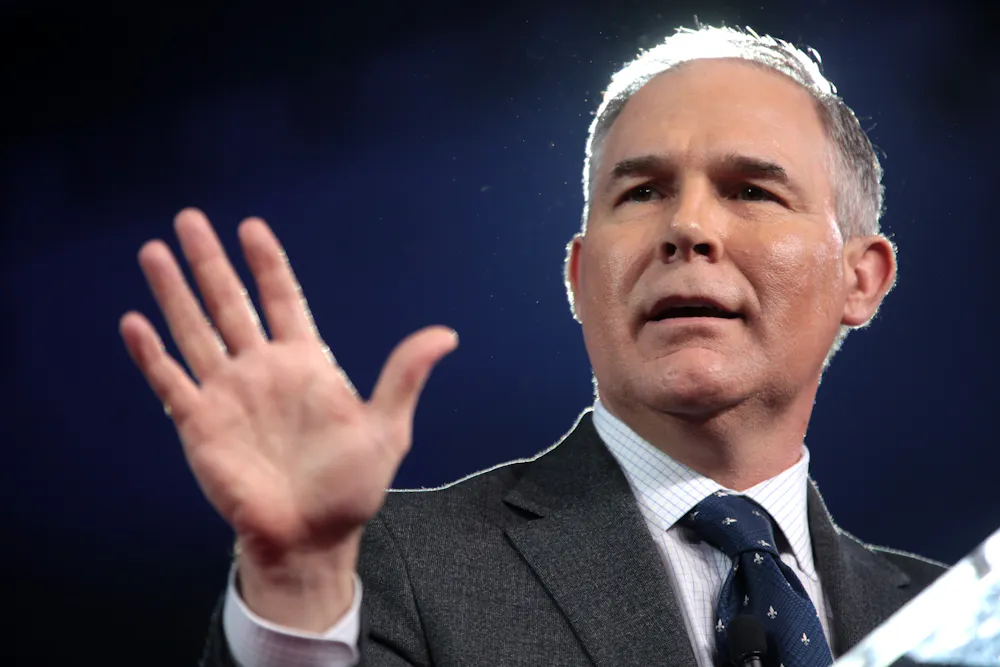
In seeking to roll back fuel economy standards and other regulations, EPA Administrator Scott Pruitt’s staff hasn’t shown the same attention to the rule-making process as his predecessor
In seeking to roll back fuel economy standards and other regulations, EPA Administrator Scott Pruitt’s staff hasn’t shown the same attention to the rule-making process as his predecessor. (Gage Skidmore, CC BY-NC-ND)

Making announcements about a desire to repeal regulations is easy. President Trump did so in December (although his claim that 22 regulations had been repealed for every new regulation was vastly exaggerated). Actually repealing significant regulations is much harder, as the administration is finding out.

An agency must start by developing a proposal to repeal a regulation. This must often be accompanied by a detailed economic analysis of the repeal. The proposal and the analysis are then sent to the Office of Management and Budget for a review. When that review is complete, the proposal is published in the Federal Register for public comment. Agencies must review the public comments, respond to them, make any changes they feel necessary to their proposal and analysis, and then resubmit it to OMB before publishing a final rule. Finally, the rule is subject to litigation.

To navigate this process takes time and expertise. President Trump and his Cabinet members, particularly Scott Pruitt at the EPA, have instead tried to rush through the many steps of this process. This has meant that the last step, the litigation over regulatory repeals, has proven particularly problematic for the administration. At the EPA, courts have struck down delays or repeals of regulations six times already. This pattern holds across the government.

Another kind of damage
Part of the problem for the Trump administration is that while they have been hasty in trying to repeal regulations, the Obama administration was thorough in promulgating them. Over the course of eight years, Obama appointees solicited comments on their proposals, did detailed economic analyses, and built strong cases for many of their regulations. For example, the former EPA administration compiled a 1,217-page analysis done over years to buttress its fuel economy rules, while the current administration generated a 38-page document dominated by auto industry comments to justify reviewing and rescinding them.

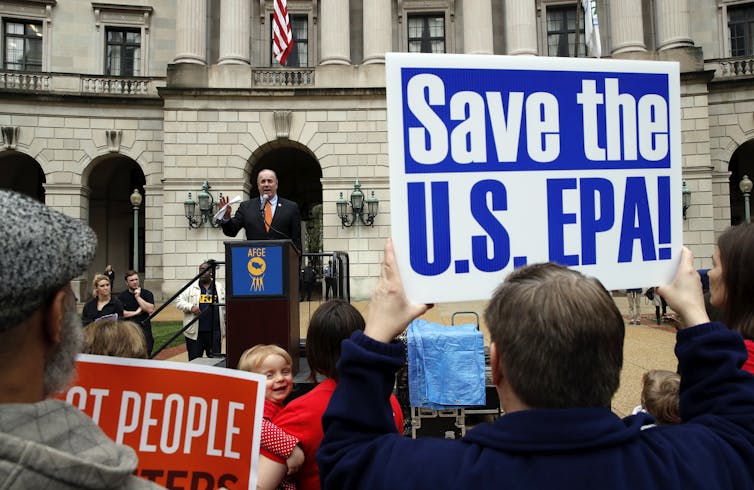
Repealing existing regulations requires the work of government staffers who know the processes but a number of agencies, including the EPA, have lost many significant employees
Repealing existing regulations requires the work of government staffers who know the processes but a number of agencies, including the EPA, have lost many significant employees. (AP Photo/Alex Brandon)

In order to repeal these regulations, the Trump administration will have to convince courts that there are sound legal reasons to ignore all of this work. The statute that governs the creation of regulations, the Administrative Procedure Act, requires agencies to demonstrate that they are not arbitrary and capricious.

To do so, the Trump administration will have to rely on the expertise that lies within the federal bureaucracy. But President Trump and his appointees have regularly denigrated those whose help they now require. As a result, many of the most talented people at the agencies have left public service. At the EPA alone, more than 700 employees have left during this administration.

This means not only has the administration failed thus far to repeal many regulations beyond those overturned by Congress using the CRA, but their prospects for doing so in other cases are not strong. These cases include the WOTUS regulation, the Clean Power Plan to limit carbon emissions from power plants, and the recently announced plans to roll back emission standards for automobiles and take on California over their auto emission requirements.

Stephen Bannon listed the deconstruction of the administrative state as a goal of the Trump administration. The repeal of regulations is often trumpeted as the most important sign that Trump is succeeding. But while the administration is failing at the piece of deconstruction they are talking about most loudly, there are signs that they are succeeding in other ways.

The first is the enforcement of existing regulations. While the Trump administration has ramped up enforcement of immigration regulations, it has ratcheted down enforcement of environment and worker safety requirements. This selective pattern of enforcing regulations sends signals to firms that they don’t need to worry about complying with the law when it comes to the environment or public health.

Meanwhile, there has been an exodus of employees from the federal government which will likely have a corrosive long-term effect. Replacing talented public servants is not something that can be done overnight, even by a new administration dedicated to doing so. Training these new government employees will take even longer. As government becomes less effective because of the talent drain, faith in government diminishes further and a cycle of cynicism about public service is made worse.

The Trump administration has declared war on the regulatory state. But the things the administration is reluctant to take credit for, notably not enforcing the law and driving out talented public servants, are likely to have a much larger impact than its largely nonexistent regulatory repeals.

About Today's Contributor:
Stuart Shapiro, Associate Professor and Director, Public Policy Program, Rutgers University

This article was originally published on The Conversation

Bonus Picture:


(via Trumpton Facebook Page)
When someone told Mr Trump the Law of Gravity was one of Mr Obama's, he repealed it.

9 May 2018

STX Entertainment, Tencent Pictures And Free Association Join Forces On 'Zombie Brother' Feature Film

by
'Zombie Brother' - graphic
"Zombie Brother" - graphic (image via Variety.com)
STX EntertainmentRobert Simonds' next-generation media company, Tencent Pictures, the fast-expanding film and television arm of China'sinternet and social media giant Tencent, and Channing TatumReid Carolin and Peter Kiernan's Free Association production company announce a partnership to co-produce a film adaptation of the mega-hit "Zombie Brother," the top title on Tencent's digital comics and animation platform. 
⏩ Since 2011, the digital comic book has garnered more than 17 billion views over 348 episodes, and its animated series has attracted more than 3.7 billion views across its first two seasons. The franchise has also been adapted into a mobile game and a popular stage play. The stage play has had a record-breaking run of sold out shows across the region.
"Since its inception, STX Entertainment has been committed to producing, marketing and distributing universally resonant content across all platforms, with a particular focus on bridging the U.S. and Chinese markets," said Adam Fogelson, Chairman of STXfilms, a division of STX Entertainment. "As an early investor in STX, Tencent has been a strong strategic partner and we're honored to be collaborators in bringing its most valuable IP to new audiences around the world. With Tencent Pictures' awesome ecosystem of entertainment channels and Free Association's creative acumen, we think there is no end to the storytelling opportunities of this franchise.
"We are thrilled to be joining forces with STX Entertainment on one of Tencent Animation and Comics' excellent properties, 'Zombie Brother.' It has been an incredible pleasure to explore new possibilities with STX. Teamed alongside our gifted producers at Free Association, we look forward to bringing 'Zombie Brother' as a uniquely fun and fresh film for the enjoyment of audiences everywhere," said Edward Cheng, Vice President of Tencent and CEO of Tencent Pictures.
"We've long been inspired by STX's commitment to high quality storytelling that authentically speaks to audiences on both sides of the Pacific. We couldn't imagine better partners as we continue to work with Edward, Howard and the wonderful Tencent team on this beloved property. It's a pleasure to welcome them to the 'Zombie Brother' party," said Peter Kiernan of Free Association.

STX Entertainment Logo
STX Entertainment Logo (PRNewsfoto/STX Entertainment)

⏩STXfilms will distribute the film domestically and Tencent Pictures will distribute in ChinaChanning TatumReid CarolinPeter Kiernan and Michael Parets will produce for Free Association, and Edward ChengHoward Chen, and Conor Zorn will produce for Tencent Pictures. STXfilms' Chairman Adam Fogelson and head of production Sam Brown will oversee the film for the studio. 

8 May 2018

[Believe It or Not!] Ripley's 'Odd Is Art' is Now on Sale

by
Ripley's Believe It or Not! Odd Is Art - Book cover
Unframed and unbelievable, the pages of Ripley's Believe It or Not! Odd Is Art are filled with the most unconventional pieces curated from the Ripley collection and beyond.
Designed as an elegant art book and eclectic in nature, Odd Is Art showcases the most visually stunning and technically impressive Ripley pieces, plus additions from outside artists. From laundry lint iconography and sculptures made of salt, to an intricately carved human skull, some of the most fascinating pieces of art from the Ripley's Believe It or Not! collection are celebrated within the 144 pages of Odd Is Art.
MEGALODON: Inspired by 20,000 Leagues Under the Sea, the 16-ft-long (4.8-m) shark has a moving tail, glowing mouth, and eyes that open and close. Crafted from a world war ii airplane fuselage and objects found at a city dump.
Aside from strange mediums and unusual techniques, Odd Is Art also features inspiring stories of artists who have overcome obstacles others would view as total roadblocks.

 Artist Zuly Sanguino of Bogota, Colombia, was born with a rare genetic disorder that left her with underdeveloped arms and legs. At the age of 18, she began studying art and now refers to herself as a "no arms, no legs, no limits artist," painting colorful works now on display at Ripley's Believe It or Not! attractions.

THE OLD WAYS + GIRL WITH THE PEARL NECKLACE: Fourteen layers of hand cut paper arranged in a frame and lit from behind, creating a three-dimensional scene |Finely detailed profile of a woman wearing a necklace cut from a single sheet of paper.
Related Video:

 Odd Is Art is now on sale at all major booksellers


You Might Also Like