18 May 2018

The Australian Zombie Horror 'Cargo' Is Burdened By Its Own Gravitas

by

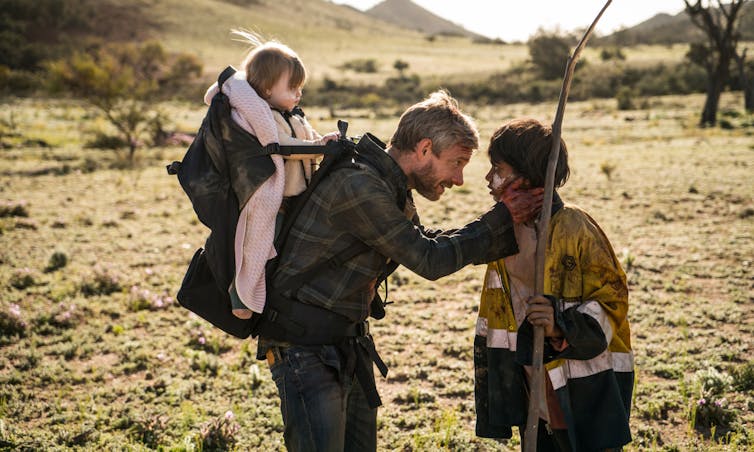
In Cargo, Martin Freeman plays Andy, a man who has to kill his wife after she turns into a zombie and travels across country with baby daughter Rosie on his back.
In Cargo, Martin Freeman plays Andy, a man who has to kill his wife after she turns into a zombie and travels across country with baby daughter Rosie on his back. (Addictive Pictures, Causeway Films, Head Gear Films)

Since the 1970s, some of the best horror films have been made in Australia. Something about the vastness of the continent, and its geographical remoteness from the northern and western hemispheres, lends itself to the kind of existential explorations of alienation that underpin the best examples of this genre.

Peter Weir’s The Cars That Ate Paris (1974) remains one of the great horror comedies, viciously lampooning small-town Australian life. Russell Mulcahy’s Razorback (1984) fully embraces the surreal-gothic potential of the Australian landscape, and the intense terror of Wolf Creek (2005) must have caused at least a few backpackers to reconsider their trips here.

But only one zombie film of note springs to mind, the Spierig Brothers’ brilliantly inventive Undead (2003). Ben Howling and Yolanda Ramke’s recent Cargo, released in Australian cinemas and to Netflix today, is another one. Whereas the Spierig Brothers approached the genre with energy and mirth, Cargo is a much more sombre affair, favouring dramatic realism and an understated visual approach over the garishness more typical of the films of the genre.

The result is mixed. The first half hour is brilliant, slowly building up tension and suspense, but once the narrative kicks into full gear, the film becomes far less satisfying. It’s not that it’s a bad film, it is moderately enjoyable, but given the renowned cast – it stars Martin Freeman, Susie Porter (excellent in a limited role) and legend of the Australian screen, David Gulpilil – and the potential of the genre in an Australian context, it could have been a lot better.

The narrative follows Andy (Freeman), a man who has to kill his wife Kay (Porter) after she turns into a zombie in the opening part of the film, as he travels across country with baby daughter Rosie on his back (his “cargo”) and befriends a teenage girl, Thoomi (Simone Landers). His wife bites him before he dies, so he knows he has only 48 hours remaining as a human, after which he will become one of the intestine eaters (there is an appropriately gross amount of blood and guts in this).


His mission, in his remaining time as a human, is to get Rosie to the group of Aboriginal people to whom Thoomi is also returning. This group have returned to a “traditional” way of living off the land, and are best equipped to repel the zombies. They are presided over by cleverman Daku (Gulpilil), who appears from time to time looking ghostly and saying little. There’s a touch of the noble savage myth about this whole subplot, and the images of blackfella magic are frequently accompanied by mystical-sounding music.

The most interesting encounters in the film are between Andy and Toomi and the several brain-eaters that populate the Australia of the future, but, unfortunately, these are few and far between. Instead, the action is driven by their encounters with several stock Australian film characters.

There’s the ethereal-woman in the outback, Lorraine, who seems too delicate to live in such an environment (played by Caren Pistorius in a wooden performance). There’s tough-as-nails Etta (Kris McQuade), an outback school teacher with a heart of gold. And there’s delusional tyrant Vic (played by Anthony Hayes, in a one-note and stilted performance) who is preparing to control Australia’s natural resources once order is restored. He gets his kicks doing really bad things like kidnapping Indigenous people and keeping them locked in cages in order to attract zombies who he then massacres for sport.
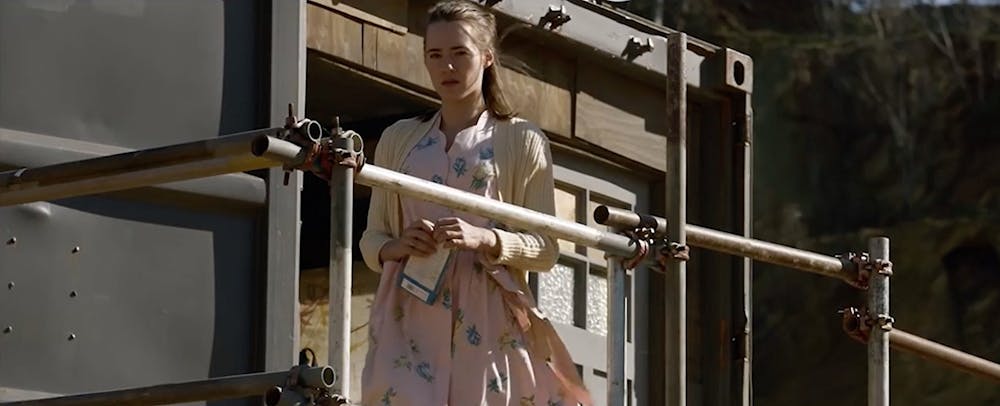
Caren Pistorius as the ethereal-woman in the outback, Lorraine.
Caren Pistorius as the ethereal-woman in the outback, Lorraine. (Addictive Pictures, Causeway Films, Head Gear Films)

These are cliches, indeed, but this shouldn’t matter for this kind of genre film. And yet, with Cargo it does. Because it seems to be straining so hard for a sense of gravitas (built through its dramatic verisimilitude and realist style), these cliches become terribly visible and disrupt the viewer’s pleasure. It’s like the filmmakers have deliberately not embraced the ludicrous potential of the subject matter and there is thus an uncomfortable tension between its sombre tone, the absurdity of its premise, and the flatness of its cliched narrative.

The American zombie film, emerging in its contemporary form with the George Romero films beginning with Night of the Living Dead (1968) is generally considered a critique of consumerism in the post-Vietnam era, and the most interesting element of Cargo is its attempt to reimagine the genre in an Australian context that reflects anxieties about the land and its destruction.

The film features scenes, for example, of abandoned fracking sites, and the fact that the whole thing becomes a kind of battle between a power-hungry mining type and Indigenous people could have provided grounds for incisive social and political commentary. But the treatment is unnecessarily sentimental, and it doesn’t feel like there’s any genuine emotional potency by the end. Even the sweeping panoramic shots of the Australian landscape feel contrived and unimpressive, almost like stock drone footage taken from an online tourist commercial.

Alas, Cargo seems like a made-for-Netflix movie – it makes sense, in this context, that it is premiering on Netflix – watchable but also forgettable, after its dazzling opening third. It was developed, furthermore, from a short film that went viral, and like a lot of films made from shorts (or from Saturday Night Live sketches), it feels like it lacks the legs to sustain the length of a feature.

Cargo is worth watching, particularly for fans of horror cinema, but its aesthetic will be best served, I suspect, by the small screen.


About Today's Contributor:
Ari Mattes, Lecturer in Media Studies, University of Notre Dame Australia

This article was originally published on The Conversation

Ice Cream Truck Vs. the Trump USDA: Latest DCX Activist Prank in the News

by
Parody ice cream truck and DCX Team member visit the White House to confront Trump administration
Parody ice cream truck and DCX Team member visit the White House to confront Trump administration (photo credit DCX)
Earlier this week, President Trump grabbed headlines for calling the Mueller investigation "the greatest witch hunt in American history," as well as for reimbursing Michael Cohen for a $130,000 payment to Stormy Daniels.  Meanwhile his administration quietly let expire a popular organic food policy.  
⏩ The Organic Livestock and Poultry Practices (OLPP) rule, which was over ten years in the making, aimed to tighten USDA organic standards and close loopholes that organic activists claim can easily be exploited by industrial producers.  
⏩ The OLPP enjoyed the support of organic farmers and advocates alike (of the 72,000 comments submitted during an open commentary period, 56,000 supported it. Only 50 comments were against these further regulations).
Citing a pattern whereby the president's controversial tweets and personal scandals draw attention away from unpopular policy enactments, a Brooklyn-based group DCX Growth Accelerator launched an ice cream truck, designed to shine the spotlight back upon the Trump administration's meddling with USDA organic food rules.  

DCX painted the name Presidential Creamery on the side of the truck, along with a jovial mascot: a cow udder with a Trump-style toupee waving an ice cream cone. The group drove it to Washington, DC where it drew long lines of consumers, and in recent days have been driving it through the streets of Manhattan, speaking with television news networks. 
The ice cream truck's menu boards are similar in style to those of a quaint organic creamery, but instead of organic products, they list "cage-raised vanilla" milkshakes, "3 chicken per square foot" egg creams, and a sandwich named "the Sonny Perdue Beakless Chicken Po-boy."  The product names refer to the animal welfare protections in the OLPP that were rolled back this week by new Trump-appointed USDA head, Sonny Perdue.  
⏩ The menus describe these foods as "organic-ish" and give them the satirical stamp of a new "certified USDA Organic-ish" logo. 
DCX is known for using creativity to give momentum to social issues. In the past the group has sent students to school wearing bulletproof vests to push for sensible gun control regulation, and has held an Artisanal Landlord Price Hike Sale on behalf of a deli facing an exorbitant rent increase, in order to out gentrification in the national media spotlight.

SOURCE: DCX Growth Accelerator

17 May 2018

'Avengers: Infinity War' Reflects Transformation Of Chinese Movie Market [Video Included]

by
'Avengers: Infinity War' - Chinese poster
'Avengers: Infinity War' - Chinese poster (via therealstanlee.com)
The following is a news report by China.org.cn on the Chinese movie market (scroll down to watch the video):
"The new Disney and Marvel's superhero movie "Avengers: Infinity War" hit the Chinese mainland on May 11. Previously, it raked in US$100 million worldwide in a record 11 days. Despite such success, the movie's popularity in China and the public frenzy for a debut ticket still staggered me.

Sun Wanlu, a china.org.cn reporter, bought her ticket one week in advance, but even then she was only able to get one for the midnight showtime.

Statistics show that the Chinese movie market has been the world's second largest since 2012. In 2017, its total gross reached 55.91 billion yuan, roughly equivalent to US$8.8 billion, or 77.63 percent of the North American market.

China's movie market has undergone enormous transformations in the past years. Decades ago, people had to bring stools from home to watch movies projected onto a screen in the open air. In remote villages, the only opportunity to watch a movie was during an important festival.

After the start of reform and opening up in 1978, especially in the 1980s, Chinese people began going to the cinema more frequently. However, cinemas at that time were minimally available and poorly equipped.

Profound changes have taken place in China's movie industry thereafter. Particularly since its entry into the WTO, China has continually increased its openness, and thus imported more top-billing foreign movies. From "Pearl Harbor" to "The Lord of the Rings" and "Finding Nemo," a large number of European and U.S. blockbusters have brought aesthetic pleasure to Chinese audiences.

Meanwhile, China has also stepped up the reform of its cultural industry, allowing non-government capital to enter the sectors of movie production, release and screening. Nowadays, many modern cinemas have been built in busy business districts full of restaurants and shopping malls. The number of movie screens in China has approached 50,000, and you can find digital cinemas even in rural areas. Also, the yield and quality of domestic movies have improved rapidly. From the Oscar-nominated "Hero" to "Wolf Warrior 2," which achieved total ticket sales of 5.6 billion yuan (US$884.2 million), domestically-produced movies have shared the spotlight on the global stage.

With fast economic growth and the increase of personal income, the Chinese people have developed higher consumption demands. Watching movies has become a popular form of entertainment. Forty years have passed since the introduction of the reform and opening up policy, and the booming development of Chinese movie industry is just one of the achievements China has made in four decades."
A News Report By China.org.cn On The Chinese Movie Market - The Video:
SOURCE:  China.org.cn
Related "Avengers: Infinity War" Stories: 

15 May 2018

"Stop Attacks On Children" [Statement By UNICEF Executive Director Henrietta H. Fore]

by
On 3 April 2018 in the Syrian Arab Republic, children stay at a school-turned shelter in Zeyarah village, north of Aleppo city.
On 3 April 2018 in the Syrian Arab Republic, children stay at a school-turned shelter in Zeyarah village, north of Aleppo city. © UNICEF/UN0207849/Al-Issa (CNW Group/UNICEF Canada)
Statement by UNICEF Executive Director Henrietta H. Fore 

"From the Central African Republic to South Sudan, and from Syria to Afghanistan, attacks on children in conflict have continued unabated during the first four months of the year.

With little remorse and even less accountability, parties to conflict continue to blatantly disregard one of the most basic rules in war: the protection of children.

No method of warfare has been off-limits, no matter how deadly for children: Indiscriminate attacks on schools, hospitals and other civilian infrastructure, abductions, child recruitment, besiegement, abuse in detention, and denial of humanitarian assistance were all too commonplace.

In Yemen, for example, more than 220 children were allegedly killed and over 330 were injured since the beginning of the year as a result of the conflict. Nearly 4.3 million children are now at risk of starvation, a 24 per cent increase over 2017 levels. An acute watery diarrhoea and cholera outbreak which killed more than 400 children under the age of five last year is threatening to claim even more young lives as the rainy season begins and hygiene conditions deteriorate further.

In Syria, hopes for peace remain dim. More than 70 attacks on hospitals and health facilities were verified during the first three months of the year, denying children and families vital health services. Over 300 education facilities have been attacked since the beginning of the conflict. Some 5.3 million children have been internally displaced or became refugees, and nearly 850,000 children continue to live in besieged or hard-to-reach areas.

In Bangladesh, more than 400,000 Rohingya refugee children who survived recent atrocities in Myanmar need humanitarian assistance. As the monsoon season approaches, the risk of cholera and other waterborne diseases is higher than ever.

In South Sudan, the first country I visited as UNICEF Executive Director, at least 2.6 million children have been forced to flee their homes. More than 1 million children are acutely malnourished including over 250,000 severely so and at increased risk of death. Although close to 600 children have been released from armed groups so far this year, around 19,000 continue to serve as fighters, messengers, porters, cooks and even sex slaves for the warring parties.

In Afghanistan, more than 150 children were reported killed and over 400 injured during the first three months of the year because of the conflict.

In the Central African Republic, renewed violence over the past few months has forced nearly 29,000 children to flee their homes, bringing the total number of internally displaced children close to 360,000. More than 2 in 5 children under the age of five suffer from chronic malnutrition and one third of school-aged children are now out of school.

In all these countries and many more, committed teams from UNICEF and partners are doing all they can to alleviate the suffering of the most vulnerable, those separated from their families, terrified and alone, those getting sick in densely populated refugee camps, those on the move in monsoon and unrelenting dry seasons, and those who are starving.

Despite funding shortfalls – we have only received 16 per cent of our funding needs for this year – we are resolutely committed to serving the most vulnerable. We are vaccinating children, treating them for malnutrition, sending them to school, providing them with protection services, and trying to meet their basic needs.

Humanitarian aid alone is not enough. Children need peace and protection at all times. The rules of war prohibit the unlawful targeting of civilians; attacks on schools or hospitals; the use, recruitment, and unlawful detention of children; and the denial of humanitarian assistance. When conflicts break out, these rules need to be respected and those who break them need to be held to account. Enough is enough. Stop attacks on children."
Iraq, 2018: Noor and Sarah walk in the west of Mosul where many buildings have been totally destroyed. "I do not know what happened to my father. He's been missing for three months," says Nour.
Iraq, 2018: Noor and Sarah walk in the west of Mosul where many buildings have been totally destroyed. "I do not know what happened to my father. He's been missing for three months," says Nour. (© UNICEF/UN0161148/Rfaat)
About UNICEF:
UNICEF has saved more children's lives than any other humanitarian organization. We work tirelessly to help children and their families, doing whatever it takes to ensure children survive. We provide children with healthcare and immunization, clean water, nutrition and food security, education, emergency relief and more.

UNICEF is supported entirely by voluntary donations and helps children regardless of race, religion or politics. As part of the UN, we are active in over 190 countries - more than any other organization. Our determination and our reach are unparalleled. Because nowhere is too far to go to help a child survive. 
For more information about UNICEF, please visit unicef.ca.
Democratic Republic of Congo (DRC), 2017: Marie-Pierre Poirier, UNICEF's Regional Director for West and Central Africa, visits the "BaptĆŖme et Graduation Des Capoeristes" in Goma. (© UNICEF/UN0126977/Wessels)

SOURCE: UNICEF Canada


14 May 2018

DreamWorks Animation: The Exhibition - Journey from Sketch to Screen at the Montreal Science Centre

by
DreamWorks Animation: The Exhibition
DreamWorks Animation: The Exhibition (Credit: Mark Ashkanasy)
The beloved characters from DreamWorks most celebrated films, including How to Train Your Dragon, ShrekMadagascar and Kung Fu Panda, are spending the summer in town at the MontrĆ©al Science Centre's newest exhibition DreamWorks Animation: The Exhibition – from Sketch to Screen.
DreamWorks Animation: The Exhibition
DreamWorks Animation: The Exhibition (Credit: Mark Ashkanasy)
More than 400 objects on display 
To mark its 20th anniversary, DreamWorks Animation has mined its vaults for rare and never-before-seen items, including maquettes, sketches, photographs, posters and accessories. This impressive collection is combined with unpublished interviews and behind-the-scenes footage, giving visitors an exclusive look inside  the creative process that brings the much-loved characters of the world's leading animation studio to life. 
DreamWorks Animation: The Exhibition
DreamWorks Animation: The Exhibition (Credit: Mark Ashkanasy)
Technology in the service of art 
Divided into three sections (Character, Story and World), the Exhibition is full of surprising, interactive experiences including 'flying' on the back of a dragon as well as creating your own 2D animation sequence. "DreamWorks has developed unique animation techniques over the years, a fascinating blend of art and technology that has thrilled generations of moviegoers. I suspect that many parents will not have to be asked to come to the Science Centre this summer," said Science Centre Director Isabel Dansereau.
DreamWorks Animation: The Exhibition
DreamWorks Animation: The Exhibition (Via Old Port of Montreal)
Exploring some of the Characters

Shrek
Shrek  (PRNewsFoto/DreamWorks Home Entertainment)
SHREK: The Shrek films were originally inspired by William Steig’s children’s story about a frightful ogre who finds true love when he saves a magnificently ugly princess. Through the magic of DreamWorks; however, this grumpy green ogre transforms into an anti-hero whose fearsome appearance belies a kind heart. Director Vicky Jensen outlines, “The story is all about self-acceptance and that things aren’t always as they appear. We definitely turn the concept of beauty on its ear, which I think is a powerful theme” (The Art of DreamWorks Animation, p. 55).

The Exhibition allows visitors to trace the gradual evolution of the look of this character, showing how the original designs were closer to the character in Steig’s picture book and how these gradually developed into the lovable character that we all recognize today. Shrek nevertheless remains undeniably ugly, and it was up to the animation team to communicate his true nature and range of emotions through complex facial expressions, made possible via new digital animation techniques.

Shrek’s vulnerability and lack of self-esteem is integral to his characterization and how audiences respond to him. This aspect of Shrek’s character is central to the moment when Shrek mishears a conversation between Fiona and Donkey and thinks Fiona is repelled by his ugliness. Producer Aron Warner explains, “There was something about that moment that spoke to his delicate vulnerability as a character. Everyone related to it, and you had immediate compassion for him” (Shrek: From the Swamp to the Screen, p. 21).

In Shrek 2, Shrek continues to be haunted by his lack of self-esteem and insecurity, and drinks a magic potion to transform himself into a handsome hero. In transforming Shrek, the character designers focused on retaining some of the original ogre within the handsome features of the new-look Shrek. Character designer Tom Hester solved this challenge by using “toned-down aspects of his ogre features, like his squared-off nose and under bite, and gave him the body of a football player —big, strong and developed, but with a softening layer of body fat” (Shrek: From the Swamp to the Screen, p. 85).
DreamWorks Animation: The Exhibition - Kung Fu Panda
DreamWorks Animation: The Exhibition - Kung Fu Panda (Credit: Mark Ashkanasy)
KUNG FU PANDA: Inspired by the traditional art of kung fu and set in ancient China, Kung Fu Panda tells the story of Po, a panda who loves kung fu more than anything else in the world. This unlikely hero is voiced by actor Jack Black, who describes Po as, “an innocent, chubby dreamer on a quest to find his destiny” (The Art of Kung Fu Panda, p. 6).

Chosen by Grand Master Oogway over the Furious Five (characters based on different styles of kung fu fighting: Monkey, Snake, Crane, Tiger and Praying Mantis), Po must prove himself to be the true Dragon Warrior. To do this, he needs to use his special qualities as a panda — his size, shape and ravenous hunger — to defeat the terrifying snow leopard Tai Lung.

Character designer Nicolas Marlet worked with the natural shapes of the animal characters. As production designer Raymond Zibach states, “The way Nicolas designs, he looks at the actual animal and tries to distill down what's there into something that works for the film” (Academy of Art Character and Creature Design Notes).

Po’s soft, round panda shape influenced the overall character design in which “good things were round and soft.” His large and unwieldy body contrasts with the elegance of the settings and opened the way for much visual humour. Body shape is also used to great comical effect in the relationship between Po and his father, Mr. Ping, a duck.

Because of the decision to adhere fairly closely to all of the characters’ natural animal silhouettes, costume was a particular challenge. The traditional Chinese costumes and robes that were part of the original concept art had to be pared down so as not to interfere with the natural animal-like movements of the characters. The character design also had to allow for the characters’ individual and distinctive fighting styles.
DreamWorks Animation: The Exhibition - Madagascar
DreamWorks Animation: The Exhibition - Madagascar (Credit: Andrew Morley)
MADAGASCAR: Madagascar tells the story of four animal friends — Alex, Melman, Gloria and Marty —who travel far from their home in New York’s Central Park Zoo and end up on the island of Madagascar.The characters featured in Madagascar were designed to look ‘cartoon-like’ and were originally inspired by children’s picture books from the 1950s and slapstick cartoons of the Golden Age of American Animation. The simple design of the characters, in turn, determined the design of the world they inhabit: slightly askew with straight lines contrasting against curves.
 
As well as adding to the comedy of the characters, this simple character design allowed the animators to apply the classic “squash and stretch” animation technique (where characters are stretched into extreme shapes and then snapped back to convey extreme motion and impact). As the film’s producer, Mireille Soria, outlines, “The design is definitely more “cartoony” than anything we’ve done before. We applied that style to the characters and to the overall design of the movie” (The Art of DreamWorks Animation, p. 102).
 
Each of the four main characters is based on a simple geometric shape: Alex is an inverted triangle, Marty a cylinder, Melman a tall, skinny stick and Gloria a circle. These shapes and design identity elements also help to communicate particular personality traits for each character: Alex’s posture and mane communicate his self-confidence, Marty’s huge and expressive mouth and eyes communicate his upbeat personality, Melman’s skinny body and large facial features highlight his phobic character traits, while Gloria’s full-figured gracefulness is linked to her strength and stability.The material displayed in the Exhibition reveals the development of these four key characters and includes colour gouache portraits; pencil sketches detailing anatomical poses and movements, as well as large-scale character masks.
 
Spirit: Stallion of the Cimarron
Spirit: Stallion of the Cimarron (DreamWorks)
SPIRIT: STALLION OF THE CIMARRON: Set in the 19th century American Wild West, Spirit explores the clash between the wilderness and the forces of colonization and settlement. Refusing to be tamed or defeated by the invaders, the wild stallion, Spirit, is a combination of strength, courage, tenderness and determination. 

Director Lorna Cook states that, “There is something wonderful about the character of Spirit, who can endure so many trials and tribulations and still maintain his strength and courage” (The Art of DreamWorks Animation, p. 60).

Spirit’s story is unusually recounted as a voice-over narration in the first person, but from the perspective of the animal. While voice actor Matt Damon occasionally narrates Spirit’s thoughts, most of Spirit’s personality is communicated through the animation. The emphasis on presenting these wild and beautiful animals within their natural state was achieved by the animation team by using real horses as reference for designing and developing the horse characters. The challenge for the animators was to create characters with which audiences could identify, but to also depict the dignity and beauty of the real-life animals portrayed. As Spirit begins his story, he tells the audience that it is up to them to decide “whether the west was won or lost.”

While DreamWorks is known for its innovative approach to 3D animation, Spirit is a blend of 2D hand-drawn animation and 3D digital animation. DreamWorks’ CEO at the time, Jeffrey Katzenberg (2004-2016), describes this approach as “tradigital animation.”

When visiting the Exhibition, visitors will be able to track the development of the Spirit character from delicate early drawings through to animators’ sketches, oil paintings and character maquette.
⏩ DreamWorks Animation: The Exhibition, produced in collaboration with the Australian Centre for the Moving Image (ACMI) and DreamWorks, in partnership with Universal Brand Development, will be on display until September 16, 2018
DreamWorks Animation: The Exhibition
DreamWorks Animation: The Exhibition (Credit: Mark Gambino)
About the MontrƩal Science Centre
Attracting more than 750,000 visitors annually, the MontrƩal Science Centre is a complex dedicated to science and technology. It is characterized by its accessible, interactive approach and its showcasing of local innovation and expertise.
About Australian Centre for the Moving Image (ACMI) 
ACMI is Australia's national museum of film, video games, digital culture and art - situated at the very heart of Melbourne, in Federation Square. The world's most visited moving image or film museum, ACMI exists to celebrate, support and explore the past, present and future of the moving image through a vibrant calendar of exhibitions, screenings, installations and commissions, festivals, workshops, as well as public and education programs, in Australia and beyond. 
More at acmi.net.au
About Universal Brand Development 
Universal Brand Development globally drives expansion of the company's intellectual properties, franchises, characters and stories through innovative physical and digital products, content, and consumer experiences.  Along with franchise brand management, Universal Brand Development's core businesses include Consumer Products, Games and Digital Platforms, and Live Entertainment based on the company's extensive portfolio of intellectual properties created by Universal Pictures, Illumination Entertainment, DreamWorks, and NBCUniversal cable and television.  Universal Brand Development is a business segment of Universal Filmed Entertainment Group, and part of NBCUniversal, a subsidiary of Comcast Corporation. 
For more information visit: universalbranddevelopment.com
DreamWorks Animation: The Exhibition
DreamWorks Animation: The Exhibition (Via Old Port of Montreal)


You Might Also Like