18 October 2018

New Book by Paul Orwell Compares Back to the Future Bully Biff Tannen to President Trump

by
"Sad! Donald 'Biff' Trump is President"
"Sad! Donald 'Biff' Trump is President" - Front Cover
A new book from Oceania Press will be released on Back To The Future Day – this Sunday October 21st – which ponders whether Donald Trump, or perhaps The Russian Government, used a time-travelling DeLorean to influence the 2016 Presidential Election.  Debate performances, punchlines and information leaks could have been tweaked after-the-fact to cause the upset win.
The book compares the character of bully Biff Tannen from Back to the Future II to President Trump (referred to as "Biff" Trump in this book) who share physical characteristics (hair, height) as well as the number of wives, a similar business history, and belligerent personalities.
The book's conclusion is that time travel is fanciful but the comparison between the two men is not.  While Biff Tannen did use time travel in Back to the Future II, it was thick skin, stubborn persistence and showmanship that put Donald 'Biff' Trump into the White House.
Author Paul Orwell draws striking similarities between Biff Tannen and "Biff" Trump and bemoans "the transition from issue politics to 'death by tweet.'"  "We shouldn't have to wake up and wonder who the president is going to bully today," he adds.
The book is critical of Trump but not of Republican politics, and loaded with scene and theme references from the beloved movie series. It discusses why Trump's message resonated with small-town America (Hill Valley, in the movie series).
Donald Trump on women: "You have to treat 'em like s**t"
Trump's well-known quote about women (spoken to friend Philip Johnson, according to New York Magazine) and the other various allegations of Trump's interpersonal misbehavior are compared in the book to the behavior of Biff Tannen, who sexually assaults Lorraine McFly in Back To The Future I and mistreats her in Back to the Future II.  
The book asks the question: why do we tolerate this behavior from a President when we cannot tolerate it from a movie character?
There are also chapters on President Obama's humiliation of Trump at the White House Correspondent's dinner in April 2011, and how President Pence would be a very different President.
⏩ "Sad! Donald 'Biff' Trump is President" is available as a book and ebook from Amazon.com on Back To The Future Day, October 21st, the day Marty traveled in time in the movie series.
  • Back to the Future is the 14th highest grossing (US) movie trilogy of all time and it stars one of the most famous bully characters - Biff Tannen - in movie history.  
  • Screenwriter/producer Bob Gale is on the record (Daily BeastOctober 21st, 2015) as saying that the character of Biff Tannen in Back to the Future II was based on the Donald Trump of the late 1980's.

"Sad! Donald 'Biff' Trump is President" - Title Block
About Paul Orwell:
Paul Orwell is the pen name for a businessman who admits to benefiting from Republican tax cuts. He's an immigrant, but the kind the US President currently welcomes to the country. Orwell has lived in London, New York, Moscow and Washington DC, and yearns for an era where political conversation and bi-partisan compromise are possible.
SOURCE: Oceania Press

17 October 2018

Confirmed! Ben Affleck Will Join Star-Studded Lineup at San Antonio's Inaugural Celebrity Fan Fest

by
Academy Award Winner Ben Affleck Joins Star-Studded Lineup at San Antonio’s Inaugural Celebrity Fan Fest
Academy Award Winner Ben Affleck Joins Star-Studded Lineup at San Antonio’s Inaugural Celebrity Fan Fest (Photo Credit: William Morris Endeavor (WME)/ DC Entertainment)
San Antonio-based entertainment company, PMX Events, is thrilled to announce that Ben Affleck will officially join their celebrity lineup at the launch of its inaugural Celebrity Fan Fest, a two-day interactive fan festival. 

The event will feature celebrity appearances, photo ops, celebrity panels, special attractions and more on November 10 and 11 at the JW Marriot Hill Country Resort Hotel in San Antonio, Texas.
Ben Affleck will be joining fellow "Justice League" cast members Jason Momoa, who will be starring in the upcoming holiday blockbuster movie, "Aquaman," and Ray Fisher
Fisher was most recently seen as Victor Stone (aka Cyborg) in "Justice League and Batman v Superman: Dawn of Justice." 
Other notable guest appearances include, "Stargate: Atlantis" stars Joe Flanigan (Major/Lt. Colonel John Sheppard) and Jewel Staite (Dr. Jennifer Keller), CW Network's "iZombie" stars David Anders (Blaine DeBeers) and Aly Michalka (Peyton Charles).
Ben Affleck (Batman/Bruce Wayne)
"Over the span of several decades in the entertainment industry, Director, Actor, Writer, Producer and Philanthropist Ben Affleck has had notable performances, reprising the iconic role of Batman in three feature films and top acting credits in "Pearl Harbor," "Hollywoodland," "The Accountant" and "Armageddon," said PMX Events President Bob Wills. "Affleck is currently working on a new crime-drama film, "Triple Frontier," alongside actors Charlie HunnamOscar Isaac and Garrett Hedlund. We couldn't be more excited to welcome him to Celebrity Fan Fest and offer his many fans the once-in-a-lifetime opportunity to meet him in-person on Sunday, November 11."


What is truly unique about Celebrity Fan Fest will be its format. There will be a limited number of available tickets for celebrity photo opportunities and VIP panels so that attending fans can fully enjoy this totally immersive event.
Ray Fisher/Victor Stone/Cyborg
Ray Fisher/Victor Stone/Cyborg (Image via pmxevents.com)
About Celebrity Fan Fest:
Based in San Antonio, Texas, Celebrity Fan Fest is a two-day interactive fan festival featuring special appearances by prominent film and television celebrities. 

The "fan festival experience" offers an elevated immersive form of entertainment including celebrity meet and greet opportunities, "Vendor Village", special performances by the stars, plus much more. 

The event will lead up to the 2019 Celebrity Movie Con also produced by PMX Events.
About PMX Events:
PMX Events specializes in creating one-of-a-kind productions including comic conventions, movie and music festivals, family shows, non-profit fundraising events as well as foodie experiences.  

For more information about PMX events please visit, pmxevents.com.
Jason Momoa/Aquaman
Jason Momoa/Aquaman (Image via pmxevents.com)
Tickets for Celebrity Fan Fest are available for purchase online only at pmxevents.com. Event doors will open at 9:00 a.m. – 9:00 p.m. on Saturday, November 10 and 10:00 a.m. – 7:00 p.m. on Sunday, November 11.
SOURCE: PMX Events
Bonus Pictures:
Joe Flanigan: Major/Lt. Colonel John Sheppard in "Stargate: Atlantis"
Joe Flanigan: Major/Lt. Colonel John Sheppard in "Stargate: Atlantis" (Image via pmxevents.com)
Jewel Staite: Dr. Jennifer Keller in "Stargate: Atlantis"
Jewel Staite: Dr. Jennifer Keller in "Stargate: Atlantis" (Image via pmxevents.com)

16 October 2018

US: Three Generations "Fearful" About Future of Democracy

by
AARP and Association for Young Americans Three Generations Survey
New survey results find that a strong majority of Americans from three generations say the country is headed in the wrong direction and say they are "fearful" about the future of democracy in America. 
The poll from AARP and the Association for Young Americans (AYA) also found that Millennials, Generation X and Baby Boomers agree that the top issue facing the country is "honesty in government."
AARP and Association for Young Americans Three Generations Survey
The national survey of 4,862 adults representing three generations comes just weeks before the pivotal midterm elections when control of Congress and governorships in three dozen states are up for grabs. AARP has been mounting a major campaign called "Be the Difference. Vote," which is designed to drive voters to the polls on Election Day.
"These poll results show how concerned all Americans are with the current state of politics," said AARP's Executive Vice President Nancy LeaMond. "With the midterm elections just a few weeks away, voters will have the opportunity to hold candidates accountable and make them pay attention to the issues that matter to them and their families. People need to realize that their vote counts."
AARP and Association for Young Americans Three Generations Survey
Overall, 64 percent of those surveyed said the country is headed in the "wrong direction" and 62 percent said they are "fearful about the future of democracy in America." 
When asked to rank the importance of 18 issues facing the country, the No. 1 issue selected by each of the three generations was the same: honesty in government. It was ranked ahead of jobs, health care and access to education.
AARP and Association for Young Americans Three Generations Survey
While midterm elections often see low turnout, the AARP/AYA Three Generations poll found that strong majorities from across the age spectrum are planning to go to the polls on Nov. 6. Overall, 70 percent of those surveyed said they were "very likely" to vote in the midterm elections, including 55 percent of Millennials, 70 percent of Gen Xers and 83 percent of Baby Boomers.
Ben Brown, Founder of AYA, said, "We want Americans to really understand that their votes count. Association of Young Americans particularly wants to see more Millennials vote, but not just be politically active on Election Day, but every day, because the data shows that they're fearful for our democracy and find honesty in government the number one issue."  
The survey was the third in a series from AARP and AYA on a wide variety of issues facing Americans. Earlier results found shared concern across the generations about the level of student loan debt and anxiety about finances in the future. These survey results do not necessarily reflect the policy positions of AYA or AARP.
AARP's "Be the Difference. Vote" campaign is designed to encourage Americans to make their voices heard at the ballot box this fall. 

For more information on AARP's "Be The Difference. Vote" campaign and to pledge to vote in this year's elections, go to aarp.org/vote.
"Be The Difference. Vote" - Logo
"Be The Difference. Vote"
⏩ The poll was conducted by NORC's AmeriSpeak nationally representative online panel for AARP from July 10, 2018 to August 7, 2018, with 4,862 adults between the ages of 18 to 74 encompassing Millennial, Generation X, and Baby Boomer adults. 
  • The margin of error is +/- 2.01 percent at the 95 percent confidence level. 
  • The sample includes nationally representative samples of African-Americans and Hispanic-Americans.

 SOURCE: AARP

15 October 2018

Google, Facebook, and Twitter Release Data on Political Ads (More or Less)

by
When it Comes to Political Ads, President Trump, Texas Senate Candidate Beto O'Rourke, and Senate Republican PAC are Big Spenders
When it Comes to Political Ads, President Trump, Texas Senate Candidate Beto O'Rourke, and Senate Republican PAC are Big Spenders (Image via LoupDargent.info)
Using cutting-edge machine learning and data scraping tools, computer scientists at the New York University Tandon School of Engineering today released the first database and analysis of political advertising based on more than 884,000 ads identified by Google, Twitter, and Facebook.
The team launched their user-friendly Online Political Ads Transparency Project in July with data from Facebook, which was the first company to provide it. But the researchers were forced to switch techniques when Facebook blocked their data collection two weeks later. 
Today's report is the first to include not only Facebook (including Instagram), but also data newly shared by Twitter and Google.
Although they found numerous roadblocks to meaningful transparency – ranging from faulty archives constructed in haste by the social media giants to varying definitions of "political advertising" and throttling of data collection by Facebook – NYU Tandon Computer Science and Engineering Assistant Professor Damon McCoy and his team nonetheless reported meaningful insights:
  • President Donald Trump and his PAC registered the largest number of ads of any candidate, due in large part to the preponderance of small, micro-targeted advertising. Virtually all were aimed at raising funds during the study period, September 9-22, 2018. The researchers found similar dominance by President Trump in their initial, Facebook-only, analysis. 
                                                   
  • The Democratic candidate for Senate from TexasBeto O'Rourke, continued to be the apparent largest spender, mostly seeking small donations from outside his state via Facebook and Twitter. Although O'Rourke was the rare federal candidate unaffiliated with a PAC, he was like other candidates in using social media to raise funds outside their districts, McCoy noted.    
                                                
  • The Senate Leadership Fund, a Republican Super PAC, was the largest spender on Google and across all three platforms combined.
                                          
  • Priorities USA, a left-leaning PAC, was among the big spenders, but exact figures are not available because it collaborated on ad placements with other PACs. 
         
  • Left-leaning organizations are the big spenders on Facebook and Twitter; on Google, the trend is reversed. 
                                                      
  • Facebook apparently carries the most political ads, but Google apparently ranks higher in impressions and spending. This is due, in part, to the large number of small, micro-targeted ads on Facebook (60 percent) and because the majority of spending on Google (61 percent) is by PACs, which are more like to have large budgets. But analysis is muddied by the fact that both Google and Facebook disclose only ranges; only Twitter discloses exact spending and impressions. Each of the giants also defines "political advertising" differently. For example, Facebook alone includes non-media for-profit companies promoting slanted political content, companies selling merchandise with political messages, and solar panel firms with environmental messages. Google and Twitter, meanwhile, limited their reporting to only federal candidates, at least initially. 
                                                      
  • PACs accounted for 23 percent of the spending on Facebook during the study period. 
                                                   
  • The very top spenders during the study period on Facebook, though, were Facebook itself and its own Instagram – Facebook to publicize its responses to Russian election hacking and Instagram to spread a get-out-the-vote message. But the researchers pointed out that the company seemed to overcharge itself, based upon impressions.
Ads that appeared on Facebook and Twitter were more often left-leaning and those on Google right-leaning during the study period.
Ads that appeared on Facebook and Twitter were more often left-leaning and those on Google right-leaning during the study period. (Image via NYU Tandon School of Engineering)
Collaborators on the Online Political Ads Transparency Project are NYU Tandon doctoral student Laura Edelson, NYU Shanghai visiting undergraduate student Shikhar Sakhuja, and Ratan Dey, a former NYU doctoral student studying under Professor Keith Ross and now an assistant professor of practice in computer science at NYU Shanghai.
McCoy conceived the project to build easy-to-use tools to collect, archive, and analyze political advertising data. Although Facebook became the first major social media company to launch a searchable archive of political advertising, for both Facebook and Instagram, in May 2018, McCoy found the archive difficult to use, requiring time-consuming manual searches. He decided to apply versions of the data scraping techniques he had previously used against criminals, including human traffickers who advertised and used Bitcoin.
Despite the difficulty the team subsequently encountered accessing Facebook data, they report it has by far the most comprehensive political archive among the three social media companies. The report outlines problems with the API – an interface with other platforms – introduced in beta form by Facebook to allow researchers access to its archives.
Google's data is the easiest for the public to access, as a BigQuery dataset, available in its entirety via the Google Cloud service. But it is updated in real time, with no archiving, so the NYU researchers are capturing the data daily, to share and archive.
Twitter has no easily accessible political ad archive, so the NYU research team is scraping all political advertising data identified by Twitter and sharing and archiving for the public, as well.
Although the researchers used the September period for comparison purposes, they have now compiled data from late May through October 3, with a gap of about six weeks while Facebook blocked its data scraping. 
They praised the social media companies for implementing fixes they recommended and continue to work toward transparency.
NYU Tandon School of Engineering Logo (PRNewsFoto/NYU Tandon School of Engineering)
The work was funded in part by the National Science Foundation under a grant to McCoy for research that explores bias and the manipulation of online data.

Visit the project and download data at: online-pol-ads.github.io.
SOURCE: NYU Tandon School of Engineering

14 October 2018

First Man: A New Vision Of The Apollo 11 Mission To Set Foot On The Moon

by
First Man: Ryan Gosling as Neil Armstrong, the first man on the Moon.
First Man: Ryan Gosling as Neil Armstrong, the first man on the Moon. (Universal Pictures and DreamWorks Pictures)
The Apollo 11 lunar landing was the first time humans stepped on another celestial body, and the events leading up to that historic moment – which celebrates its 50th anniversary next year – are depicted in the new movie First Man, out in cinemas now.

Director Damien Chazelle has delivered an intense film about astronaut Neil Armstrong, who made those iconic first steps.

But this is no triumphant paean to the Cold War Space Race, and you’ll find no trite comparisons of Apollo technology to the computing power of today’s smart phones here.


Drawn from the official biography by James R Hansen, Armstrong is portrayed with muscular introversion by Ryan Gosling, grappling with Armstrong’s renowned discomfort with the public demands of the space program, his role of husband and father, the intellectual and physical challenges of the quest for the moon, and a series of deeply personal tragedies.

In other words, the First Man on the Moon is shown to be a fallible and complex human being.

The man and the Moon 
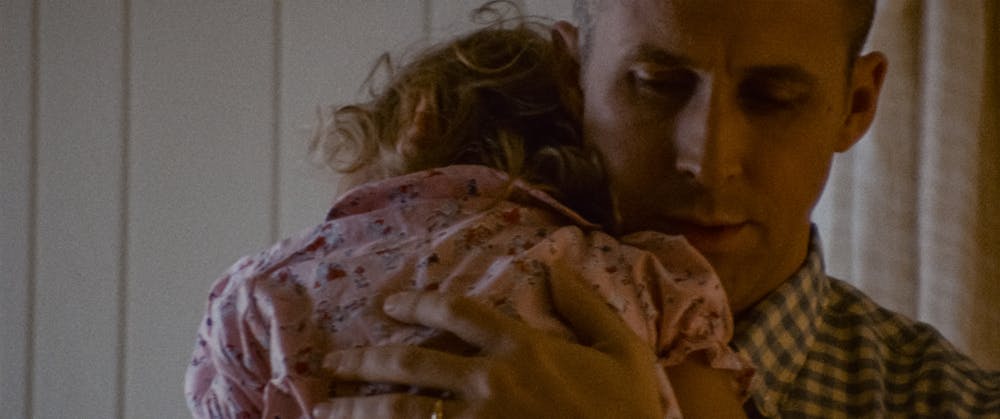
In a quiet opening scene, Armstrong sings a lullaby, I See the Moon, to his infant daughter, echoing the transcendental fascination with the Moon held by generations of sleepless parents and children over the course of our evolution.

Ryan Gosling as Neil Armstrong the father.
Ryan Gosling as Neil Armstrong the father. (Daniel McFadden)
Armstrong is haunted by the Moon and death throughout the film. His lunar quest is tied indelibly to his relationship with his daughter.

Shot often from Armstrong’s perspective, this film is an exploration of apparent emptiness – of space, the Moon, and a man in grief, accustomed to loss and most comfortable when cut off from those closest to him.

The Moon landing is the backdrop, the ultimate distraction from his world of pain, and Gosling plays it beautifully.

We’ve been there before, in film 
For almost as long as there have been moving pictures, we have had movies imagining space flight. In 1902 Georges Méliès directed and starred in what is considered the first science fiction film, the influential A Trip to the Moon (Le Voyage Dans La Lune).

Space films developed a few recurring themes since then. There’s the heroic manly astronaut addicted to risking life and limb. With the notable exception of Hidden Figures, women tend to be shown marooned at home, anguished and accommodating of their physically and emotionally distant husbands. Then there’s the passionate flight director, swearing to all who will listen that he’ll get the astronauts home safe.

It’s a real triumph that First Man (mostly) avoids these cliches and genuinely gives us something new, and somehow more real.

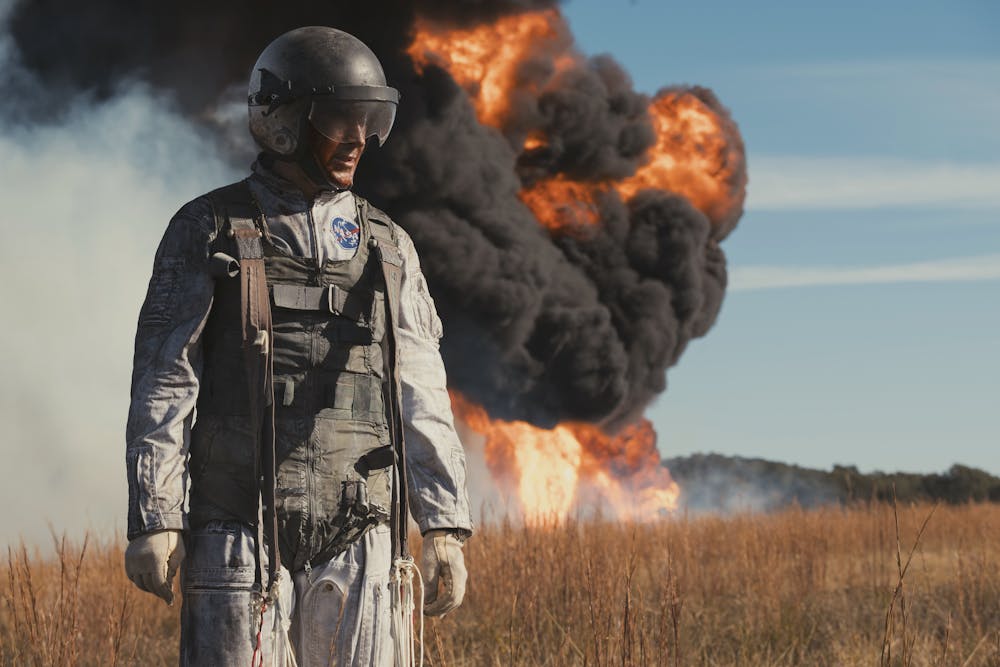
The dangers of space were not exaggerated, and started with the terrestrial training. Neil Armstrong (Ryan Gosling) ejected seconds before the Lunar Landing Research Vehicle crashed and burned at Ellington Air Force Base.
The dangers of space were not exaggerated, and started with the terrestrial training. Neil Armstrong (Ryan Gosling) ejected seconds before the Lunar Landing Research Vehicle crashed and burned at Ellington Air Force Base.(Daniel McFadden)
There are a respectful number of references to other movies such as The Right Stuff, Apollo 13, and 2001 A Space Odyssey that embed First Man within the well-established tradition of cinematic space flight.

These references highlight this film’s differences, drawn from the well-grounded depictions of Armstrong and his wife Janet, played by Claire Foy. The sequences between husband and wife are emotionally charged, rather than sentimentalised. The scenes where she listens to the radio feed from the landing are riveting. It is hard to imagine more Oscar-worthy contenders.

An emotional time on Earth for Janet Armstrong (Claire Foy)
An emotional time on Earth for Janet Armstrong (Claire Foy). (Daniel McFadden)
Flagging outrage 
The film does not sanitise the space program. Embracing the politics of the day, Chazelle recreates the protests around the Apollo missions.

Many people are shown questioning its value. Journalists demand to know how much it is worth, in lives lost and in dollars.

But First Man refocuses the emphasis of the Apollo 11 mission from US nationalism to Armstrong’s personal journey, and this doesn’t sit well with the current far right in Trump’s America.

Republican Senator Marco Rubio is angry that the planting of the US flag – an action symbolising the colonisation of territory – is not shown (although the flag appears more than once).


Some are calling for a boycott over the flag issue. Armstrong’s colleague on the Apollo 11 mission, astronaut Buzz Aldrin, has also implied his dissatisfaction with the film in a tweet.


Chazelle, the Oscar-winning director of La La Land, said the omission was not political; instead he chose to focus on the “unfamous stuff” as well as Armstrong’s experience and character.

The flag was controversial even at the peak of the Cold War. The United Nations Outer Space Treaty, ratified by the US just two years before, forbids territorial claims in space. How could an American mission claim to represent humanity if it included a symbolic act of American colonialism?

Fortunately, the response of the international community was to celebrate the collective human achievement rather than the national one.

More than a national effort: (left to right) Buzz Aldrin (Corey Stoll), Mike Collins (Lukas Haas) and Neil Armstrong (Ryan Gosling) head for the Moon.
More than a national effort: (left to right) Buzz Aldrin (Corey Stoll), Mike Collins (Lukas Haas) and Neil Armstrong (Ryan Gosling) head for the Moon. (Daniel McFadden)
There were numerous international contributions made to the Apollo missions. Australia provided tracking stations – famously, Armstrong’s first footfalls on the Moon were transmitted through the Honeysuckle Creek station, outside Canberra.

Australian space scientist Professor Brian O'Brien, then at Rice University in Texas, designed a dust-detecting experiment that was left on the surface of the Moon.

When the Moon is not enough 
There is an element of anti-climax about the film’s conclusion. As with Apollo 13, we know how it’s going to end.

But First Man does so on a carefully crafted note, a plausible hypothesis suggested by biographer Hansen that may have been designed to further humanise the inscrutable astronaut. The scene implies that the emotional distances he has to travel on Earth are greater than those which he crossed to the Moon.

Where we go from here is the question. Do we show the moral courage to take on the difficult tasks and solve the earthbound crises facing us today, or do we channel our energies and enterprise into becoming a multi-planet species?

Now that we have “conquered” the Moon, perhaps the only mission worthy of Armstrong’s legacy is to be humble, thoughtful and inspired about our place in the universe, while we still have one.

About Today's Contributors:
Alice Gorman, Senior Lecturer in Archaeology and Space Studies, Flinders University and Heather L. Robinson, Research Associate & PhD Candidate, College of Humanities, Arts & Social Sciences, Flinders University

This article is republished from The Conversation under a Creative Commons license. 

You Might Also Like