20 December 2018

In 1968, Apollo 8 Realised The 2,000-Year-Old Dream Of A Roman Philosopher

by
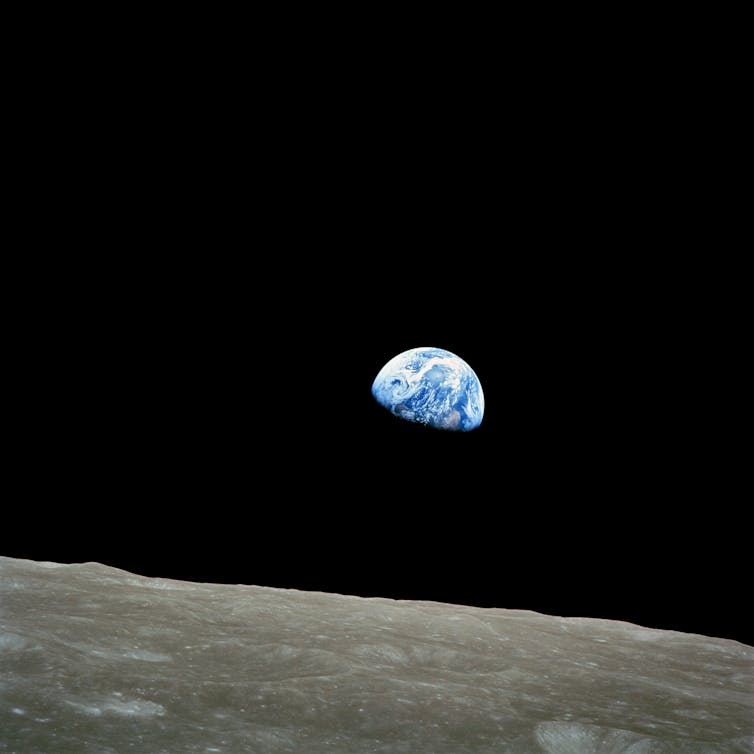
Earth seen from the Moon
Earth seen from the Moon (NASA)
Half a century of Christmases ago, the NASA space mission Apollo 8 became the first manned craft to leave low Earth orbit, atop the unprecedentedly powerful Saturn V rocket, and head out to circumnavigate another celestial body, making 11 orbits of the moon before its return. The mission is often cast in a supporting role – a sort of warm up for the first moon landing. Yet for me, the voyage of Borman, Lovell and Anders six months before Neil Armstrong’s “small step for a man” will always be the great leap for humankind.

Apollo 8 is the space mission for the humanities, if ever there was one: this was the moment that humanity realised a dream conceived in our cultural imagination over two millennia ago. And like that first imagined journey into space, Apollo 8 also changed our moral perspective on the world forever.

In the first century BC, Roman statesman and philosopher Marcus Tullius Cicero penned a fictional dream attributed to the Roman general Scipio Aemilianus. The soldier is taken up into the sphere of distant stars to gaze back towards the Earth from the furthest reaches of the cosmos:
And as I surveyed them from this point, all the other heavenly bodies appeared to be glorious and wonderful — now the stars were such as we have never seen from this earth; and such was the magnitude of them all as we have never dreamed; and the least of them all was that planet, which farthest from the heavenly sphere and nearest to our earth, was shining with borrowed light, but the spheres of the stars easily surpassed the earth in magnitude — already the earth itself appeared to me so small, that it grieved me to think of our empire, with which we cover but a point, as it were, of its surface.

Earth-centric

Even for those of us who are familiar with the ancient and medieval Earth-centred cosmology, with its concentric celestial spheres of sun, moon, planets and finally the stars wheeling around us in splendid eternal rotation, this comes as a shock. For the diagrams that illustrate pre-modern accounts of cosmology invariably show the Earth occupying a fair fraction of the entire universe.
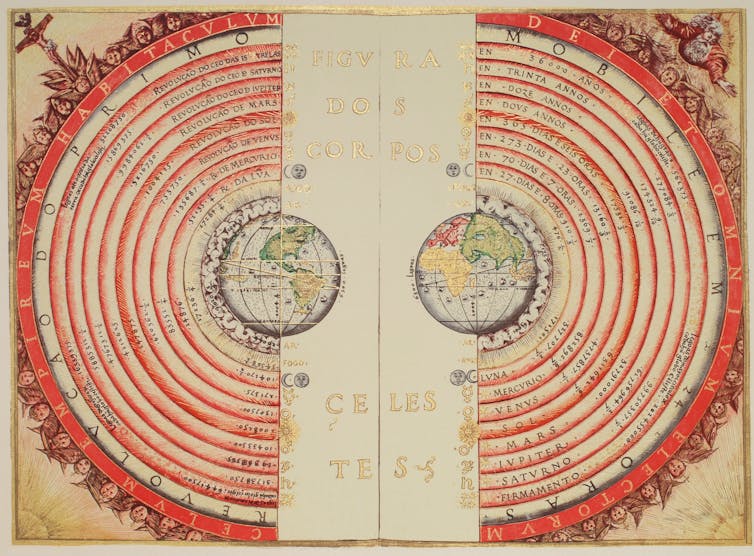
The geocentric model. Bartolomeu Velho, 1568 (Bibliothèque Nationale, Paris)
The geocentric model. Bartolomeu Velho, 1568 (Bibliothèque Nationale, Paris). Wikimedia Commons
Cicero’s text informs us right away that these illustrations are merely schematic, bearing as much relation to the actual imagined scale of the universe as today’s London Tube map does to the real geography of its tunnels. And his Dream of Scipio was by no means an arcane musing lost to history – becoming a major part of the canon for succeeding centuries. The fourth century Roman provincial scholar Macrobius built one of the great and compendious “commentaries” of late antiquity around it, ensuring its place in learning throughout the first millennium AD.

Cicero, and Macrobius after him, make two intrinsically-linked deductions. Today we would say that the first belongs to science, the second to the humanities, but, for ancient writers, knowledge was not so artificially fragmented. In Cicero’s text, Scipio first observes that the Earth recedes from this distance to a small sphere hardly distinguishable from a point. Second, he reflects that what we please to call great power is, on the scale of the cosmos, insignificant. Scipio’s companion remarks:
I see, that you are even now regarding the abode and habitation of mankind. And if this appears to you as insignificant as it really is, you will always look up to these celestial things and you won’t worry about those of men. For what renown among men, or what glory worth the seeking, can you acquire?
The vision of the Earth, hanging small and lowly in the vastness of space, generated an inversion of values for Cicero; a human humility. This also occurred in the case of the three astronauts of Apollo 8.

A change in perspective

There is a vast difference between lunar and Earth orbit – the destination of all earlier space missions. “Space” is not far away. The international space station orbits, as most manned missions, a mere 250 miles above our heads. We could drive that distance in half a day. The Earth fills half the sky from there, as it does for us on the ground.
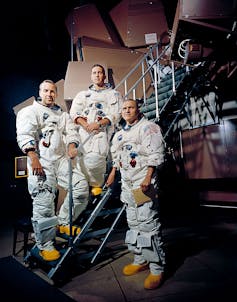
Apollo 8 crew-members: James Lovell Jr., William Anders, Frank Borman
Apollo 8 crew-members: James Lovell Jr., William Anders, Frank Borman (L-R). NASA
But the moon is 250,000 miles distant. And so Apollo 8, in one firing of the S4B third stage engine to leave Earth orbit, increased the distance from Earth attained by a human being by not one order of magnitude, but three. From the moon, the Earth is a small glistening coin of blue, white and brown in the distant black sky.

So it was that, as their spacecraft emerged from the far side of its satellite, and they saw the Earth slowly rise over the bleak and barren horizon, the crew grabbed all cameras to hand and shot the now iconic “Earthrise” pictures that are arguably the great cultural legacy of the Apollo program. Intoning the first verses from the Book of Genesis as their Christmas message to Earth – “… and the Earth was without form, and void, and darkness was upon the face of the deep…” – was their way of sharing the new questions that this perspective urges. As Lovell put it in an interview this year:
But suddenly, when you get out there and see the Earth as it really is, and when you realise that the Earth is only one of nine planets and it’s a mere speck in the Milky Way galaxy, and it’s lost to oblivion in the universe — I mean, we’re a nothing as far as the universe goes, or even our galaxy. So, you have to say, ‘Gee, how did I get here? Why am I here?’
The 20th century realisation of Scipio’s first century BC vision also energised the early stirrings of the environmental movement. When we have seen the fragility and unique compactness of our home in the universe, we know that we have one duty of care, and just one chance.

Space is the destiny of our imagination, and always has been, but Earth is our precious dwelling place. Cicero’s Dream, as well as its realisation in 1968, remind the world, fresh from the Poland climate talks, that what we do with our dreams today will affect generations to come.The Conversation

About Today's Contributor:

Tom McLeish, Professor of Natural Philosophy in the Department of Physics, University of York
This article is republished from The Conversation under a Creative Commons license. 

Space And NASA Related Stories:


Air Pollution May Be Making Us Less Intelligent

by
Long-term exposure to air pollution was linked to cognitive decline in elderly people.
Long-term exposure to air pollution was linked to cognitive decline in elderly people. (Tao55/ Shutterstock)
Not only is air pollution bad for our lungs and heart, it turns out it could actually be making us less intelligent, too. A recent study found that in elderly people living in China, long-term exposure to air pollution may hinder cognitive performance (things like our ability to pay attention, to recall past knowledge and generate new information) in verbal and maths tests. As people age, the link between air pollution and their mental decline becomes stronger. The study also found men and less educated people were especially at risk, though the reason why is currently unknown.

We already have compelling evidence that air pollution – especially the tiniest, invisible particulates in pollution – damages the brain in both humans and animals. Traffic pollution is associated with dementia, delinquent behaviour in adolescents, and stunted brain development in children who attend highly polluted schools.

Read more: London air pollution is restricting children's lung development – new research
In animals, mice exposed to urban air pollution for four months showed reduced brain function and inflammatory responses in major brain regions. This meant the brain tissues changed in response to the harmful stimuli produced by the pollution.

We don’t yet know which aspects of the air pollution particulate “cocktail” (such as the size, number or composition of particles) contribute most to reported brain deterioration. However, there’s evidence that nanoscale pollution particles might be one cause.

These particles are around 2,000 times smaller than the diameter of a human hair, and can be moved around the body via the bloodstream after being inhaled. They may even reach the brain directly through the olfactory nerves that give the brain information about smell. This would let the particles bypass the blood-brain barrier, which normally protects the brain from harmful things circulating in the bloodstream.

Postmortem brain samples from people exposed to high levels of air pollution while living in Mexico City and Manchester, UK, displayed the typical signs of Alzheimer’s disease. These included clumps of abnormal protein fragments (plaques) between nerve cells, inflammation, and an abundance of metal-rich nanoparticles (including iron, copper, nickel, platinum, and cobalt) in the brain.


Automobiles are a major cause of the world’s air pollution.
Automobiles are a major cause of the world’s air pollution. (Tao55/ Shutterstock)
The metal-rich nanoparticles found in these brain samples are similar to those found everywhere in urban air pollution, which form from burning oil and other fuel, and wear in engines and brakes. These toxic nanoparticles are often associated with other hazardous compounds, including polyaromatic hydrocarbons that occur naturally in fossil fuels, and can cause kidney and liver damage, and cancer.

Repeatedly inhaling nanoparticles found in air pollution may have a number of negative effects on the brain, including chronic inflammation of the brain’s nerve cells. When we inhale air pollution, it may activate the brain’s immune cells, the microglia. Breathing air pollution may constantly activate the killing response in immune cells, which can allow dangerous molecules, known as reactive oxygen species, to form more often. High levels of these molecules could cause cell damage and cell death.

The presence of iron found in air pollution may speed up this process. Iron-rich (magnetite) nanoparticles are directly associated with plaques in the brain. Magnetite nanoparticles can also increase the toxicity of the abnormal proteins found at the centre of the plaques. Postmortem analysis of brains from Alzheimer’s and Parkinson’s disease patients shows that microglial activation is common in these neurodegenerative diseases.

Read more: Your exposure to air pollution could be much higher than your neighbour's – here's why
The latest study of the link between air pollution and declining intelligence, alongside the evidence we already have for the link between air pollution and dementia, makes the case for cutting down air pollution even more compelling. A combination of changes to vehicle technology, regulation and policy could provide a practical way to reduce the health burden of air pollution globally.

However, there are some things we can do to protect ourselves. Driving less and walking or cycling more can reduce pollution. If you have to use a car, driving smoothly without fierce acceleration or braking, and avoiding travel during rush hours, can reduce emissions. Keeping windows closed and recirculating air in the car might help to reduce pollution exposure during traffic jams as well.


Reducing vehicle use by walking or cycling instead could have a major impact on air pollution levels.
Reducing vehicle use by walking or cycling instead could have a major impact on air pollution levels. (Nick Starichenko/ Shutterstock)
But young children are among the most vulnerable because their brains are still developing. Many schools are located close to major roads, so substantially reducing air pollution is necessary. Planting specific tree species that are good at capturing particulates along roads or around schools could help.

Indoor pollution can also cause health problems, so ventilation is needed while cooking. Open fires (both indoors and outdoors) are a significant source of particulate pollution, with woodburning stoves producing a large percentage of outdoor air pollution in the winter. Using dry, well-seasoned wood, and an efficient ecodesign-rated stove is essential if you don’t want to pollute the atmosphere around your home. If you live in a naturally-ventilated house next to a busy road, using living spaces at the back of the house or upstairs will reduce your pollution exposure daily.

Finally, what’s good for your heart is good for your brain. Keeping your brain active and stimulated, eating a good diet rich in antioxidants, and keeping fit and active can all build up resilience. But as we don’t yet know exactly the mechanisms by which pollution causes damage to our brains – and how, if possible, their effects might be reversed – the best way we can protect ourselves is to reduce or avoid pollution exposure as much as possible.

About Today's Contributor:

Barbara Maher, Professor, Environmental science, Lancaster University
This article is republished from The Conversation under a Creative Commons license.

19 December 2018

PicsArt Unveils Most Uploaded, Edited & Socially Shared Celebrities of 2018 [Infographic]

by
"Year in Review"
"Year in Review"
PicsArt, the world's largest creative platform with more than 100 million monthly active users and influencers, today announced the release of its inaugural "Year in Review" infographic featuring the most uploaded, edited, and socially shared celebrities trending on social media in 2018!
With more than half a billion images, stickers, and user-generated content uploaded and shared to its platform every month, PicsArt looked at the top 10 most-uploaded and edited celebrities trending in 2018 for the following categories: Actors and Actresses, Music Artists, Models, and Celebrity Tributes (in honor of those who have passed). 
The top 10 lists were developed based off insights from PicsArt's user upload and edit trend data between January 1, 2018-December 1, 2018. 

A few highlights include: 

  • A Star Was Born Indeed - No surprise here! Lady Gaga made the top five in the Actors category for her buzzworthy performance in A Star is Born. She joins the list with veterans Angelina Joliecoming in at #8, and Scarlett Johansson rounding off the list at #10.
  • Grande's Got Game - As the hardest working woman in pop, it's no surprise that tiny and mighty Ariana Grande wins the #1 top music artist spot. Grande supersedes pop artist sensations Shawn Mendes and Taylor Swift which captured the #2 and #3 spots respectively.
  • Kardashian vs Jenner - Kim Kardashian may be the Queen of likes on Instagram, but sister Kendall Jenner is ranked #1 for being the most edited and socially shared model on social media this year.
  • From Comic Superhero to The King of Pop - Stan Lee and Michael Jackson may be gone, but their stream of fan tributes are alive and strong on social media this year.
See PicsArt 2018 Year in Review Recap here.

The Infographic:

PicsArt 2018 Year in Review - Infographic
"PicsArt has thousands of fandoms and interest groups spotlighting everything from celebrities and models to bands and brands, comic book heroes, and more," said Hovhannes Avoyan, founder and CEO of PicsArt. "Pulling our top trending celebrities by year end is a fun way to see which celebrities had stronger fandoms and creative enthusiasts. It'll be exciting to see what 2019 has in store and who will prevail!"
 SOURCE: PicsArt

18 December 2018

Screen Legend Shirley MacLaine to Receive Career Achievement Honor at AARP The Magazine's Annual Movies for Grownups Awards

by
Shirley MacLaine
Shirley MacLaine (Image via Variety)
Shirley MacLaine will receive AARP The Magazine's 2018 Movies for Grownups Career Achievement Awardthe publication announced today. MacLaine will be honored at the 18th annual Movies for Grownups Awards ceremony on Feb. 4, 2019 in Beverly Hills, California.
The AARP Movies for Grownups multimedia franchise was established in 2002 to celebrate and encourage filmmaking with unique appeal to movie lovers with a grownup state of mind — and recognize the inspiring artists who make them.
MacLaine's remarkable career comprises more than 50 feature films highlighted by an Academy Award win and six nominations, seven Golden Globe Awards — including the Cecil B. DeMille Award for Lifetime Achievement — and six Emmy Award nominations. She is also an international bestselling author with 15 titles to her name.
"The award means a lot to me personally because AARP was there when I began," said Shirley MacLaine. "Many thanks to AARP for bestowing this award."
MacLaine will receive Movies for Grownups' highest honor at the awards ceremony, hosted by AARP The Magazine, where 2018's best films and filmmakers, including Best Actor, Best Actress, Best Director, and more, will also receive honors.
MacLaine joins a prestigious list of previous AARP Movies for Grownups Career Achievement honorees, including Helen MirrenMorgan FreemanMichael DouglasKevin CostnerSusan SarandonSharon StoneRobert Redford and Robert De Niro.
"We are delighted to give this award to Shirley MacLaine, a remarkable performer and a true original, who has charmed and entertained us decade after decade," said Myrna Blyth, Senior Vice President and Editorial Director for AARP Media.
  • The Movies for Grownups Awards will be broadcast for the second consecutive year on PBS. Co-produced by the Great Performances series, the Awards premiere Friday, February 15 at 9 p.m. on PBS, (check local listings), and will stream the following day on pbs.org/gperf and PBS apps. 
"Great Performances has long celebrated the talents of artists from numerous disciplines," said Great Performances Executive Producer David Horn. "By showcasing the talents of the accomplished professionals both on screen and behind the scenes in the year's great movies, Great Performances and The Movies for Grownups Awards can shine a spotlight on important art and artists for public media audiences."
Shirley MacLaine
Shirley MacLaine (image via AARP)

About Shirley MacLaine:

She made her professional debut dancing in a Broadway revival of Oklahomain the 1950s. Alfred Hitchcock's The Trouble with Harry, marked her film debut, earning her a Golden Globe Award for "New Star of the Year – Actress" in 1955. 

MacLaine then starred in Some Came Running (1958), which led to her first Academy award nomination and an additional Golden Globe nomination. 

Her career continued to flourish with Oscar nominations for her work in The Children's Hour, The Apartment and Irma La Douce.  

Shirley MacLaine with Jack Lemmon in 1960's 'The Apartment'
In 1975, MacLaine received her fourth Oscar nomination, this time for Best Documentary as a producer and star of The Other Half of the Sky: A China Memoir.  Two years later, she was nominated for her starring role in The Turning Point.  

In 1983, MacLaine won an Academy Award for her landmark performance in Terms of Endearment.  She continued to receive recognition for her work and won a Golden Globe Award for her performance in Madame Sousatzka.  

MacLaine was honored with the Cecil B. DeMille Golden Globe Award for Lifetime Achievement in 1998. 
MacLaine's additional credits include notable films such as Steel Magnolias, Postcards from the Edge, In Her Shoes, and Rumor Has It…. Television credits include the telefilms These Old Broads, Carolina and Salem Witch Trials. She also starred in the CBS miniseries The Battle of Mary Kay and in PBS' Downton Abbey.
MacLaine also is an author of ten international bestsellers, including Sage-ing While Age-ing and the New York Times bestseller, I'm Over All That: And Other Confessions.  Her most recent book What If... A Lifetime of Questions, Speculations, Reasonable Guesses, and a Few Things I Know for Sure, was featured on Oprah's "Super Soul Sunday."  
Movies For Grownups Awards - Banner

About AARP The Magazine's Movies For Grownups Awards' Philanthropic Goals:

The annual Movies for Grownups Awards raises funds for AARP Foundation, AARP's affiliated charity, which helps struggling people 50-plus around the country transform their lives through programs, services and vigorous legal advocacy. The Foundation works to increase economic opportunity and social connections to prevent and reduce senior poverty.

About AARP:

AARP is the nation's largest nonprofit, nonpartisan organization dedicated to empowering people 50 and older to choose how they live as they age. With a nationwide presence and nearly 38 million members, AARP strengthens communities and advocates for what matters most to families: health security, financial stability and personal fulfillment. AARP also produces the nation's largest circulation publications: AARP The Magazine and AARP Bulletin. 
SOURCE: AARP

AARP Related Stories:

17 December 2018

Exorcisms Have Been Part Of Christianity For Centuries

by
A painting showing Saint Francis Borgia, a 16th century saint, performing an exorcism.
A painting showing Saint Francis Borgia, a 16th century saint, performing an exorcism. (Francisco Goya)
The Exorcist,” a horror film released 45 years ago, is a terrifying depiction of supernatural evil. The film tells the story of a young American girl who is possessed by a demon and eventually exorcised by a Catholic priest.

Many viewers were drawn in by the film’s portrayal of exorcism in Christianity. As a scholar of Christian theology, my own research into the history of Christian exorcisms reveals how the notion of engaging in battle against demons has been an important way that Christians have understood their faith and the world.

Early and medieval Christianity

The Bible’s account of the life of Jesus features several exorcism stories. The Gospels, reflecting views common in Judaism in the first century A.D., portray demons as spirits opposed to God that haunt, possess or tempt people to evil.

Exorcism by St. Exupere, Bishop of Toulouse, France, at the beginning of fifth century.
Exorcism by St. Exupere, Bishop of Toulouse, France, at the beginning of fifth century. (Philippe Alès, CC BY-SA)
Possessed individuals are depicted as displaying bizarre and erratic behaviors. In the Gospel of Luke, for example, a boy is possessed by a demon that makes him foam at the mouth and experience violent spasms. Jesus is shown to have a unique power to cast out demons and promises that his followers can do the same.

In the centuries that followed, accounts of using Jesus’ name for casting out demons are common. Origen, an early Christian theologian, writing in the second century, explains how the name of Jesus is used by Christians to expel “evil spirits from … souls and bodies.”

Over the years exorcism came to be associated more widely with the Christian faith. Several Christian writers mention exorcisms taking place publicly as a way to convince people to become Christians. They argued that people should convert because the exorcisms Christians performed were more effective than those of “pagans.”

Early Christian texts mention various exorcism methods that Christians used, including making the sign of the cross over possessed persons or even breathing on them.

Minor exorcism

Beginning some time in the early Middle Ages, specific priests were uniquely trained and sanctioned for exorcism. This remains the case today in Roman Catholicism, while Eastern Orthodox traditions allow all priests to perform exorcisms.

Early Christians also practiced what is sometimes called a “minor exorcism.” This type of exorcism is not for those considered to be acutely possessed.

This took place before or during the ritual of baptism, a ceremony whereby someone officially joins the Church. The practice emerges from the assumption that all people are generally susceptible to evil spiritual forces. For this reason some sort of prayer or statement against the power of the devil would often be recited during catechesis, a period of preparation prior to baptism, baptism, or both.

Demons and Protestants

Between the 15th to 17th centuries, there was an increased concern about demons in Western Europe. Not only are there abundant accounts of priests exorcising individuals from this time period, but also of animals, inanimate objects and even land.

A woodcut from 1598 shows an exorcism performed on a woman by a priest and his assistant, with a demon emerging from her mouth.
A woodcut from 1598 shows an exorcism performed on a woman by a priest and his assistant, with a demon emerging from her mouth. (Pierre Boaistuau, et al., Histoires prodigieuses et memorables, extraictes de plusieurs fameux autheurs, Grecs, & Latins, sacrez & prophanes (Paris, 1598), vol. 1.)
The narratives are also much more detailed. When someone possessed by a demon was confronted by an exorcist priest, it was believed that the demon would be aggravated and cause the individual to engage in more intense and violent behavior. There are reports of physical altercations, floating around the room, and speaking or screaming loudly and angrily during the exorcism process.

Protestants, who were skeptical of many Catholic rituals, combated demonic possession with more informal practices such as impromptu prayer for the afflicted individual.

During the Enlightenment, between 17th to 19th centuries, Europeans began to cast doubt on so-called “superstitious” elements of religion. Many intellectuals and even church leaders argued that people’s experiences of demons could be explained away by psychology and other sciences. Exorcism began to be viewed by many as unnecessary or even dangerous.

Exorcism today

Many Christian denominations still practice some form of minor exorcism. Before people are baptized in the Episcopal Church, for example, they are asked: “Do you renounce Satan and all the spiritual forces of wickedness that rebel against God?

Exorcism is practiced by Christians across the world
Exorcism is practiced by Christians across the world (Lutsenko_Oleksandr/Shutterstock.com)
The Catholic Church still has an active ministry devoted to performing exorcisms of possessed individuals. The current practice includes safeguards that require, among others, persons suspected of being possessed to undergo medical and psychiatric evaluation before an exorcism takes place.

Exorcism is particularly common in Pentecostalism, a form of Christianity that has grown rapidly in recent decades. This branch of Christianity emphasizes spiritual experience in everyday life. Pentecostals practice something akin to exorcism but which is typically called “deliverance.” Pentecostals maintain that possessed persons can be delivered through prayer by other Christians or recognized spiritual leader. Pentecostalism is an international Christian tradition and specific deliverance practices can vary widely around the world.

In the United States belief in demons remains high. Over half of all Americans believe that demons can possess individuals.

So, despite modern-day skepticism, exorcism remains a common practice of Christians around the world.The Conversation


About Today's Contributor:

S. Kyle Johnson, Doctoral Student in Systematic Theology, Boston College


This article is republished from The Conversation under a Creative Commons license. 

You Might Also Like