1 March 2019

UNICEF: 'Alarming Global Surge Of Measles Cases A Growing Threat To Children '

by
On 9 February 2019 in Yemen, children vaccinated in Aden during a mobile Measles and Rubella vaccination campaign
On 9 February 2019 in Yemen, children vaccinated in Aden during a mobile Measles and Rubella vaccination campaign. © UNICEF/UN0284426/Fadhel (CNW Group/UNICEF Canada)
UNICEF warned today that global cases of measles are surging to alarmingly high levels, led by ten countries accounting for more than 74 per cent of the total increase, and several others that had previously been declared measles free.

Countries with ten highest increases in cases between 2017 & 2018

  1. Ukraine: 30,338
  2. Philippines: 13,192
  3. Brazil: 10,262
  4. Yemen: 6,641
  5. Venezuela: 4,916
  6. Serbia: 4,355
  7. Madagascar: 4,307
  8. Sudan: 3,496
  9. Thailand: 2,758
  10. France: 2,269  
Globally, 98 countries reported more cases of measles in 2018 compared to 2017, eroding progress against this highly preventable, but potentially deadly disease.
"Vaccines work. They save millions of lives a year and are an important reason why more children today survive," said David Morley, President and CEO of UNICEF Canada.
Ukraine, the Philippines and Brazil saw the largest increases in measles cases from 2017 to 2018. In Ukraine alone, there were 35,120 cases of measles in 2018. According to the government, another 24,042 people were infected just in the first two months of 2019. In the Philippines so far this year, there have been 12,736 measles cases and 203 deaths, compared to 15,599 cases in the whole of 2018.
"This is a wake-up call. We have a safe, effective and inexpensive vaccine against a highly contagious disease – a vaccine that has saved almost a million lives every year over the last two decades," said Henrietta H. Fore, UNICEF's Executive Director. "These cases haven't happened overnight. Just as the serious outbreaks we are seeing today took hold in 2018, lack of action today will have disastrous consequences for children tomorrow."
Measles is highly contagious, more so than Ebola, tuberculosis or influenza. The virus can be contracted by someone up to two hours after an infected person has left a room. It spreads through air and infects the respiratory tract, potentially killing malnourished children or babies too young to be vaccinated. Once infected, there is no specific treatment for measles, so vaccination is a life-saving tool for children.
In response to a recent outbreak of measles in British Columbia, Morley added: "Canada must invest in comprehensive monitoring and reporting to close the data gap in vaccination rates and identify populations at risk during outbreaks. We applaud the commitment in mid-February by Canada's Chief Public Health Officer, Dr. Theresa Tam, to tackle misinformation around vaccinations."

UNICEFs global response

In response to these outbreaks, UNICEF and its partners are supporting governments to urgently reach millions of children in countries around the globe. For example:
  • In Ukraine, UNICEF has provided ongoing support to accelerate routine immunization across the country and address vaccine hesitancy, including additional efforts to stop the most recent outbreak that has claimed 30 lives since 2017. In February, the Ministry of Health, with UNICEF's support, launched an immunization drive at schools and clinics in the worst-hit Lviv region in western Ukraine, where negative attitudes toward immunization, and previous shortages in vaccine supply, have resulted in low vaccination rates.
  • In the Philippines, the government, with support from UNICEF and partners, will conduct a campaign to vaccinate 9 million children against measles across 17 regions. Using social media, campaigners plan to encourage apprehensive parents, and health workers.
  • In Brazil, from August to September 2018, the government carried out a campaign against polio and measles, targeting more than 11 million children under five. UNICEF encouraged people to get vaccinated, and trained health monitors working in migrant shelters for Venezuelans. UNICEF has included the measles vaccine as part of the Municipal Seal programme that covers 1,924 municipalities.
  • In Yemen, where years of conflict led to an outbreak, local authorities with support from UNICEF, WHO and GAVI vaccinated more than 11.5 million children in February.
  • In Madagascar, from 3 September to 21 February, 76,871 people were infected by measles and 928 died, a majority of which were children. In January, the government, with support of partners including UNICEF, launched an immunization campaign to target all 114 districts. Over 2 million children were immunized in 25 districts. In February, 1.4 million children were vaccinated, with another 3.9 million more to follow in March.
"As one of the largest donors of vaccines in the world, Canada has long shown its leadership for immunizing children, which plays a key role in preventing life-threatening illnesses such as polio, pneumonia, tetanus and diarrheal disease," added Morley.

Notable reported measles cases in 2018 in countries with no reported cases in 2017

  • Brazil: 10,262
  • Moldova: 312
  • Montenegro: 203
  • Colombia: 188
  • Timor-Leste: 59
  • Peru: 38
  • Chile: 23
  • Uzbekistan: 17
Poor health infrastructure, civil strife, low community awareness, complacency and vaccine hesitancy in some cases have led to these outbreaks in both developed and developing countries. For example, in the United States, the number of measles cases increased six-fold between 2017 and 2018, reaching 791 cases. More recently, the U.S. has seen outbreaks in New York and Washington state.
"Almost all of these cases are preventable, and yet children are getting infected even in places where there is simply no excuse," said Fore. "Measles may be the disease, but, all too often, the real infection is misinformation, mistrust and complacency. We must do more to accurately inform every parent, to help us safely vaccinate every child."

To fight measles, UNICEF is issuing an urgent appeal to governments, health care providers, and parents to do more to contain the disease by:

  • Understanding that vaccines are safe and effective and can save a child's life
  • Vaccinating all children between the ages of six months to five years during outbreaks
  • Training and equipping health workers so they can provide quality services
  • Strengthening immunization programmes to deliver all life-saving vaccines

About the Measles and Rubella Initiative:

UNICEF is part of the Measles and Rubella Initiative, a private-public partnership of five global partners including WHO, CDC, United Nations Foundation and American Red Cross that has been spearheading a global push towards measles and rubella elimination.

SOURCE: UNICEF Canada

Related Video:


28 February 2019

'The Wandering Earth:' Learns And Differs From Hollywood

by
'The Wandering Earth'
'The Wandering Earth' - Poster

The following is a news report by China Mosaic on The Wandering Earth:

"The Wandering Earth" achieved huge box office success during the Lunar New Year period. As China's first homemade sci-fi blockbuster, the film has sparked extensive discussions. The New York Times reported that "it will represent the dawning of a new era in Chinese film making." Director James Cameron also wrote on Sina Weibo that he wished good luck to "The Wandering Earth" and the voyage of Chinese sci-fi films.

The commercial film with high-quality special effects was adapted from the novel of Asia's first Hugo Award Winner Liu Cixin, which boasts a boldly imaginative plot of "building giant planet thrusters to move Earth out of its orbit and to sail it to a new star system."

Frankly speaking, the film has much to learn from the Hollywood industry in terms of framing, scriptwriting, etc. However, it conveys values different from what is typical of Hollywood's films, namely one or a group of superheroes saving the world.

At the end of the film, rescuers from various countries jointly complete the mission to save mankind. What the film aims to reflect is not the heroism of a person, a country, or a nation. Even "collectivism" is not a precise word for its theme since the "community" in the film includes all mankind. In the space station, astronauts use a simultaneous interpretation system to interact fluidly across language boundaries. This frame upholds the vision for a community with a shared future and highlights communication and collaboration as the best ways to address risks.

The film also features Chinese people's attachment to the place where they have lived for a long time and their unwillingness to leave it. Instead of seeking for a new habitat, humans display deep affection for their homeland by "wandering" with Earth to save their civilization.

Liu Cixin said that China now has a strong "sense of future." China's Aperture Spherical radio Telescope (FAST) first discovered a radio millisecond pulsar. The cotton seeds carried by the Chang'e 4 have sprouted on the moon. Such breakthroughs drew worldwide attention. China's rapid modernization in recent decades also allows fertile soil for scientific literature and films to grow. We hope that the soil will yield more amazing fruits of Chinese sci-fi film making.

The China Mosaic News Report - Video:


SOURCE: China.org.cn

Related Videos:


Looks Like China And India Are Leading The Way In Making The Planet Greener

by
Looks Like China And India Are Leading The Way In Making The Planet Greener
China And India Are Leading The Way In Making The Planet Greener 

The following is a news report by China Mosaic  on the "greener" Earth:

NASA happily reported earlier this month that the Earth is greener than it was 20 years ago. Satellite data shows that the Earth's green leaf area has increased by five percent since the early 2000s, an area equivalent to all of the Amazon rainforests. China and India are two leading contributors, jointly responsible for a third of the foliage increase.

This good news surprised many internet users, who had thought that China and India, two populous Asian neighbors, were suffering or would suffer land degradation caused by over-exploitation. Even NASA itself called the finding "counterintuitive." An article published in the journal Nature Sustainability explained that the effect comes mostly from intensive agriculture in both countries and productive tree-planting programs in China.

China launched its National Forestry and Grassland Administration last year, as part of the institutional reform process. Over the past seven decades since the founding of the People's Republic of China, the administration in charge of national forestry affairs has changed its name several times, from the Ministry of Forestry and Land Reclamation to the Ministry of the Forestry Industry, the Ministry of Agriculture and Forestry, and the State Forestry Administration, etc. Its original names suggest that, in the period of socialist construction when China needed to tap its vast resources, the administration mainly undertook the tasks of developing and utilizing forests.

Today, the focus is more on forest protection and restoration, and taking a more scientific, systematic, holistic and forward-looking approach. Relevant efforts have been made on many fronts, including knowledge diffusion, scientific research, planning, industrial support and individual subsidy. As a result, the people who once cut down trees now plant them, and many deserts have been turned into forests. At present, China's total forest coverage has reached 207.69 million hectares, or 21.6 percent of the land area.

A Chinese proverb says, "We shouldn't squander the fortune left by our ancestors or make trouble for future generations." What we are doing today to promote afforestation will benefit the generations to come. In the film "The Wandering Earth," which we discussed in the last episode, humanity has started a journey that will last 2,500 years or 100 generations to save the Earth. The Chinese people really have the resolve to protect their homeland for subsequent generations. Moreover, the Earth is not as damaged as the film depicts, but rather a beautiful planet. To protect it deserves the efforts of everyone.

Words are but wind, but seeing is believing. Data and satellite images may fail to make an intuitive impression. So, we welcome friends from around the world here to feel a "greener" China.

The Video:


SOURCE: China.org.cn

27 February 2019

3 Things Schools Should Teach About America's History Of White Supremacy

by
A Ku Klux Klan parade in Washington, D.C., in 1926
A Ku Klux Klan parade in Washington, D.C., in 1926. (Everett Historical from shutterstock.com)
When it comes to how deeply embedded racism is in American society, blacks and whites have sharply different views.

For instance, 70 percent of whites believe that individual discrimination is a bigger problem than discrimination built into the nation’s laws and institutions. Only 48 percent of blacks believe that is true.

Many blacks and whites also fail to see eye to eye regarding the use of blackface, which dominated the news cycle during the early part of 2019 due to a series of scandals that involve the highest elected leaders in Virginia, where I teach.

The donning of blackface happens throughout the country, particularly on college campuses. Recent polls indicate that 42 percent of white American adults either think blackface is acceptable or are uncertain as to whether it is.

One of the most recent blackface scandals has involved Virginia Gov. Ralph Northam, whose yearbook page from medical school features someone in blackface standing alongside another person dressed in a Ku Klux Klan robe. Northam has denied being either person. The more Northam has tried to defend his past actions, the clearer it has become to me how little he appears to know about fundamental aspects of American history, such as slavery. For instance, Northam referred to Virginia’s earliest slaves as indentured servants. His ignorance has led to greater scrutiny of how he managed to ascend to the highest leadership position in a racially diverse state with such a profound history of racism and white supremacy.

Ignorance is pervasive

The reality is Gov. Northam is not alone. Most Americans are largely uninformed of our nation’s history of white supremacy and racial terror.

As a scholar who researches racial discrimination, I believe much of this ignorance is due to negligence in our education system. For example, a recent study found that only 8 percent of high school seniors knew that slavery was the central cause of the Civil War. There are ample opportunities to include much more about white supremacy, racial discrimination and racial violence into school curricula. Here are three things that I believe should be incorporated into all social studies curricula today:

1. The Civil War was fought over slavery and one of its offshoots – the convict-lease system – did not end until the 1940s

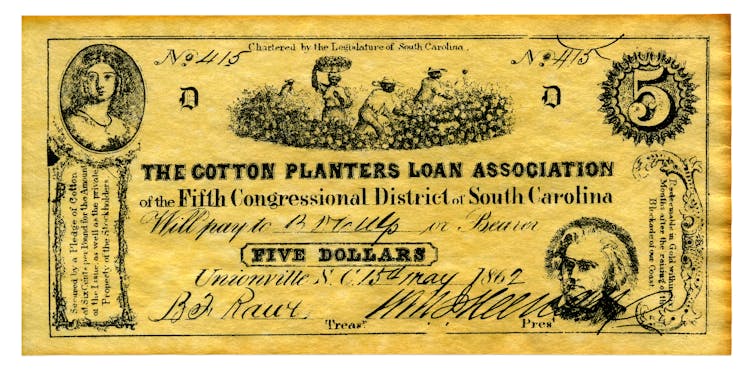
The Civil War was fought over the South’s desire to maintain the institution of slavery in order to continue to profit from it. It is not possible to separate the Confederacy from a pro-slavery agenda and curriculums across the nation must be clear about this fact.
A Confederate treasury note from the Civil War Era shows how reliant the South’s economy was on slave labor.
A Confederate treasury note from the Civil War Era shows how reliant the South’s economy was on slave labor. (Scott Rothstein from shutterstock.com)
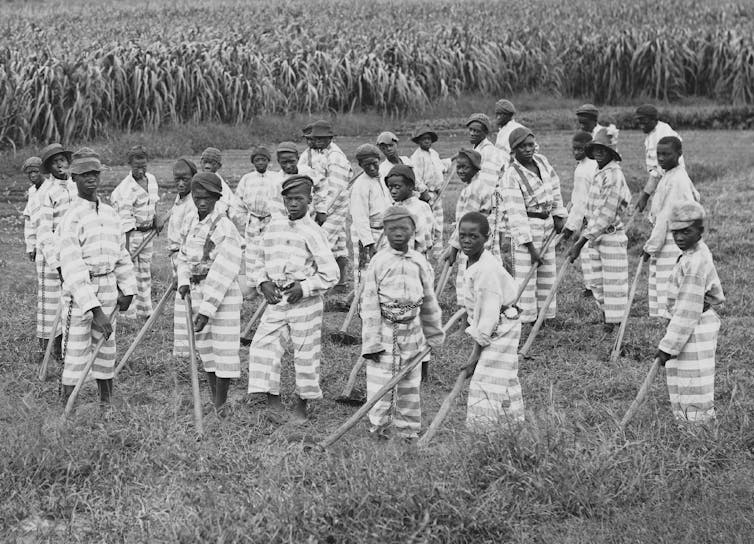
After the end of the Civil War, southern whites sought to keep slavery through other means. Following a brief post-Civil War period known as Reconstruction, white southerners created new laws that gave them legal authority to arrest blacks over the most minor offenses, such as not being able to prove they had a job.

While imprisoned under these laws, blacks were then leased to corporations and farms where they were forced to work without pay under extremely harsh conditions. This “convict leasing” was, as many have argued, slavery by another name and it persisted until the 1940s.
Southern jails made money leasing convicts for forced labor in the Jim Crow South. Circa 1903.
Southern jails made money leasing convicts for forced labor in the Jim Crow South. Circa 1903. (Everett Historical / shutterstock.com)

2. The Jim Crow era was violent

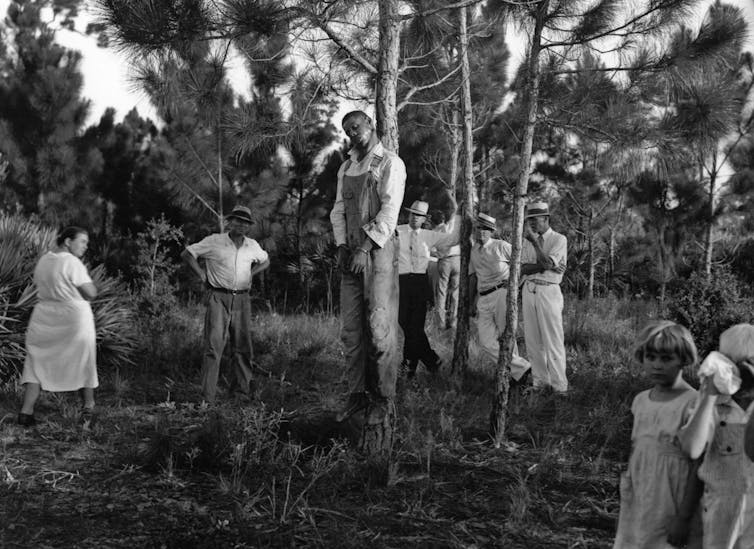
While students may be taught about segregation and laws preventing blacks from voting, they often are not taught about the extreme violence whites enacted upon blacks throughout the Jim Crow era, which took place from 1877 through the 1950s. Mob violence and lynchings were frequent occurrences – and not just in the South – throughout the Jim Crow era.
The body of Rubin Stacy, 32, hangs from a tree in Fort Lauderdale, Florida, as neighbors visit the site July 19, 1935. White lynchings of blacks were common during the era.
The body of Rubin Stacy, 32, hangs from a tree in Fort Lauderdale, Florida, as neighbors visit the site July 19, 1935. White lynchings of blacks were common during the era. (AP)
Racial terror was used as a means for whites to maintain power and prevent blacks from gaining equality. Notably, many whites – not just white supremacist groups like the Klu Klux Klan – engaged in this violence. Moreover, the torture and murder of blacks was not associated with any consequences.

During this same time, white society created negative stereotypes about blacks as a way to dehumanize blacks and justify the violence whites enacted upon them. These negative stereotypes included that blacks were ignorant, lazy, cowardly, criminal and hypersexual.

Blackface minstrelsy refers to whites darkening their skin and dressing in tattered clothing to perform the negative stereotypes as part of entertainment. This imagery and entertainment served to solidify negative stereotypes about blacks in society. Many of these negative stereotypes persist today.

3. Racial inequality was preserved through housing discrimination and segregation

During the early 1900s, a number of policies were put into place in our country’s most important institutions to further segregate and oppress blacks. For example, in the 1930s, the federal government, banks and the real estate industry worked together to prevent blacks from becoming homeowners and to create racially segregated neighborhoods.

This process, known as redlining, served to concentrate whites in middle-class suburbs and blacks in impoverished urban centers. Racial segregation in housing has consequences for everything from education to employment. Moreover, because public school funding relies so heavily on local taxes, housing segregation affects the quality of schools students attend.

All of this means that even after the removal of discriminatory housing policies and school segregation laws in the 1950s and 1960s, the consequences of this intentional segregation in housing persist in the form of highly segregated and unequal schools. All students should learn this history to ensure that they do not wrongly conclude that current racial disparities are based on individual shortcomings – or worse, black inferiority – as opposed to systematic oppression.

Americans live in a starkly unequal society where health and economic outcomes are largely influenced by race. We cannot begin to meaningfully address this inequality as a society if we do not properly understand its origins. The white supremacists responsible for sanitizing our history lessons understood this. Their intent was clearly to keep the country ignorant of its racist past in order to stymie racial equality. To change the tide, we must incorporate a more accurate depiction of our country’s racist history in our K-12 curricula.The Conversation

About Today Contributor:

Noelle Hurd, Scully Family Discovery Associate Professor in Psychology, University of Virginia

This article is republished from The Conversation under a Creative Commons license. 

Related Stories:


26 February 2019

Jack Lake Productions Inc. Introduces Binah Moon's Fantasy Art Collection

by
Binah Moon's Fantasy Art Collection
Binah Moon's Fantasy Art Collection (image via Jack Lake Productions Inc)
Jack Lake Productions Inc. announced today the release of Korean Canadian artist Binah Moon's Fantasy Art Collection.
The collection is made up of 35 high quality 13" x 29" poster prints, each print sells for $25.00 US plus shipping and handling charges. 

Each print has also been signed by the artist.
Binah Moon is a graduate of Georgian College, Ontario, Canada. Binah worked for Jack Lake Productions Inc. starting in 2003 as a freelance artist, remastering and digitizing the Classics Illustrated Junior comics from the 1950s and 1960s. 

‘The Mystic Island” by artist Binah Moon
 ‘The Mystic Island” by artist Binah Moon. (image via Jack Lake Productions Inc.)
She has also had many one-man art shows and in 2015 she published, through Jack Lake Productions Inc., her first 32 page comic, "The Mystic Island" (also available on the website).
Binah Moon's Fantasy Art Collection
Binah Moon's Fantasy Art Collection (image via Jack Lake Productions Inc)
Binah Moon's Fantasy Art Collection are works she produced since 2000, and her art is a whimsical escape into romantic fantasy emphasizing love, nature, children and the feminine form.

SOURCE: Jack Lake Productions Inc.

You Might Also Like