21 March 2019

On 20th Anniversary of the Matrix, MIT Game Industry Veteran To Release The Simulation Hypothesis

by
The Simulation Hypothesis - Front Cover
The Simulation Hypothesis - Front Cover (PRNewsfoto/Rizwan Virk)
At the Game Developers Conference (GDC), bestselling author, renowned MIT computer scientist and Silicon Valley video game designer Rizwan Virk announced that his book, The Simulation Hypothesis, will be released on the 20th anniversary of the release of the film, the Matrix

  • This is the first serious book by a video game industry veteran to explain one of the most consequential theories of our time, that we are living inside a sophisticated video-game.
"When the Matrix came out in 1999, it was in the realm of science fiction," said Virk. "In the 20 years since, with the evolution of MMORPGs, Virtual Reality, AR, AI, and Neuroscience, we are getting closer and closer. In this book, I lay out a clear path from today's tech to building the Matrix."
Virk is the founder of Play Labs @ MIT, a video game startup incubator at the MIT Game Lab, and co-founder, advisor and investor in many video game startups including Discord, Telltale Games, Funzio, Gameview, Tapjoy and Sliver.tv.

Pulling together concepts from computer science, artificial intelligence, video games, quantum physics, and both ancient eastern and western religious texts, Virk shows how all of these traditions come together to point to the idea that we may be inside a simulated reality like the Matrix.

Science fiction writers like Philip K. Dick have explored the idea of a simulated reality. More recently, prominent figures like Elon Musk, and scientists like Neil deGrasse Tyson and others have spoken about the idea. 


Futurists like Google's Ray Kurzweil have popularized the idea of downloading consciousness, and Oxford's Nick Bostrom published a paper in 2003 that concluded we are living in a simulation.

The book explores the history of video game development and brings together arguments from these diverse thinkers. The Simulation Hypothesis is for computer scientists, science fiction fans, video game enthusiasts, and spiritual seekers looking to understand the nature of reality.

The book includes endorsements by Noah Falstein, Tessa B. Dick, Jacques Vallee, Dannion Brinkley, Brent Bushnell and Diana Walsh Pasulka. 


SOURCE: Rizwan Virk


20 March 2019

Theresa May Requests Short Brexit Extension: How To Understand This Reckless Move

by
Theresa May
Theresa May (PA)
Before the October 1964 general election, Harold Wilson was reported to have stated “a week is a long time in politics”.

Never has that maxim been truer than in relation to the politics of Brexit and the publication of prime minister Theresa May’s letter to Donald Tusk, president of the European Council, requesting an extension to the Article 50 period until June 30 2019.

Less than a week earlier, a day after MPs had for a second time rejected May’s European Union withdrawal deal by a thumping majority of 149, her own de facto deputy prime minister David Lidington had told the House of Commons that the government was opposed to seeking a short extension rather than a long one, stating::
"In the absence of a deal, seeking such a short and, critically, one-off extension would be downright reckless and completely at odds with the position that this House adopted only last night, making a no-deal scenario far more, rather than less, likely. Not only that, but from everything we have heard from the EU, both in public and in private, it is a proposal it would not accept."
Less than a week later, without parliamentary support for her deal, May has sought that very short, one-off and “downright reckless” extension, which is completely at odds with the House of Commons’ position.

A number of important consequences are likely to follow on from May’s actions on what may become known as her “Reckless Wednesday”.

Her request for a short extension is, for a start, unlikely to be accepted by all 27 European Union member states without more concessions from the UK. Upon receiving May’s letter, Tusk said the extension would be possible if MPs approved her deal first.

The EU’s chief negotiator Michel Barnier had previously reiterated that the EU27 would only countenance such an extension if it received “a concrete plan from the UK” which increased the chances of ratification of the withdrawal agreement, or if the UK requested more time to rework the non-binding political declaration setting out the rough plan for the future relationship between the UK and EU.

Tusk is meeting with EU leaders this week
Tusk is meeting with EU leaders this week. (EPA/Olivier Hoslet)
May’s request letter has not set out a persuasive “concrete plan”. She cannot guarantee that any third meaningful vote on her EU Withdrawal deal will see her deal passed by MPs. She cannot even guarantee, at this stage, that a third vote will happen – given that the speaker of the House of Commons has warned that she cannot ask MPs to vote again on exactly the same proposal. In her letter, May merely states that it remains her intention to put the deal to the house for a third vote, without saying how that is to come about.
Nor has May requested more time to rework the political declaration. She has instead requested that the European Council approve the supplementary documents to the withdrawal agreement and political declaration agreed with Jean-Claude Juncker, the president of the European Commission – precisely the deal rejected by the House of Commons.

Was this a resignation letter?

What’s more, by ruling out a much longer extension, May has increased the odds of a no-deal Brexit. A longer extension might have enabled a clear plan to be implemented to enable cross-party support to be built for an alternative to her own withdrawal agreement. That seems unlikely in the shorter timeframe.

With that longer extension and threat to Brexit now explicitly ruled out by May, many of the hardcore of European Research Group Conservative MPs will feel that a further defeat for the government in any third vote will increase the likelihood of their preferred no-deal scenario. It will also have the bonus effect of ridding the Conservative Party of a leader and prime minister they have openly opposed, but failed to unseat in last December’s vote of no confidence.

In effect, May has set out the timetable and personal terms for her own resignation and departure as prime minister. If, as seems probable, the House of Commons rejects her EU withdrawal deal for an historic third (and likely final) time – so that Tusk cannot agree to a short extension – and then votes to seek an extension from the European Union beyond June 30, in order to allow sufficient time to negotiate an alternative Brexit or to hold a general election or further referendum, May will have little choice but to resign.

In the foreword to her party’s 2017 election manifesto, May stated: “Brexit will define us: our place in the world, our economic security and our future prosperity.

Rarely were truer words spoken. Brexit has defined May’s premiership. It has been a shambles from first to last. It has put at risk the UK’s place in the world, and compromised its economic security and future prosperity. It was for precisely those reasons that, on April 25 2016, May herself had advocated the UK remaining in the EU.

Article 50 was triggered by May without a concrete plan for its delivery which could command the support of her own MPs, let alone a majority of the House of Commons. Now, on her own “Reckless Wednesday”, May has sought an extension to Article 50, again without a concrete plan which can command the support of her own party or the House of Commons. By her own hand, May has written her own political obituary as prime minister.The Conversation

About Today's Contributor:

Simon Lee, Senior Lecturer in Politics, University of Hull

This article is republished from The Conversation under a Creative Commons license. 

Koichi Sakamoto, Director behind "Ultraman," "Kamen Rider," "Super Sentai" and "Power Rangers," Creates New Era of "Ninja Super Hero" Ready to Be Released Worldwide

by
BLACKFOX: Age of the Ninja
BLACKFOX: Age of the Ninja ((C) PROJECT BLACKFOX)
Samurai Drama Channel, Japan's paid television broadcasting exclusively Japanese period dramas, announced on March 20 the release of a new Japanese special-effect period drama called "BLACKFOX: Age of the Ninja" produced by director Koichi Sakamoto. 

  • This will be the world's first project interlocking animation and Samurai drama, with the original SF action animation "BLACKFOX," produced by director Kazuya Nomura of Studio 3Hz.
The Japanese special-effect action costume drama has a female ninja in the leading role and, while the animation version tells the story of a ninja clan descendant set against a near-future backdrop, the live-action drama is set in the past, going back to the ninja and samurai era.

Director Koichi Sakamoto
Director Sakamoto, who is known as a key person in the Japanese special-effect "Tokusatsu" film industry, was looking to take on a new challenge: "I have included in the production everything I know, particularly what I learned from my time in Hollywood -- a sense of tempo, commitment to action and homage to my favorite work." While adding that he is delighted with the final result, he said he is ready to inspire people from Japan and elsewhere in the world.
  • The first video trailer of the live-action version will be released on March 23 on the official website and the official SNS account as well as at a BS Fuji booth and an Infinite booth at "AnimeJapan 2019" that is being held at Tokyo Big Sight on the same day onwards. 

BLACKFOX - the animation version
BLACKFOX - the animation version ((C) PROJECT BLACKFOX)


19 March 2019

The Burden of Secret Keeping in HBO's Game of Thrones

by
Game of Thrones - Varys and Tyrion Lannister
Game of Thrones is full of secrets. Characters keep secrets, exploit secrets, and reveal secrets to build alliances. New research by Columbia Business School Professor Michael Slepian reveals the extent that Varys and other characters in Game of Thrones are encumbered by secrets—both their own and others'. 

As HBO's blockbuster series airs its final season this spring, Slepian's scholarship suggests that one of the greatest burdens its characters have carried through the eight-season mega-drama is not physical, but the mental weight of secrecy.

Slepian, who has used examples from Game of Thrones to illustrate negotiation principles in the classroom, says this scene of Varys promising to keep a secret for Tyrion Lannister underscores the upside and the downside of keeping others' secrets:
"Secrets are worth more than silver or sapphires," says the character Varys, who trades in secrets as the official "master of whisperers."

"Rest easy my lord," Varys says to Tyrion Lannister in an early episode, "I am very good at keeping secrets."

"Your discretion is legendary, where your friends are concerned," responds Tyrion, realizing that he is trapped under a burden of secrecy with Varys.
On the one hand, says Slepian, Varys is taking on a burden because he will have to think about, and conceal, Tyrion's secret. But Varys is also creating a bond of confidence and trust, which is something in short supply among the dueling personalities of Game of Thrones.

Game of Thrones - Lord Varys
Game of Thrones - Lord Varys  (image via Zimbio)
Slepian's research shows that secrets are not all equaling taxing. Across four different studies, Slepian, along with co-authors James Kirby of the University of Queensland and Elise Kalokerinosof the University of Newcastle, reviewed 1,000 participants keeping more than 6,000 secrets and found that we think more about secrets that cause us shame than those that cause us guilt.

In one study, nearly 200 participants were asked to recall a secret as well as the associated feelings of either shame or guilt on a rating of 1 to 7. Participants then reported the number of times over 30 days they spontaneously thought about the secret or felt the need to conceal the secret.

"When a secret evoked feelings of shame, the secret was more likely to intrude upon one's thinking in irrelevant moments," according to the paper. This consuming nature of shameful secrets might give new context to season five of Game of Thrones, when a humiliated Queen Cersei—who has long hidden a shameful secret of infidelity—must walk through the streets of King's Landing while a clergywoman cries "Shame! Shame! Shame!"

Game of Thrones - Queen Cersei
Game of Thrones - Queen Cersei (image via Wrath Of The Geek)
Secrecy can have an upside, however. In a separate paper, Slepian and Katharine Greenaway of the University of Melbourne measured the burdens of keeping our own secrets versus others' secrets—and the potential benefits to intimacy.
According to the research, at any given time, we are each keeping an average of 15 secrets for other people. Across three studies with more than 600 participants holding more than 10,000 secrets, the researchers found that the burdensomeness of others' secrets is a function of how often one must actively conceal the secret on their behalf due to an overlap in social circles.

Related Stories:


18 March 2019

Monopoly Was Designed 100 Years Ago To Teach The Dangers Of Capitalism

by
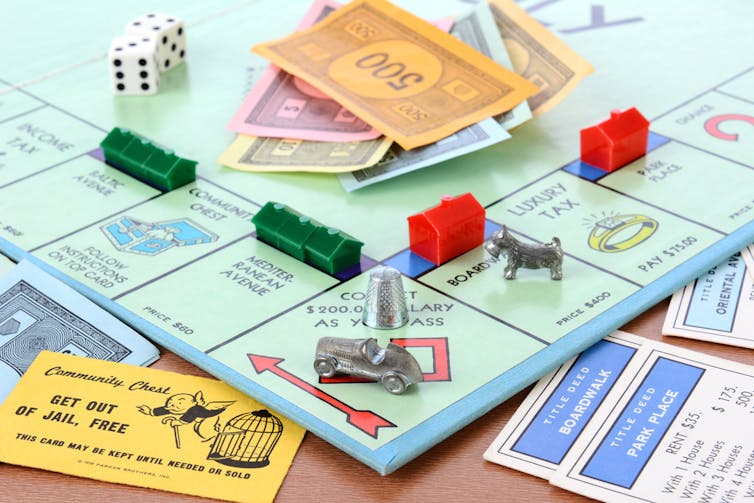
Monopoly was designed by a progressive writer to teach players the dangers of wealth concentration.
Do not pass GO! Monopoly was designed by a progressive writer to teach players the dangers of wealth concentration. (Shutterstock)
Have you played Monopoly lately? Or maybe snakes and ladders? These board games are examples of 100-year-old games that many still play today.

But the way they are played today may not be teaching the lessons their designers hoped to share.

At the start of the 20th century, children were part of the regular workforce. They possessed few toys. When U.S. manufacturers created games, they built them to market to parents: to teach as well as to entertain.

Progressive writer Elizabeth Magie Phillips created Monopoly in 1904 to teach players about the dangers of wealth concentration. Originally called The Landlord’s Game, it celebrated the teachings of the anti-monopolist Henry George whose widely read book, Progress and Poverty, published in 1879, argued that governments did not have a right to tax labour. They only had a right to tax land.

Monopoly didn’t become a hit until the Depression. Its original message that all should benefit from wealth was transformed to its current version — where you crush opponents by accumulating wealth — by its second developer, an unemployed heating engineer named Charles Darrow. By the mid-1930s, orders for the game had become so extensive that employees of Parker Brothers stared piling the order forms in laundry baskets.
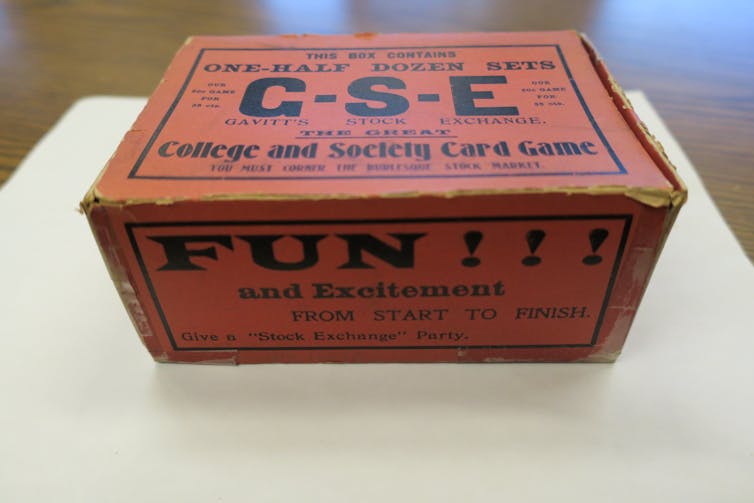
Gavitt’s Stock Exchange (1903), a precursor to the modern day card game Pit.
Gavitt’s Stock Exchange (1903), a precursor to the modern day card game Pit.(Strong Museum of Play, 109.11515)

Games with meaning

Many of the games in circulation today are more than a century old. Pitt (originally Gavitt’s Stock Exchange) was made during economic panics, railroad failures, speculation and anti-monopoly movements. Patented by Harry E. Gavitt in 1903, the game was designed (as the rulebook says), to reproduce the excitement and confusion generally witnessed in stock and grain exchanges.

Players work to gain a monopoly over an economic market. They gather all the copies of one product and inflate its value to reap substantial profits.

Monopoly and Pitt taught economics while Chutes and Ladders focused on morality.
Chutes and Ladders was inspired by games played in South Asia about 1,000 years ago. Many of these games had explicit Hindu religious themes. They had different names: Nepal (Nāgapāśa); Tibet (The Game of Liberation); and India (JƱāna Chaupār). A Buddhist monk, Sa-skya Pandita, created the Game of Liberation for his sick mother in the 13th century. He likely based it on earlier forms of the game he encountered as part of his pilgrimages.

In Nāgapāśa, players attempted to reach a realm of one of the Hindu gods. In the Game of Liberation, they aimed to reach nirvana.

British and American manufacturers stripped the game of its religion, but they kept its emphasis on morality and the game stayed much the same: moving upwards on the board represents good moral decisions; falling back is a punishment for poor choices.

Teaching tools

Toys and games offered a way for teachers and parents to prepare children for their adult lives. Parents used mechanical toys to teach engineering to boys. They used dolls to teach sewing, ingenuity, and household management to girls. It was one way to take complex ideas about society and translate them into forms children could understand.

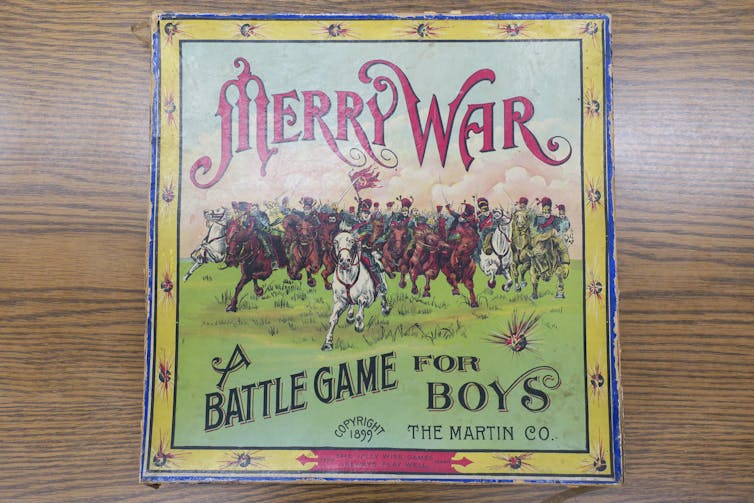
Playing games could also be a way to learn history. During the the Philippine-American War, game designers created Merry War to teach children about the conflict.
Merry War: A Battle Game for Boys (1899) has U.S. and Filipino soldiers battle against one another.
Merry War: A Battle Game for Boys (1899) has U.S. and Filipino soldiers battle against one another. (Strong Museum of Play, 107.3631)
In 1899, a newspaper columnist in The Seattle Post-Intelligencer wrote that toy makers…are as watchful as politicians and scientists to keep abreast of the events of the day.”

Market changes

By the 1960s, manufacturers began to advertise directly to children, rather than to their parents. They emphasized the excitement of their products over their educational value.

At the same time, civil rights unrest, the rise of feminism and rapid technological innovation made the world seem unpredictable. How could you prepare your children for their adult lives when the future seemed so difficult to understand?

Today, lessons remain embedded in many board games, but they sit apart from games just for fun. Board games are no longer a key venue to transmit information across generations.

Yet for all that has changed, we still play these old games, even if we don’t remember their lessons.The Conversation

About Today's Contributor:

Benjamin Hoy, Assistant Professor of History, University of Saskatchewan


This article is republished from The Conversation under a Creative Commons license. 

You Might Also Like