16 May 2017

UK: Labour's Manifesto Shows It Is The True Party Of Workers' Rights

by
Jeremy Corbyn launches the Labour manifesto
Jeremy Corbyn launches the Labour manifesto. Owen Humphreys/PA Wire/PA Images

By Gregor Gall, University of Bradford

It cannot be an accident that Jeremy Corbyn launched what may be his one and only general election manifesto in the city of Bradford. One of the forerunners of today’s Corbyn-led Labour Party was the Independent Labour Party (ILP). It was a full-blooded left wing party, founded in 1893 in Bradford. And, Keir Hardie, the ILP’s first leader and founder of the Labour Party, has frequently been cited by Corbyn as one of his inspirations. The Conversation

Both Hardie and the ILP were very strong advocates of workers’ rights, having emerged from the then nascent union movement. Corbyn, a former full-time officer of one of the forerunner’s of the biggest union in Britain, UNISON, is equally a very strong advocate of workers’ rights. This shows up in the publication today of Labour’s general election manifesto.


Keir Hardie
Keir Hardie. US Library of Congress

With the Conservatives trying to muscle in on traditional Labour territory by painting themselves as the party of workers, it’s worth taking a closer look to see which party truly represents workers.

Among the most significant of the pledges in the manifesto on rights at work are:
  • All workers equal rights from day one, whether part-time or full-time
  • Banning zero hours contracts so that every worker gets a guaranteed number of hours each week
  • Ending the use of overseas labour to undercut domestic wages and conditions
  • Repealing the Trade Union Act 2016 and rolling out collective bargaining by sector
  • Guaranteeing unions a right to access workplaces to represent members
  • Raising the minimum wage to the level of the living wage
  • Ending the public sector pay cap
  • Instituting a maximum pay ratio of 20:1 in the public sector and companies bidding for public contracts
  • Banning unpaid internships
  • Abolishing employment tribunal fees
  • Giving self-employed workers the status of workers
  • Setting up a commission to modernise the law around employment status
  • Creating a Ministry of Labour with the resources to enforce workers’ rights
These pledges are essentially a replication of A Manifesto for Labour Law by the Institute of Employment Rights in June 2016, devised in conjunction with labour law academics to promote healthy policy for workers.

Labour’s worker problem
The socialist left has often argued that Labour has failed to inspire the loyalty of workers, and union members especially, by being insufficiently radical. Consequently, the argument goes, there was less than a compelling reason to vote for Labour. Along with pledges to bring the water industry, railways, Royal Mail and some energy companies back into public ownership (which should reduce pressure on workers’ wages and conditions), this cannot be said to be the case this time round.

Some have criticised Corbyn’s Labour for giving into the allegedly vested and backward interest of unions. As Martin Kettle of the Guardian argued, “union power is not the same as workers’ rights”.

At one level, this is a valid point. With only around a quarter of workers now holding union membership, workers cannot rely on unions any time soon to be able to effectively defend their rights and interests.

But when one recognises that the implementation of workers’ rights has always needed the help of unions because they are the only sizeable independent organisations with the resources to do so, this point loses its force. Unions inform workers of their rights and help them apply them. Plus, unions have always helped more than just their members because employers apply the gains of union negotiated deals to all employees.

Wider significance
But focusing on the union aspect blinds critics to the actual significance of Labour’s manifesto. This is that, compared to what the Tories are proposing, Labour prioritises collective rights over individual rights so that workers can act together to advance their interests. Labour’s manifesto recognises that the workers are stronger together, echoing a fundamental belief of Karl Marx that the condition of the freedom of the individual is the condition of the freedom of all.

Indeed, without collective rights in law, especially with regard to the right to strike, any collective bargaining can easily end up being merely collective begging.

Union members protesting for their rights
Collective action is stronger than individual action. Matt Alexander/PA Archive/PA Images
The most obvious case in point concerns the right to sectoral collective bargaining, which Labour has emphasised in its manifesto. In Britain, companies in the same sector compete primarily against each other on the basis of their labour costs. Hence, there is a competitive advantage to cut wages and conditions as the principle route to profitability.

But by providing a statutory basis to sectoral collective bargaining, all companies in a sector would be compelled to furnish workers with the same minimum terms and conditions. No longer would they compete on labour costs in a “race to the bottom”. And, their attention would turn to improving productivity through investment in technology and training.

With stronger collective rights, applied and enforced with the help of unions, both unions and workers’ rights would be immeasurably strengthened. Time will shortly tell whether Labour’s manifesto will help it regain the support of working class voters. Or whether Theresa May’s pitch to be the workers’ friend will gain sufficient traction.

If Corbyn is successful, it will be a fitting tribute to the heritage of Bradford. It was here that an almighty 19-week strike at the city’s Manningham Mills textile factory by some 5,000 workers over wage cuts in 1891 gave a big spur to the founding of the ILP. It will also have been fitting that Labour launched the manifesto at the University of Bradford given that it started out life in 1832 as the Bradford Mechanics Institute, an organisation designed to help working class people gain the necessary skills for the ever changing world of work.

About Today's Contributor:
Gregor Gall, Professor of Industrial Relations, University of Bradford


This article was originally published on The Conversation

15 May 2017

One Wounded Warrior Project's Supporter Recently Wrote A Song To Raise Support & Awareness For It

by
Kendall Clausen
Wounded Warrior Project's supporter, Kendall Clausen, wrote a song for WWP

Generous donors from all walks of life and of all ages allow Wounded Warrior Project (WWP) to provide free, life-changing programs and services to injured veterans, their caregivers, and family members. Recently, a talented young singer named Kendall Clausen used her skills to support WWP through a performance with her school choir.
"For a school project, we had the option to do whatever we loved doing to support Wounded Warrior Project," Kendall said. "I chose to write a song. I sat down and came up with the idea to write about a soldier going off to war. The song focused on how in the end, the soldier is not going to give up no matter what happens. The song is called 'Warrior,' and I want to donate half of whatever money it raises to support Wounded Warrior Project."
"I'm pretty amazed," said Karl Clausen, her father. "She's sung other people's music in the past, but this is the first time she sat down and wrote an entire piece."
Kendall explained the decision to support WWP was collaborative among her fellow choir members – and a meaningful cause for many of them.
"A lot of my classmates have family who have served, or who were served by Wounded Warrior Project," Kendall said. "That personal connection really brought the idea to life."
At the school concert, Kendall and her classmates performed and set up an area where concert attendees could donate to WWP.
"I think the concert really inspired people because we raised a good amount of money for Wounded Warrior Project," Kendall said. "There are people who are willing to fight and die for my country – all my freedoms and privileges are here because of what others have fought for. The courage of our nation's veterans is unbelievable, and I'm so thankful for that."

"Warrior" is for sale on iTunes, Amazon, and other digital retailers, and can be seen on Kendall's YouTube page. Students of all ages can support warriors served by WWP by starting a Student Ambassadors fundraising campaign.

About Wounded Warrior Project
Wounded Warrior Project (WWP) connects, serves, and empowers wounded warriors. Read more at newsroom.woundedwarriorproject.org/about-us.

SOURCE: Wounded Warrior Project

The Video:

Dazzling Star Will Showcase Animation Series "Beijing Opera Cats" At the 2017 Las Vegas Licensing Expo

by
Beijing Opera Cats four main characters
As a leading Chinese animation production company, Dazzling Star is delighted to attend 2017 Las Vegas Licensing Expo with its award-winning animation work "Beijing Opera Cats", from 23rd to 25th May in Las Vegas.
"Beijing Opera Cats" is a hit animation in China. It is the first series combining Kung Fu and Beijing Opera elements, targeting audiences aged 6-12 years old. Since the debut of the first season in 2015, it has rewritten the record books in terms of reaching 18.02% of Chinese market share and accumulating over 700 million views on the mainstream platform. 
Dazzling Star also brings stores and characters to life through developing games, consumer products and theme parks across the world.  
The story takes place in a world called Purpetua, which used to be a paradise for cats, but after being taken over by evil forces, it has turned into a chaotic place with monsters everywhere. Only "Beijing Opera Cats" and their "harmony power" can lead the residents in the fight to take back Purpetua. 
The action is a mixture of Kung Fu, magic and comedic moments that also work to break up the fight sequences nicely. "Beijing Opera Cats" aims to encourage audiences everywhere to develop into kind people with curious minds, compassionate hearts, and courage so they can grow into their authentic selves and find their place in the world.
Combining Kung Fu and Beijing Opera elements, Dazzling Star aims to create a worldwide animation success.
Dazzling Star took 6 years to create "Beijing Opera Cats", which is the first original cartoon series combining Kung Fu and Beijing Opera elements. Cats, as the heroes, help convey a positive energy in the exciting plot. "Beijing Opera Cats" has been shown with several famous children channels and mainstream platforms. 
With its attractive legendary stories and delicate pictures, it received tons of positive feedback and attracted a legion of loyal fans.
Dazzling Star is committed to creating and distributing original animation work
"In the Chinese animation industry, there is an increasing number of production teams that tend to learn and copy from overseas teams. They lost themselves, I think."
YangGang Du, CEO of Dazzling Star
Dazzling Star Culture Development Co., Ltd. was founded in 2009. Providing a guidance of positive value for audiences was mission of the company. Meanwhile, combining Chinese Kung Fu and advanced technology are the key to success. 
Mr. YangGang Du, the founder of Dazzling Star, was mentioned in his interview, "Dazzling Star is a company that provides a high quality Asian cultural animation series on the world stage." Under this great dream and passion, Mr. Du leads the team and produced "Beijing Opera Cats". The excellent visual experience of Chinese animation is the goal of moving forward.

SOURCE: Dazzling Star Culture Development Co., Ltd.

The Trailer:

13 May 2017

How Theatre Can Help Us Understand Donald Trump And Brexit

by

little clown looking through theatre's curtains
Image via Shutterstock
By Hans-Ludwig Buchholz, University of Aberdeen


When it comes to the chaotic policies of Donald Trump or the seeming irrationality of Brexit, traditional political explanations can fail to produce satisfactory answers. The Conversation

Political science may help to solve some of these riddles, but far from all. For example, scholars may be able to argue that those disappointed or marginalised by the US political establishment voted for Trump’s promises. Or they could claim that people voted for the UK to leave the EU because it was seen as the project of a rich elite.

But they cannot fully explain why millions believe in “alternative facts”, or why the arguments for these are made so passionately. Perhaps unexpectedly, theatre can be an instrument for thinking about politics and making sense of Trump, Brexit and other political upheavals.

The type of theatre we’re talking about here isn’t Shakespeare’s historic plays or modern TV dramas in the style of House of Cards or The West Wing – they can make visible what happens behind closed doors. What we really need to do is take a step back to understand what is going on in the whole of society – and in ourselves. And it is theatrical comedy that opens up this way of thinking.

The Swiss dramatist and author Friedrich Dürrenmatt is considered an international writer of classic plays, but is popular only in German-speaking countries. However, Dürrenmatt can teach us how to make sense of irrational policies through the use of literature, and especially comedy. He shows us how everyone can use art to think politically.

Dürrenmatt’s position is that our complicated, chaotic world, where a clear morality no longer exists, has to be translated by literature into an understandable narrative. Theatre can represent certain aspects of the world and place them in a concrete story.

As the audience, we can step back from our own prejudices, and fear for or laugh at the figures on stage. In comedy especially, we can watch something we don’t need to take too seriously – only to realise afterwards that we behave in our own lives exactly as the characters on stage do. Our own frustrations and foibles are revealed to us as the play unfolds. By experiencing the drama, we have unwittingly considered, mocked and judged ourselves. Dürrenmatt once said: “I love to trick the audience into thinking about their own case, which is always political”.

So, how can this theory be applied?

Play for today
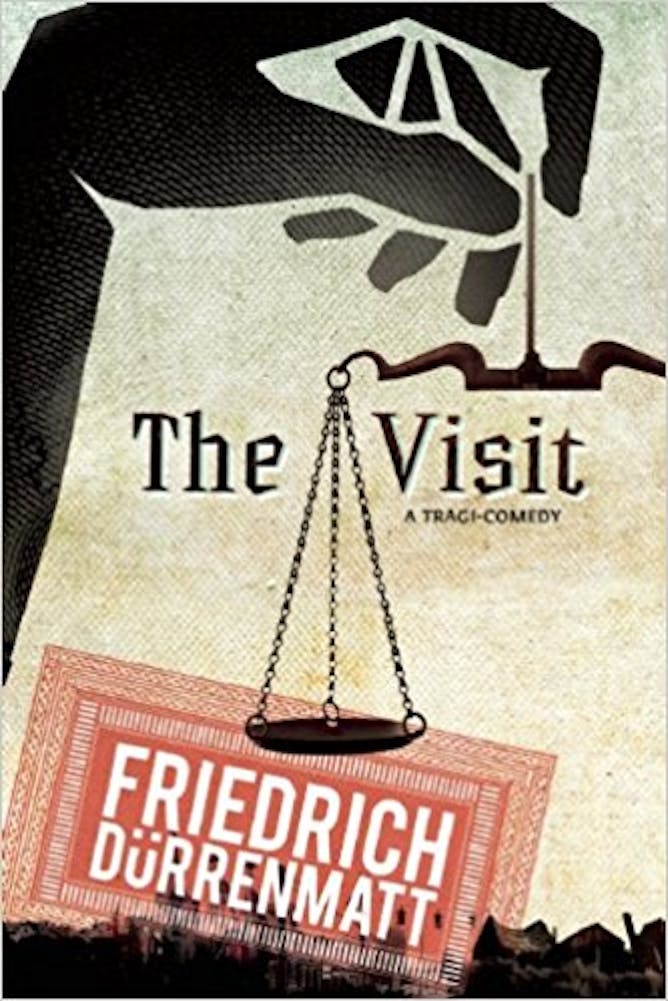
Dürrenmatt’s most famous comedy The Visit (1956) tells the story of Claire Zachanassian, a wealthy old woman who visits the now-impoverished village of her youth. She offers the villagers the sum of one billion Swiss francs under the condition that someone kills the owner of the village shop.

As a young woman, Zachanassian had loved this man, but he had jilted her when she was poor and pregnant. Now she wants to exact her revenge and see justice done. At first the villagers reject the immoral offer. But soon they start to talk about how the money could alleviate their poverty and suffering. Then, figuring they deserve it, the locals begin to buy expensive things on credit in anticipation of their wealth, making the shop owner increasingly nervous. In the end – spoiler alert – they accept the offer and kill him.

Of course, the comedy discusses big questions of justice, but as we watch, it mainly makes us laugh and judge. The characters on stage are portrayed in ridiculous ways: their obedient bow to the rich old woman is idiotic; their greed is farcical; their willingness to put aside loyalty is weak; their poor excuses for taking the money are laughable.

The Visit
Friedrich Dürrenmatt’s play is a subtle but devastating critique of human nature and society. Amazon, CC BY-SA

After the play ends, we may ask ourselves how we would have reacted to Zachanassian’s offer. We can use it to think about the choices in our lives, like accepting high interest rates that are too good to be true from dubious banks; or voting for politicians who are only acting for those rich or British enough; or for parties advocating low taxation.

And suddenly all our usual excuses and justifications are toppled. In the course of the play we dismiss the villagers as laughable, ridiculous and shameful. But as Dürrenmatt claimed, we have been tricked into thinking about our own lives all along.

Through the parallels of the play to our own lives, we are led into thinking politically without the usual prejudices. Now we begin to understand why people believe lies and vote for irrational politicians. In this situation it is easy to avoid responsibility with feeble excuses – because everyone’s doing it and it’s necessary to survive. It is possible to convince yourself to vote for a necessary evil, just as the impoverished villagers decided to kill the shop keeper.

Dissolving limitations
Appalling lies are swallowed in order to make the chosen evil acceptable. The people hit by Trump’s travel bans, or Britain’s European neighbours, are the necessary sacrifices for what surely must be the only option left, some might reason.

Literature in politics can only hint at how we should think. Otherwise we repeat the problems of political science, which is stuck with a rigid way of thinking designed to produce absolute truths. Thinking about difficult moral questions with the help of literature is more playful, and dissolves all limitations.

Taking literature too seriously – making messages absolute and ideological – would destroy this possibility. Instead, literature has to be vague, emotional, and open – used as an opportunity to explore our sense of morality and justice. Literature may not be able to fully explain Brexit, but it can help make sense of it.

Brexiteers are Claire Zachanassian figures in that they promise to save Britain and the NHS – if Europeans living in the UK and British people living abroad are made to suffer the necessary sacrifice. Like the villagers in the play we are then asked the difficult question, and the answer we give should help us see ourselves more clearly – if we are honest.

About Today's Contributor:
Hans-Ludwig Buchholz, PhD candidate in Modern Thought, University of Aberdeen


This article was originally published on The Conversation. 

Seated Ballerina By Jeff Koons On View May 12 - June 2, 2017 at Rockefeller Center

by
Seated Ballerina
Seated Ballerina, 2017 © Jeff Koons / Photo: Tom Powel Imaging
Kiehl's Since 1851 and Art Production Fund are pleased to present Jeff Koons's Seated Ballerina, a large-scale public art installation, hosted by Tishman Speyer at Rockefeller Center from May 12 – June 2, 2017. The inflatable nylon sculpture stands 45 feet high and depicts a seated ballerina from the artist's iconic Antiquity series.
Often referencing historical imagery and found objects, Koons based Seated Ballerina on a small porcelain figurine. The sculpture acts as a contemporary iteration of the goddess Venus, and symbolizes notions of beauty and connectivity. Its reflective surface mirrors its immediate environment and engages with each viewer.  The work aims to bring awareness to National Missing Children's Month this May, in an effort to support organizations like the International Centre for Missing & Exploited Children (ICMEC) that work tirelessly to create a safer world for children.
"It's a pleasure to work with Kiehl's and Art Production Fund on this charitable project. This partnership will increase awareness and help the International Centre for Missing & Exploited Children make the world a safer place for children," said Jeff Koons. "I hope the installation of Seated Ballerina at Rockefeller Center offers a sense of affirmation and excitement to the viewer to reach their potential. The aspect of reflectivity emulates life's energy; it's about contemplation and what it means to be a human being. It's a very hopeful piece."
"We have enjoyed a great relationship with Jeff Koons, starting with Puppy and recently with Split-Rocker, which were both a tremendous success," said Tishman Speyer President and CEO Rob Speyer. "It's an honor to work with the Art Production Fund and Kiehl's and bring Jeff's art back to Rockefeller Center. Seated Ballerina promises to offer one of those unforgettable New York experiences that will be remembered for years to come."
"We are honored to work with Jeff Koons, Kiehl's and Tishman Speyer to present Seated Ballerina at Rockefeller Center," said Casey FremontExecutive Director of Art Production Fund. "We believe in the power of collaboration, and we are thrilled to present a public art project that raises awareness of the urgent need to protect children worldwide."

In honor of National Missing Children's Month, Koons has also created a limited edition Seated Ballerina tin for the Midnight Recovery Collection. Throughout May, Kiehl's will donate 100% of its net profits from the collection, up to $100,000, to directly benefit ICMEC. A fervent advocate for protecting children, Koons worked with ICMEC to co-found The Koons Family Institute on International Law & Policy in 2007 to combat child abduction and exploitation. 
He also serves on ICMEC's Board of Directors. The installation highlights the longstanding relationship Kiehl's has forged with Jeff Koons and ICMEC since 2011. Art Production Fund has also worked on a number of projects with Koons since 2009, donating a portion of sales from its Works on Whatever Collection to ICMEC.
"We're thrilled to continue what's become a Kiehl's tradition of partnering with Jeff Koons," says Chris Salgardo, President, Kiehl's USA."With more than 465,000 reports of missing children last year in the United States alone, it's gratifying to know that via this fourth partnership with Koons and the International Centre for Missing & Exploited Children, we are able to make a difference in the lives of our children."
"ICMEC is proud and honored to partner with our long-term friend and Board member – the great American artist Jeff Koons – and with the iconic Kiehl's Since 1851, in a campaign that raises awareness and supports our efforts to make the world a safer place for all children," says Maura Harty, President & CEO ICMEC.

About Jeff Koons
Jeff Koons was born in YorkPennsylvania and studied at the Art Institute of Chicago and the Maryland Institute College of Art; the latter from where he received his BFA. He currently lives and works in New York City. One of the foremost internationally recognized contemporary artists of our time, Jeff Koons earned renown for his iconic sculptures such as Rabbit (1986), Michael Jackson and Bubbles (1988) and his public sculptures, such as the monumental floral sculptures Puppy (1992) and Split-Rocker (2000), both of which were previously installed at Rockefeller Center.
About the International Centre for Missing & Exploited Children: 
The International Centre for Missing & Exploited Children is a private 501(c)(3) non-governmental, nonprofit organization. For almost 20 years, ICMEC has been a leader in identifying gaps in the global community's ability to protect children from abduction, sexual abuse and exploitation, and expertly assembling the people, resources and tools needed to fill those gaps. ICMEC focuses on programs that have an impact on addressing the issues surrounding missing children, child abduction, child sexual abuse and exploitation. 
Through The Koons Family Institute on International Law & Policy, ICMEC conducts and commissions original research into the status of child protection legislation around the world to help make children safer.

12 May 2017

'Horseshoe Theory' Is Nonsense – The Far Right And Far Left Have Little In Common

by
Jean-Luc MƩlenchon and Marine Le Pen
Jean-Luc MƩlenchon and Marine Le Pen (Guillaume Horcajuelo / Frederic Scheiber / EPA)
By Simon Choat, Kingston University

After the first round of the French presidential elections, several liberal commentators condemned the defeated leftist candidate Jean-Luc MƩlenchon for refusing to endorse the centrist Emmanuel Macron. His decision was portrayed as a failure to oppose the far-right Front National, and it was argued that many of his supporters were likely to vote for Marine Le Pen in the second round. Comparisons were drawn with the US presidential elections and the alleged failure of Bernie Sanders supporters to back Hilary Clinton over Donald Trump. The Conversation

Underlying these claims is a broader and increasingly popular notion that the far left and the far right have more in common than either would like to admit. This is known as the “horseshoe theory”, so called because rather than envisaging the political spectrum as a straight line from communism to fascism, it pictures the spectrum as a horseshoe in which the far left and far right have more in common with each other than they do with the political centre. The theory also underlies many of the attacks on the leader of the UK Labour Party, Jeremy Corbyn, who is accused of cosying up to authoritarian and theocratic regimes and fostering antisemitism within his party.


Taken one by one, these claims do not withstand scrutiny. Did MĆ©lenchon give succour to Le Pen? No: he explicitly ruled out supporting Le Pen, and most of his supporters voted for Macron in the second round. Are there antisemites in the Labour Party? Yes: but there are antisemites in every British political party; the difference is that repeated incidents of racism in other parties go unremarked (as does Corbyn’s longstanding record of anti-racist activism).

Fans of the horseshoe theory like to lend their views weight and credibility by pointing to the alleged history of collusion between fascists and communists: the favoured example is the Nazi-Soviet Pact. But – aside from the fact that the Soviet Union played a vital role in defeating the Nazis – it is patently absurd to compare Stalin to present-day leftists like MĆ©lenchon or Corbyn.


Can we instead find convergence between far left and far right at the level of policy? It is true that both attack neoliberal globalisation and its elites. But there is no agreement between far left and far right over who counts as the “elite”, why they are a problem, and how to respond to them. When the billionaire real-estate mogul Donald Trump decries global elites, for example, he is either simply giving his audience what he thinks they want to hear or he is indulging in antisemitic dog-whistling.

For the left, the problem with globalisation is that it has given free rein to capital and entrenched economic and political inequality. The solution is therefore to place constraints on capital and/or to allow people to have the same freedom of movement currently given to capital, goods, and services. They want an alternative globalisation. For the right, the problem with globalisation is that it has corroded supposedly traditional and homogeneous cultural and ethnic communities – their solution is therefore to reverse globalisation, protecting national capital and placing further restrictions on the movement of people.


Donald Trump
Trump and Sanders both attacked globalisation – for different reasons. Michael Vadon, CC BY-SA

Is there a more fundamental, ideological resonance between far left and far right? Again, only in the vaguest sense that both challenge the liberal-democratic status quo. But they do so for very different reasons and with very different aims. When fascists reject liberal individualism, it is in the name of a vision of national unity and ethnic purity rooted in a romanticised past; when communists and socialists do so, it is in the name of international solidarity and the redistribution of wealth.

Given the basic implausibility of the horseshoe theory, why do so many centrist commentators insist on perpetuating it? The likely answer is that it allows those in the centre to discredit the left while disavowing their own complicity with the far right. Historically, it has been “centrist” liberals – in Spain, Chile, Brazil, and in many other countries – who have helped the far right to power, usually because they would rather have had a fascist in power than a socialist.

Today’s fascists have also been facilitated by centrists – and not just, for example, those on the centre-right who have explicitly defended Le Pen. When centrists ape the Islamophobia and immigrant-bashing of the far right, many people begin to think that fascism is legitimate; when they pursue policies which exacerbate economic inequality and hollow out democracy, many begin to think that fascism looks desirable.
If liberals genuinely want to understand and confront the rise of the far right, then rather than smearing the left they should perhaps reflect on their own faults.

About Today's Contributor:
Simon Choat, Senior Lecturer in Political Theory, Kingston University


This article was originally published on The Conversation. 

You Might Also Like