2 October 2017

Art Of Villalpando Will Bring Together Philanthropists In New York To Support Mexican Culture

by
Cristóbal de Villalpando (ca. 1649–1714). Moses and the Brazen Serpent and the Transfiguration of Jesus (detail), 1683
On the occasion of the exhibition Cristóbal de Villalpando: Mexican Painter of the Baroque at The Metropolitan Museum of New York, currently running through October 15, the Mexican Cultural Institute of New York (MCINY) will host a benefit evening with a private tour of the exhibition on October 3. The event will be chaired by Mexico's Ambassador to the United States, Gerónimo Gutiérrez Fernández and Diego Gómez Pickering, Consul General of Mexico in New York, and co-chaired by Claudia (Gonzalez) Romo Edelman.
The benefit reception, organized by MCINY, pays homage to the work of Estrellita B. Brodsky, a well-known curator and philanthropist, who has promoted Mexican art throughout the globe, especially in the United States. Part of the ticket sales will be donated to the relief efforts in Mexico.
"With this event, we seek to strengthen the promotion of Mexico, specifically of our culture, in one of the most important art institutions in the United States," said Gómez Pickering. "We also aim to channel collective efforts to aid the victims of the tragic earthquakes that shook Mexico," he added.
"The exhibition is the first major Mexican art project at The Met since 1990. For over 25 years the MCINY has worked to foster a better understanding of Mexico through the promotion of its vibrant culture. Now is a particularly important moment to support the Institute's mission and with it, our Mexican fellow citizens," commented Claudia Romo Edelman.
The MCINY, currently directed by Caterina Toscano, is a non-profit organization committed to promoting the richness, dynamism and cultural diversity of Mexico, a plural and creative nation. It is also the cultural division of the Consulate General of Mexico in New York.
The work of Cristóbal de Villalpando is recognized as emblematic of the art of viceregal Mexico. The collection exhibited at The Met was first presented this year at the Citibanamex Palacio de Cultura-Palacio de Iturbide in Mexico City, from March 9 to June 4
The exhibition includes the painting Moses and the Brazen Serpent and the Transfiguration of Jesus, a 28-foot-tall canvas finished in 1683, which has never been exhibited outside Mexico.
The exhibition is organized by The Metropolitan Museum of Art and Fomento Cultural Banamex, A.C. It is made possible by Citibanamex and Fundación Diez Morodo.

Additional support is provided by the Ministry of Foreign Affairs of Mexico (SRE), AMEXCID, and the Consulate General of Mexico in New York.

SOURCE: Mexican Cultural Institute of New York

With Honour Announces New Modern Modest Sportswear With Active Cooling Technology

by
The SnapJab by With Honour
U.S. based product developer, With Honour, is unveiling a range of stylish yet amazingly functional active fashion wear for modest women and athletes. With Honour noticed the need for modest clothing that suits modern women, so they decided to create it themselves.
The With Honour range consisting of self-cooling "SnapJab" and "Aurora hoodie" will be pre-selling their products through the crowdfunding platform, Kickstarter. During a 30-day sale the range will be selling at a discount.
The Aurora Hoodie by With Honour
Having spotted a gap in the market for a fashionable, comfortable and practical modest active wear. The team went out and spoke to female athletes in over five countries, lots and lots of athletes. So, the quest was to create the ultimate clothing range for these women. The result is the With Honour range.
First designed to be functional. Easy access non-snag snaps, snug fitting yet comfortable with amazing built in active-cooling tech – that keeps you cool no matter what the sport.
They then took that functionality and made it beautiful. "We wanted to create a range of active wear – that is ideal for serious female athletes but can be worn by anyone," says founder Kamal Kalifa.
The SnapJab
The SnapJab  
The founder, Kamal Kalifa, firmly believes that "What you wear should never limit what you can achieve."
With Honour is now ready to launch their product to the public. 

The Videos:
The Aurora Hoodie Promo

The SnapJab Promo

SOURCE: With Honour

1 October 2017

Dear Elon Musk: Your Dazzling Mars Plan Overlooks Some Big Nontechnical Hurdles

by

File 20171001 13542 15sjp1f
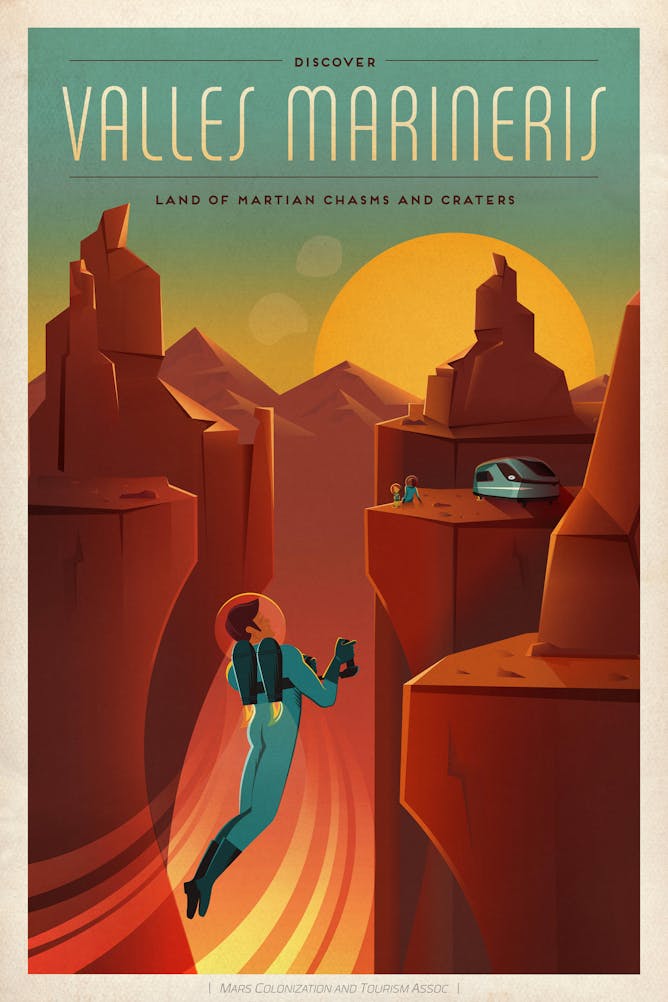
Will it be only a few decades before Mars tourism is a reality? (SpaceX, CC BY)
By Andrew Maynard, Arizona State University

Elon Musk has a plan, and it’s about as audacious as they come. Not content with living on our pale blue dot, Musk and his company SpaceX want to colonize Mars, fast. They say they’ll send a duo of supply ships to the red planet within five years. By 2024, they’re aiming to send the first humans. From there they have visions of building a space port, a city and, ultimately, a planet they’d like to “geoengineer” to be as welcoming as a second Earth.

If he succeeds, Musk could thoroughly transform our relationship with our solar system, inspiring a new generation of scientists and engineers along the way. But between here and success, Musk and SpaceX will need to traverse an unbelievably complex risk landscape.

Many will be technical. The rocket that’s going to take Musk’s colonizers to Mars (code named the “BFR” – no prizes for guessing what that stands for) hasn’t even been built yet. No one knows what hidden hurdles will emerge as testing begins. Musk does have a habit of successfully solving complex engineering problems though; and despite the mountainous technical challenges SpaceX faces, there’s a fair chance they’ll succeed.

As a scholar of risk innovation, what I’m not sure about is how SpaceX will handle some of the less obvious social and political hurdles they face. To give Elon Musk a bit of a head start, here are some of the obstacles I think he should have on his mission-to-Mars checklist.

Musk typically drives hard toward his goals – in this case, Mars. (AP Photo/Refugio Ruiz)

Planetary protection
Imagine there was once life on Mars, but in our haste to set up shop there, we obliterate any trace of its existence. Or imagine that harmful organisms exist on Mars and spacecraft inadvertently bring them back to Earth.

These are scenarios that keep astrobiologists and planetary protection specialists awake at night. They’ve led to unbelievably stringent international policies around what can and cannot be done on government-sponsored space missions.

Yet Musk’s plans threaten to throw the rule book on planetary protection out the window. As a private company SpaceX isn’t directly bound by international planetary protection policies. And while some governments could wrap the company up in space bureaucracy, they’ll find it hard to impose the same levels of hoop-jumping that NASA missions, for instance, currently need to navigate.

It’s conceivable (but extremely unlikely) that a laissez-faire attitude toward interplanetary contamination could lead to Martian bugs invading Earth. The bigger risk is stymying our chances of ever discovering whether life existed on Mars before human beings and their grubby microbiomes get there. And the last thing Musk needs is a whole community of disgruntled astrobiologists baying for his blood as he tramples over their turf and robs them of their dreams.

Ecoterrorism
Musk’s long-term vision is to terraform Mars – reengineer our neighboring planet as “a nice place to be” – and allow humans to become a multi-planetary species. Sounds awesome – but not to everyone. I’d wager there will be some people sufficiently appalled by the idea that they decide to take illegal action to interfere with it.

Ecoterrorists claimed responsibility in 1998 for burning part of a Colorado ski resort they said threatened animal habitats. (Vail Fire Department)

The mythology surrounding ecoterrorism makes it hard to pin down how much of it actually happens. But there certainly are individuals and groups like the Earth Liberation Front willing to flout the law in their quest to preserve pristine wildernesses. It’s a fair bet there will be people similarly willing to take extreme action to stop the pristine wilderness of Mars being desecrated by humans.

How this might play out is anyone’s guess, although science fiction novels like Kim Stanley Robinson’s “Mars Trilogy” give an interesting glimpse into what could transpire once we get there. More likely, SpaceX will need to be on the lookout for saboteurs crippling their operations before leaving Earth.

Space politics
Back in the days before private companies were allowed to send rockets into space, international agreements were signed that set out who could do what outside the Earth’s atmosphere. Under the United Nations Treaty on Principles Governing the Activities of States in the Exploration and Use of Outer Space, including the Moon and Other Celestial Bodies, for instance, states agreed to explore space for the benefit of all humankind, not place weapons of mass destruction on celestial bodies and avoid harmful contamination.

That was back in 1967, four years before Elon Musk was born. With the emergence of ambitious private space companies like SpaceX, Blue Origin and others, though, who’s allowed to do what in the solar system is less clear. It’s good news for companies like SpaceX – at least in the short term. But this uncertainty is eventually going to crystallize into enforceable space policies, laws and regulations that apply to everyone. And when it does, Musk needs to make sure he’s not left out in the cold.

This is of course policy, not politics. But there are powerful players in the global space policy arena. If they’re rubbed the wrong way, it’ll be politics that determines how resulting policies affect SpaceX.

Climate change
Perhaps the biggest danger is that Musk’s vision of colonizing Mars looks too much like a disposable Earth philosophy – we’ve messed up this planet, so time to move on to the next. Of course, this idea may not factor into Musk’s motivation, but in the world of climate change mitigation and adaptation, perceptions matter. The optics of moving to a new planet to escape the mess we’ve made here is not a scenario that’s likely to win too many friends amongst those trying to ensure Earth remains habitable. And these factions wield considerable social and economic power – enough to cause problems for SpaceX if they decide to mobilize over this.

There is another risk here too, thanks to a proposed terrestrial use of SpaceX’s BFR as a hyperfast transport between cities on Earth. Musk has recently titillated tech watchers with plans to use commercial rocket flights to make any city on Earth less than an hour’s travel from any other. This is part of a larger plan to make the BFR profitable, and help cover the costs of planetary exploration. It’s a crazy idea – that just might work. But what about the environmental impact?

Even though the BFR will spew out tons of the greenhouse gas carbon dioxide, the impacts may not be much greater than current global air travel (depending how many flights end up happening). And there’s always the dream of creating the fuel – methane and oxygen – using solar power and atmospheric gases. The BFR could even conceivably be carbon-neutral one day.

But at a time when humanity should be doing everything in our power to reduce carbon dioxide emissions, the optics aren’t great. And this could well lead to a damaging backlash before rocket-commuting even gets off the ground.

When the USSR launched Sputnik on Oct. 4, 1957, it also launched the space race.( AP Photo)

Inspiring – or infuriating?
Sixty years ago, the Soviet Union launched Sputnik, the world’s first artificial satellite – and changed the world. It was the dawn of the space age, forcing nations to rethink their technical education programs and inspiring a generation of scientists and engineers.

We may well be standing at a similar technological tipping point as researchers develop the vision and technologies that could launch humanity into the solar system. But for this to be a new generation’s Sputnik moment, we’ll need to be smart in navigating the many social and political hurdles between where we are now and where we could be.

Imagine the possibilities…. (SpaceX, CC BY)

These nontechnical hurdles come down to whether society writ large grants SpaceX and Elon Musk the freedom to boldly go where no one has gone before. It’s tempting to think of planetary entrepreneurialism as simply getting the technology right and finding a way to pay for it. But if enough people feel SpaceX is threatening what they value (such as the environment – here or there), or disadvantaging them in some way (for example, by allowing rich people to move to another planet and abandoning the rest of us here), they’ll make life difficult for the company.

The ConversationThis is where Musk and SpaceX need to be as socially adept as they are technically talented. Discounting these hidden hurdles could spell disaster for Elon Musk’s Mars in the long run. Engaging with them up front could lead to the first people living and thriving on another planet in my lifetime.

About Today's Contributor:
Andrew Maynard, Director, Risk Innovation Lab, Arizona State University


This article was originally published on The Conversation. 

29 September 2017

Freedom Colony, a Texan Family - Beyond 40 Acres and a Mule

by
The Upshaws of County Line
The Lost Pines Art League is proud to present an educational and uplifting photography show about the exhibition The Upshaws of County Line follows one family from everyday events, such as a game of dominos, to important milestones such as births and funerals.
But what makes the Upshaws unique is where they lived — County Line, a freedom colony in East Texasformed in the 1870s by newly freed slaves on land that they owned.
The photographs, taken by University of North Texas alumnus Richard Orton, will be on display through the end of October 2017 in Studio B at the Lost Pines Art Center.
The show is brought to you by a partnership of the Lost Pines Art Center and through a grant provided by the City of Bastrop.  The City of Bastrop has earned the title of the most historic small town in Texas.
The Upshaws of County Line - Book
The exhibition, which covers 25 years, is based on his 2014 book of the same name published by UNT Press. "I watched family members being born and grow up," he said. "I watched people die. I took photographs of funerals. It was a very rare gift that I was able to do what I did there."
Orton was a music major at UNT who took up photography while living in Austin after college. During a visit to his parents' home in Nacogdoches, he discovered the existence of freedom colonies and became curious about the impact that their relative autonomy had on their families.
He found the Upshaw family, which had 13 children, and told them he was interested in photographing them. The family agreed, and he began taking the documentary-style, black-and-white photographs the day after Thanksgiving in 1988.
In one memorable photo, the patriarch Edward Monel Upshaw is being introduced to his great-granddaughter, Reya, less than a year old, who is crying. Other photos include the annual homecoming celebration that brings in family members from all over the country in August.
"What I hope that it does is convey some sense of what it was like to be raised in a community like that," Orton said. "The children were not subject to all the negative aspects of the Jim Crow reality of the day. By virtue of fact they owned their own land, they automatically had their own independence."

  • The Lost Pines Art League (Lost Pines Art Center) is a 501(c)(3) nonprofit organization and runs the Lost Pines Art Center. Its membership includes a diverse set of artists and supporters of the fine arts.
  • The City of Bastrop is a historically significant city and the county seat of Bastrop County, TexasUnited States.
To learn more about the Lost Pines Art Center visit the website at www.lostpinesartcenter.org

SOURCE: Lost Pines Art League


Governments of Canada and Nunatsiavut Launch Partnership to Protect Ocean in Northern Labrador

by
Catherine McKenna, Minister of Environment and Climate Change and Minister responsible for Parks Canada, and Johannes Lampe, President of the Nunatsiavut Government, kayaking in the Labrador Sea (CNW Group/Parks Canada)
The waters around Labrador, an integral part of Inuit Nunangat, support a diverse array of birds, fish, and whales, and include some of the most unique ecosystems on the planet. With one of the highest concentration of polar bears anywhere in the world, this awe-inspiring region has sustained Inuit for thousands of years.
There - amid the oceans and icebergs of the north Atlantic - Inuit culture is strongly tied to the abundance of the land and sea.
Today the governments of Canada and Nunatsiavut are committing to a partnership to manage the ocean around northern Labrador. This is a historic commitment, and one that will ensure protection for future generations of Inuit.
Catherine McKenna, the Minister of Environment and Climate Change and Minister responsible for Parks Canada; Johannes Lampe, the President of the Nunatsiavut Government; and Dominic LeBlancthe Minister of Fisheries, Oceans, and the Canadian Coast Guard, have signed a Statement of Intent that would see the governments working together cooperatively towards an integrated vision for the marine waters of northern Labrador. This vision will recognize and respect Labrador Inuit rights and interests.
Together, the two governments are advancing the 'Imappivut' initiative – which means 'Our Waters' - put forward by the Nunatsiavut Government. Crucially, this initiative supports collaborative management, which includes the creation and co-management of marine protected areas. Moving forward, the Federal and Nunatsiavut Governments will work with local communities and with the provincial government to potentially protect a stretch of coastline longer than the State of California. 
To ensure that the marine zone covered by the Labrador Inuit Land Claims Agreement is both protected and developed sustainably, the Statement of Intent that was signed means the governments will work together to explore new solutions – like Indigenous Protected Areas – in order to maintain healthy oceans and healthy coastal communities.
With this partnership a major step is being taken in the right direction to build a legacy for future generations and ensure long lasting benefits for Inuit.

Quotes
"Our Government is proud of this historic partnership with the Nunatsiavut Government, the 'Imappivut' initiative, to protect the ocean in Northern Labrador. Together, we will not only help protect a region feeling the very real impacts of climate change – but through environmental stewardship, training, and employment – will provide economic opportunities for Inuit communities along the coast. Both governments understand we can protect the environment while strengthening the economy."

The Honourable Catherine McKenna Minister of Environment and Climate Change and Minister responsible for Parks Canada
"The Imappivut initiative is about recognizing Labrador Inuit connection, knowledge and rights to our ocean. It is about respecting our history and current needs by partnering with the Government of Canada to develop a management plan that ultimately improves the lives of those who depend on the water and the ecosystem itself. We look forward to starting this process by gathering information from Nunatsiavummiut for the management plan and working with the Government of Canada and other stakeholders to realize the expectations and interests that Labrador Inuit have for how the ocean is managed."

Johannes Lampe President, Nunatsiavut Government
"Meaningful collaboration with Indigenous communities is key to protecting Canada's three oceans. By signing this Statement of Intent, our government is recognizing the important contribution Indigenous communities can make to protect our oceans and our commitment to working closely with the Nunatsiavut Kavamanga on marine conservation and sustainable management in the Labrador region."

The Honourable Dominic LeBlancMinister of Fisheries, Oceans and the Canadian Coast Guard

SOURCE: Parks Canada


28 September 2017

USC Shoah Foundation Releases 'Lala', A VR Film About The Bond Between A Family And Their Dog During The Holocaust

by
Image via IWitness
USC Shoah Foundation is announcing the release of Lala, a virtual reality film and educational resource that tells the true story of a dog that brightened the lives of a family interned by the Nazis in a ghetto in Poland during the Holocaust.
Lala is both an immersive film for general audiences and an educational tool for students as young as grade five. The film is accessible in IWitness, the award-winning educational website from USC Shoah Foundation that uses testimonies – personal stories – from survivors and witnesses of genocide to teach students worldwide the importance of compassion and in bringing about positive societal change.
Developed by USC Shoah Foundation in partnership with Discovery Communications and Discovery Education, the film is packaged with activities, testimony clips and other resources for teachers in grades five through seven.
Offering a 360-degree experience, the six-minute film is a product of USC Shoah Foundation's Stronger Than Hate initiative to support educators by providing them with tools and training that will help educators, student leaders and policy makers engage audiences responsibly and confidently in discussions around hate and intolerance.
Narrated by 88-year-old Holocaust survivor Roman Kent, a lifetime member of USCShoah Foundation's Board of Councilors, Lala is based on the children's book he penned, "My Dog Lala."
In the film, Kent appears as he is in the present, and alternately as the animated version of himself as a child during flashback sequences.
Kent shares the story of his family's dog Lala, who did something extraordinary during the Holocaust. When he, his siblings and parents were forced to move into the Lodz ghetto in Poland, they left Lala and her new puppies behind since dogs were not allowed. But each night she appeared at their apartment in the ghetto, having managed to track them down from miles away, and stayed with them until morning, when she would return home to her puppies.
Every night for weeks Lala followed this routine, until the family was forced to hand her over to the Nazis since it was against the law for Jews to own dogs.
The film can also be viewed on a smartphone with a VR viewer, on a smartphone or mobile device on its own, or on a computer screen through YouTube, which enables viewers to click on a scene with a cursor and view the film in 360 degrees.
"Lala is a remarkable work of art that takes viewers on a emotional journey, no matter their age," said Stephen Smith, the Finci-Viterbi Endowed Executive Director at USC Shoah Foundation. "But it also offers a solution to a problem confronted by many educators: how does one introduce students to the horrors of the Holocaust, genocide and unchecked hatred in a way that is age-appropriate?"
The Video

SOURCE: USC Shoah Foundation


Extra Bits
Roman Kent was born Roman Kniker to Emanuel and Sonia Kniker in Lodz, Poland, on April 18, 1929. In 1939, soon after the Germans invaded Poland, Roman and his family were forced out of their home and had to move into an empty room in the factory that had been confiscated from his father. They were then sent to the Lódz ghetto, where conditions were harsh. In the fall of 1944, the ghetto was liquidated, and the family was deported to Auschwitz-Birkenau. To get transferred, Roman and his brother Leon said they were tradesmen and were sent to Gross-Rosen, and later to Flossenburg. While on a death march en route to Dachau, they were liberated by the U.S. Army. The brothers then traveled to Sweden, where they were reunited with their sisters in a hospital in Lubeck. In June 1946, Roman and Leon immigrated to the United States. After college, the brothers moved to New York and changed their last name to Kent because it was easier to pronounce. Roman met his future wife Hannah in New York, and they were married in 1957. They had two children, Jeffrey and Susan. Roman became involved in Holocaust education and was instrumental in the making of Children of the Holocaust, a documentary film dedicated to the memory of the children who died during the Holocaust. At the time of Roman’s interview on April 29, 1996 in New York, he and his wife Hannah had two grandchildren, Eryn and Dara.
Eva Freedman was born on July 2, 1934 in Bratislava, Czechoslovakia. By 1941, all Jews had to leave Bratislava and so Eva and her family moved to a nearby town called Nitra. During 1942-1944, all Jews were deported from Nitra. Eva, her mother, her sister Gertie went into hiding with her mother’s sisters and family. They were kept in hiding within an apartment building, moving between a room upstairs and a cellar in the basement for about eleven months. They were liberated by Soviet soldiers in early 1945. Around 1946, Eva’s eldest sister who had moved to Israel arranged for her family to get permits to live in Israel as well. Years later, she traveled to Ireland, where she learned English and also met her husband, Lennard Freedman, whom she married in December 1959. She had two children, one son, Martin, and one daughter, Allison. She was interviewed in London, England in November 1996.
Helen Fagin was born February 1, 1922 in Radomsko, Poland. In 1939, the German authorities turned the town into a ghetto. Helen, who was seventeen at the time, set up a clandestine school and taught her younger sister and other children. In October 1942, Helen’s parents were taken away in a raid while Helen and her two sisters managed to hide. Soon after, Helen’s sisters escaped from the ghetto with the help of the underground while Helen remained behind. In January 1943, Helen was selected for deportation when the ghetto was being liquidated, but she managed to escape on the march. With the help of the underground, Helen was able to secure false identity papers. After months of living under a false identity, Helen traveled in Busko, Poland where she was liberated by the Russian Army. After liberation, Helen returned to Radomsko and eventually went to Bad Gastein, Austria, a displaced persons’ camp. On May 15, 1947, Helen went to a dance in New York City where she met her future husband, Sidney Fagin. Helen and Sidney got married on November 14, 1948, and had two children, Judith and Gary. Helen received a number of awards for her work promoting tolerance and in 1994, President Clinton invited her to be on the advisory board for the World War II Memorial in Washington D.C. At the time of her interview in 1996, Helen and Sidney lived in Sarasota, Florida.

You Might Also Like