22 June 2018

US: 1968 Civil Rights Movement Comes To Ben & Jerry's Vermont Factory

by
Smithsonian curator Dr. Aaron Bryant gives a personal tour of the exhibit to Ben & Jerry’s co-founder Jerry Greenfield.
Smithsonian curator Dr. Aaron Bryant gives a personal tour of the exhibit to Ben & Jerry’s co-founder Jerry Greenfield. 
Ben & Jerry's factory in Waterbury, VT is marking the 50th anniversary of the 1968 Poor People's Campaign with a special display from the Smithsonian's National Museum of African American History and Culture. 
The ice cream factory is Vermont's largest, single tourist attraction, receiving almost 400,000 people a year.
Dr. Bernard LaFayette and his wife, Kate, stroll through a new exhibit on the 1968 Poor People’s Campaign installed at Ben & Jerry’s factory in Waterbury, VT.
On Friday, June 22, Ben & Jerry's Co-Founder Jerry Greenfield dropped the curtain on a new display depicting Dr. King's 1968 Poor People's Campaign against racism, poverty, and militarism. 
"These issues are as pressing today as they were 50 years ago," said Ben & Jerry's CEO Jostein Solheim. "We're hoping these images will inspire people to join the Poor People's Campaign for racial and economic justice."
Dr. Bernard LaFayette, Chairman of the Southern Christian Leadership Conference, was on hand to share his perspective as a long-time civil rights leader and organizer. Dr. LaFayette worked closely with Dr. King and was with him just hours before his assassination.
Dr. Aaron Bryant, curator at the National Museum of African American History and Culture in Washington, DC, gave an overview of the exhibit's significance. "This display explores Dr. King's final and most ambitious campaign to end poverty in America. It serves as an inspiration to the modern effort for economic justice and fairness, and reminds us how much more work needs to be done."
The exhibit will be on display through December 31, 2018.
Ben & Jerry’s CEO Jostein Solheim welcomes Co-Founder Jerry Greenfield at the opening of an exhibit on the 1968 Poor People’s Campaign at the company’s Vermont ice cream factory.
About Ben & Jerry's:
As an aspiring social justice company, Ben & Jerry's believes in a greater calling than simply making a profit for selling its goods. 

Ben & Jerry's incorporates its vision of Linked Prosperity into its business practices in a number of ways including a focus on values-led sourcing. In 2015 the company completed its transition to using entirely non-GMO (genetically modified organisms) ingredients by source as well as to fully source Fairtrade-certified ingredients wherever possible, which benefits farmers in developing countries. 

Ben & Jerry's, a Vermont corporation and wholly-owned subsidiary of Unilever, operates its business on a three-part Mission Statement emphasizing product quality, economic reward and a commitment to the community. 

Ben & Jerry's became a certified B Corp (Benefit Corporation) in 2012. The Ben & Jerry's Foundation's employee-led grant programs totaled $2.7MM in 2017 to support grassroots organizing for social and environmental justice around the country.
Dr. Bernard LaFayette shared his perspective as a long-time civil rights activist at the opening of an exhibit on the 1968 Poor People’s Campaign at Ben & Jerry’s Vermont factory.
About the National Museum of African American History and Culture:
The National Museum of African American History and Culture has welcomed almost 4 million visitors since opening Sept. 24, 2016, on the National Mall in Washington, D.C. 

Occupying a prominent location next to the Washington Monument, the nearly 400,000-square-foot museum is the nation's largest and most comprehensive cultural destination devoted exclusively to exploring, documenting and showcasing the African American story and its impact on American and world history. 

For more information about the museum, visit nmaahc.si.edu,
Saige Barton, 11, visits the Ben & Jerry’s factory in Waterbury, VT with his family from Ohio.
SOURCE: Ben & Jerry's

Martin Luther King Related Video:

Preventing Crimes Against Humanity in The US

by

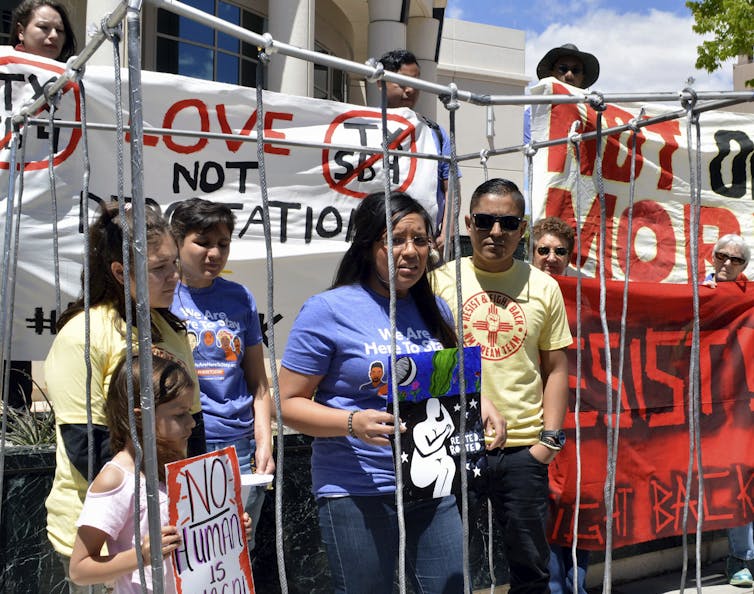
Immigrant rights advocates speak against Trump’s policies in New Mexico. Immigrant rights advocates speak against Trump’s policies in New Mexico. (AP Photo/Russell Contreras, File)
There are those who say that comparing President Donald Trump’s rhetoric to that of Adolf Hitler is alarmist, unfair and counterproductive.

And yet, there has been no dearth of such comparisons nearly one and a half years into his term.

Many commentators have also drawn parallels between the conduct and language of Trump supporters and Holocaust-era Nazis. Recent news of ICE agents separating immigrant families and housing children in cages have generated further comparisons by world leaders, as well as Holocaust survivors and scholars. Trump’s use of the word “infest” to refer to immigrants coming to the U.S. is particularly striking. Nazis referred to infestations of Jewish vermin, and Rwandan Hutu’s labeled Tutsi as cockroaches.

In August 2017, in the wake of the Charlottesville violence, the president used a familiar rhetorical strategy for signaling support to violent groups. He referenced violence on “both sides,” implying moral equivalence between protesters calling for the removal of Confederate statues and those asserting white supremacy. His comments gave white supremacists and neo-Nazis the implied approval of the president of the United States.

Many of these groups explicitly seek to eliminate from the U.S. African-Americans, Jews, immigrants and other groups, and are willing to do so through violence. As co-directors of Binghamton University’s Institute for Genocide and Mass Atrocity Prevention, we emphasize the importance of recognizing and responding to early warning signs of potential genocide and other atrocity crimes. Usually, government officials, scholars and nongovernmental organizations look for these signals in other parts of the world – Syria, Sudan or Burma.

But what about the U.S.? President Trump’s executive order halting family separations provides Congress an opportunity to act. How the legislators respond will be an important indicator of where the U.S. is headed.

Is it possible in the US? 
The term “genocide” invokes images of gas chambers the Nazis used to exterminate Jews during World War II, the Khmer Rouge killing fields of Cambodia and thousands of Tutsi bodies in the Kagera River in Rwanda. On that scale and in that manner, genocide is highly unlikely in the United States.

But genocidal violence can happen in the U.S. It has happened. Organized policies passed by elected U.S. lawmakers have targeted both Native Americans and African-Americans. Public policies defined these groups as not fully human and not protected by basic laws. Current policies treat immigrants the same way.

The threat of genocide is present wherever a country’s political leadership tolerates or even encourages acts with an intent to destroy a racial, ethnic, national or religious group, whether in whole or in part. While genocide is unlikely in the United States, atrocities which amount to mass violations of human rights and crimes against humanity are evident. The U.N. defines crimes against humanity as any “deliberate act, typically as part of a systematic campaign, that causes human suffering or death on a large scale.” Unlike genocide, it does not need to include the actual destruction or intent to destroy a group.

According to Holocaust survivors, the current visual and audio accounts of children separated from their parents in border detention facilities reminds them of practices of the Nazis in ghettos and concentration and extermination camps.

The Holocaust took the international community by surprise. In hindsight, there were many signs. In fact, scholars have learned a great deal about the danger signals for the risk of large-scale violence against vulnerable groups.

In 1996, the founder and first president of the U.S.-based advocacy group Genocide Watch, Gregory H. Stanton, introduced a model that identified eight stageslater increased to 10 – that societies frequently pass through on the way to genocidal violence and other mass atrocities. Stanton’s model has its critics. Like any such model, it can’t be applied in all cases and can’t predict the future. But it has been influential in our understanding of the sources of mass violence in Rwanda, Burma, Syria and other nations.

The 10 stages of genocide 
The early stages of Stanton’s model include “classification” and “symbolization.” These are processes in which groups of people are saddled with labels or imagined characteristics that encourage active discrimination. These stages emphasize “us-versus-them” thinking, and define a group as “the other.”


As Stanton makes clear, these processes are universally human. They do not necessarily result in a progression toward mass violence. But they prepare the ground for the next stages: active “discrimination,” “dehumanization,” “organization” and “polarization.” These middle stages may be warning signs of an increasing risk of large-scale violence.

Where are we now? 
Trump’s political rhetoric helped propel him into office by playing on the fears and resentments of the electorate. He has used derogatory labels for certain religious and ethnic groups, hinted at dark conspiracies, winked at violence and appealed to nativist and nationalist sentiments. He has promoted discriminatory policies including travel restrictions and gender-based exclusions.

Classification, symbolization, discrimination and dehumanization of Muslims, Mexicans, African-Americans, immigrants, the media and even the political opposition may be leading to polarization, stage six of Stanton’s model.

Stanton writes that polarization further drives wedges between social groups through extremism. Hate groups find an opening to send messages that further dehumanize and demonize targeted groups. Political moderates are edged out of the political arena, and extremist groups attempt to move from the former political fringes into mainstream politics.

Do Trump’s implied claims of a moral equivalence between neo-Nazis and counterprotesters in Charlottesville move us closer to the stage of polarization?

Does housing children in cages at border detention facilities in the name of deterrence represent a deepening dehumanization?

Certainly, there are reasons for deep concern. Moral equivalence – the claim that when both “sides” in a conflict use similar tactics, then one “side” must be as morally good or bad as the other – is what logicians call an informal fallacy. Philosophers take their red pens to student essays that commit it. But when a president is called on to address his nation in times of political turmoil, the claim of moral equivalence is a lot more than an undergraduate mistake.

Similarly, when warehousing children in cages and tent cities is justified as a policy of deterrence, this is more than an academic policy debate. We suggest this is a deliberate effort to dehumanize and polarize, and an invitation to what may come next.

While the U.S. may not be on the path to genocide in the sense of mass killings, it clearly is engaging in other crimes against humanity – deliberately and systematically causing human suffering on a large scale and violating fundamental human rights.

Responding and preventing 
Polarization is a warning of the increased risk of violence, not a guarantee. Stanton’s model also argues that every stage offers opportunities for prevention. Extremist groups can have their financial assets frozen. Hate crimes and hate atrocities can be more consistently investigated and prosecuted. Moderate politicians, human rights activists, representatives of threatened groups and members of the independent media can be provided increased security.

Encouraging responses have come from the international community, the electorate, business leaders and government officials. German Chancellor Angela Merkel condemned the racist and far-right violence displayed in Charlottesville, and U.K. Prime Minister Theresa May harshly criticized Trump’s use of moral equivalence. More recently, Pope Francis and the governments of various countries have spoken out about U.S. family separation practices.

The recent withdrawal of the U.S. from the U.N. Human Rights Council suggests that international pressure may not be effective. Domestic actors may have more luck.

Individuals and groups are following the recommendations presented in the Southern Poverty Law Center’s guide to combating hate in supporting victims, speaking up, pressuring leaders and staying engaged. Business leaders have also expressed their discontent with Trump’s polarizing statements and actions. The American Academy of Pediatrics has gone so far as to label the immigrant family separations a form of mass child abuse.

Local governments are struggling to maintain their status as sanctuary cities or cities of resistance. These cities try to provide refuge for immigrants despite ICE raids and arrests. The general public and politicians of both parties and at all levels are speaking out about the separations, and it appears they may be heard.

In our assessment, these actions represent essential forms of resistance to the movement toward escalating atrocities. The executive order issued by President Trump this week provides the elected representatives in Congress with an important opportunity. Will they be complicit in or act to prevent further atrocities?

The ConversationIt also provides the general public an opportunity to strongly assert a commitment to human rights. How Congress responds will be a clear indicator of whether our democratic checks and balances are functioning to stop atrocities from escalating, or whether we are continuing down a dangerous path.

About Today's Contributors:
Nadia Rubaii, Co-Director, Institute for Genocide and Mass Atrocity Prevention, and Associate Professor of Public Administration, Binghamton University, State University of New York and Max Pensky, Co-Director, Institute for Genocide and Mass Atrocity Prevention, Professor, Department of Philosophy, Binghamton University, State University of New York


This article was originally published on The Conversation

21 June 2018

Five Mutants We Want To See Appear in The Gifted

by
The Gifted.
The Gifted. (© 2017 Fox & its related entities. All Rights Reserved.)
The TV series, which premiered in October 2017, is connected to the X-Men film series but takes place in an alternate universe where the X-Men have all disappeared and humans fear, distrust, and even hate mutants. 
The show focuses on the Strucker family -- Reed Strucker (Stephen Moyer), a district attorney and mutant prosecutor, his wife Caitlin (Amy Acker), and their kids Andy (Percy Hynes White) and Lauren (Natalie Alyn Lind).
Viewers follow the Struckers as they go on the run when they discover that their children are actually mutants and have been targeted by the very government that their father works for. 
Running from the government, however, proves to be a gargantuan challenge because Sentinel services agent named Turner (Coby Bell) always seems to be a few steps behind them. 
The Struckers then have no choice but to seek help from the Mutant Underground for protection.
The show's first season which is on FOX+ proved to be a hit with Marvel and X-Men fans, receiving positive feedback and praise from critics as well. Reviewers lauded the show for tackling timely topics and straying away from overused superhero tropes. 
Fans are also excited about the mutants that star the series such as Blink, Polaris, Thunderbird, and the Strucker siblings -- mutants who otherwise have had minimal or even no exposure in the Marvel film or television universe.

The Gifted - Poster
The Gifted - Poster
Because the show explores lesser-known mutants, here are a few more super humans whose appearance we feel would be great in The Gifted:
1. Callisto
If the challenge on hand is going underground in order to escape from humans, the Morlocks would rise to that challenge the best. So who's better to help out the Strucker family than the leader of the MorlocksCallisto ­­-­ a mutant with super strength, speed, and amplified senses. 
While Callisto has made an appearance on screen in X-Men: The Last Stand, a bigger role that is more aligned with the comics may await her should she be written into The Gifted.
2. Forge
As an often overlooked and underestimated mutant, Forge has the ability to be extremely brilliant at technology and inventing things. His resourcefulness and smartness are exactly what could help propel an underground resistance team and bolster their chances at winning the fight. 
From armor to weapons to traps, Forge could prove to be an extremely important part of the team.
3. Kid Omega
This mischievous psychic is known for being a troublemaker and for being incredibly powerful. His irreverent punk lifestyle and attitude makes him an interesting fit for resisting against humans. 
While his appearance could also mean trouble for the Mutant Underground, it will be an undeniably interesting mix.
4. Boom-boom
On the note of being mischievous and roguish, Boom-boom (also known as Time Bomb, Boomer, or Meltdown) is a great fit. With an outcast backstory, Boom-boom has the ability to create small orbs of mental energy that explode destructively. 
Her rebellious attitude together with her powers can create a great ally for the Mutant Underground.
5. Rachel Summers
Being the daughter of Jean Grey and Scott Summers, Rachel doesn't have much room to appear in other X-Men related media because it may mean a warped storyline. 
But due to the alternate-timeline nature of The Gifted where we don't see or know what happens to Jean or Scott, it could mean an opportunity for the show to include this powerful telepath and explore her as a character.
SOURCE: FOX+
Related Videos:


20 June 2018

Trump And Sessions Can End Immigrant Family Separations Without Congress' Help

by

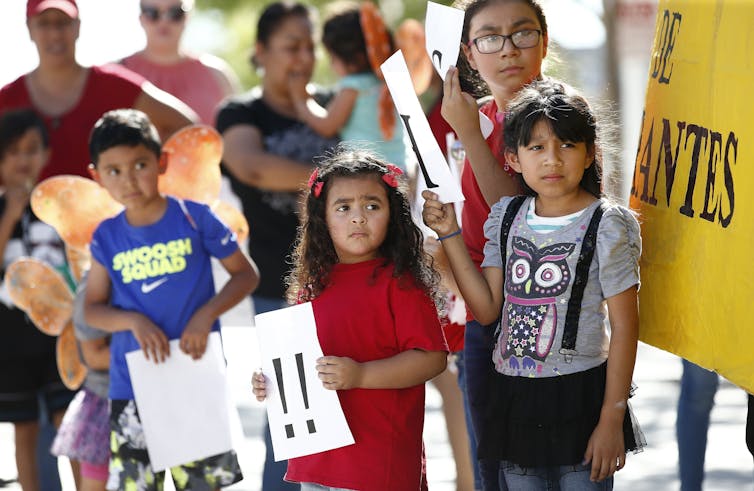
Children at an immigrant family separation protest in Phoenix.
Children at an immigrant family separation protest in Phoenix. (AP Photo/Ross D. Franklin)
A recent poll shows that two-thirds of Americans oppose the Trump administration’s policy of separating immigrant families apprehended along the U.S.-Mexico border.

Amid a firestorm of criticism, President Donald Trump has blamed Democrats and inaction in Congress for the family separation policy.

Only Congress can provide the comprehensive immigration reform that would address the fundamental problems plaguing the American immigration system, including the statuses of undocumented immigrants already living in the U.S.

However, current immigration laws give the executive branch considerable discretion in deciding which immigrants to detain and release from custody.

Trump has at his disposal a variety of alternatives – other than separating families – that would promote his stated goal of deterring migration from Central America. Those alternatives could avoid violating international human rights norms.

Immigrant detention by past administrationsMany presidents have used the detention of migrants as a tool to enforce immigration law. At the same time, the courts have rejected heavy-handed attempts to deter migration that infringe on the rights of noncitizens.

For example, in Orantes-Hernandez v. Thornburgh, a court of appeals in 1990 found mass immigrant detention and various related policies by the Reagan and first Bush administrations to be unlawful. The policies included detaining immigrants in remote locations where it was difficult for them to retain legal counsel. Together, they formed a concerted effort to deter Central Americans from pursuing asylum claims.

Similarly, in 2014, the Obama administration’s mass detention of Central Americans brought many – and many successful – lawsuits. In Flores v. Lynch in 2016, the court of appeals found that a settlement agreement in a lawsuit required the release of detained children.

Under Trump’s administration, the policy of separating families in order to detain adults has struck a nerve and generated an unprecedented political outcry. Several lawsuits have been filed seeking to end the policy of family separation, including one filed by the American Civil Liberties Union in federal court in San Diego.

The courts have played major roles in moderating the Trump administration’s immigration policies. For example, they’ve issued rulings to block Trump’s Muslim” or “travel ban and his attempt to cut federal funding to “sanctuary” cities that refuse to fully cooperate with federal immigration enforcement efforts.

Although it ultimately may take a court ruling to stop family separations, it doesn’t have to be this way. President Trump has many other policy options available to him that he can implement without any Congressional action.

Detention without separation 
In 2014, the Obama administration faced a large number of Central American migrants crossing the border without inspection. Reports at that time suggest it was a much larger influx than what Trump is facing today.

With increasing numbers of families being apprehended by immigration agents at the border, the Obama administration began using what’s called “family detention.” Entire families were detained together in one facility.

Family detention centers operated in Pennsylvania, Texas and, for a time, New Mexico. Although critics argued that family detention was also inhumane, it certainly did not generate the same level of outrage at Trump’s policy of family separation.

Bonds for immigrants 
Currently, migrants apprehended at the border are placed in detention; migrant families are separated. Detention under the Trump administration’s “zero tolerance” policy is mandatory, without the possibility of being released on bond.

Prior to this policy, when someone was detained by U.S. immigration authorities, they were allowed a hearing and the opportunity to post a bond for release. Rather than remaining detained, they were released into the community until a hearing was scheduled to evaluate their asylum or other claim.

This is the norm for anyone held in detention in the United States. In fact, the Supreme Court has held that this is a constitutional requirement.

President Trump and Attorney General Jeff Sessions have both denigrated the ordinary approach to posting bonds when it comes to dealing with noncitizens who cross the border without documentation, even if they have a bona fide claim to asylum. Trump signed a memo to end the release of immigrants into the community in April.

Some critics argue that those who are released fail to appear in court when the time comes. However, data show that the vast majority of families who are apprehended and bond out of custody subsequently appear at their removal hearings.

The Trump administration could allow bond hearings for immigrant families and release them if they are not a flight risk or danger to the community. Children could be bonded out with their families and families would remain together. Devices like ankle bracelets could be used to help ensure court appearances.

The ConversationPrevious administrations have responded to similar situations at the U.S.-Mexico border, but none have resorted to the separation of families as a device to deter migration from Central America. The president has said that Congress should fix it. But the president has the power to do that himself.

About Today's Contributor: 
Kevin Johnson, Dean and Professor of Public Interest Law and Chicana/o Studies, University of California, Davis


This article was originally published on The Conversation

Bonus Picture: 
(Via Trumpton Facebook Page)
"This is America..."

Who's Walking and Who's Dead in Mid-Season 8 of The Walking Dead

by
"The Walking Dead"
"The Walking Dead" ((C) AMC Network Entertainment LLC. All Rights Reserved)
Based on a comic book series by the same name, The Walking Dead  is one of today's most popular TV shows. The post-apocalyptic zombie horror follows sheriff's deputy Rick Grimes (Andrew Lincoln) who navigates the world with the team of survivors that he leads. 

They're not only challenged with surviving the zombies, referred to as "walkers", but also other survivor groups who oppose them. Oftentimes, these opposing survivor groups prove to be more lethal than the walkers, resulting in Rick and his survivor groups to turn to any means necessary to ensure their safety and survival.
Since its premiere in 2010, the series has had one of the largest viewership of modern day TV shows and has received extremely positive reviews from fans and critics. It has also been nominated for several awards including the Golden Globe for Best Television Series and Best New Series from the Writers Guild of America.
Marking from the season 8 mid-season premiere, there has been a death toll of over 250 characters across the span of the show. These include both side characters and supporting characters. It could be a lot to keep up with, especially for those who might just be getting into the show. 

Here's a quick list of the important characters that are left walking and those that are dead for the mid-season of season 8:
Who's Walking?
1. Rick Grimes - It's hard to imagine The Walking Dead without its main lead character and everybody' favorite deputy, Rick. He's survived a lot including being stabbed and shot, proving that he's definitely a tough one to take down.
2. Daryl Dixon - This archer and tracker is a definite fan favorite. His death would mean chaos in The Walking Dead community and for good reason too. Daryl has survived many dangerous situations and fans hope he keeps doing so.
3. Morgan Jones - Morgan, who reappeared in season 3, joined the survivors in the fifth season. The last known survivor of the Jones family, this former soldier proved to be a helpful ally and friend to both Rick and Daryl.
4. Carol Peletier - Also the last surviving member of her family, Carol has grown from a housewife to a killer weapon-wielding survivor. A very close ally of Daryl and advisor of Rick, Carol's strength and survival instincts help keep her and people around her alive.
5. Maggie Rhee - Hershel's only daughter Maggie and widow of Glenn, Maggie has risen to become one of the strongest leaders in The Walking Dead.  She is currently the leader of the Hilltop Colony and co-leads the Militia along with Rick, Ezekiel, and Cyndie.
6. Michonne - Sword-wielding fighter Michonne has become Rick's right-hand woman. After the death of her boyfriend and toddler, Michonne has proven to be a valuable ally who won't go down without a fight.
Other side characters still alive and kicking include Tara ChamblerEugene Porter, Rosita, Gabriel Stokes, Aaron, Jesus, Enid, Dwight and King Ezekiel. Opposing Rick's group, Gregory, Simon, Jadis, and Negan are still kicking as well.
A Walking Dead walker.
A Walking Dead walker. (Image via LoupDargent.info)
Who's Dead?
While the death count of The Walking Dead is astronomical for any TV show, here are some of the most recent and central deaths in the show from mid-season 8. For those who have not yet caught up with the mid-season finale, this is a huge spoiler warning.
1. Morales - It was revealed he former member of Rick's group was taken in by the Saviors and converted into one of them when he holds Rick at gunpoint in season 8's second episode. Unfortunately, he finds his death at the hands of Daryl's crossbow.
2. Eric Raleigh - In a heartbreaking death during the attack on the Saviors, Aaron's boyfriend found himself shot in the abdomen. Sadly, Aaron was unable to save him, making Eric one of the earliest deaths in season 8.
3. The Saviors - The losses on the Saviors' side were heavy this season, being the target of the walkers, Alexandria, Hilltop, and the Kingdom. While not wiped out, a good number of them have definitely been killed.
4. Gunther - Killed by Jerry's Ax, Gunther was eventually executed while trying to bring Ezekiel back to the Sanctuary.
5. Shiva - Loyal pet to Ezekiel, Shiva proved her loyalty by protecting the King from a horde of walkers. Unfortunately, the tiger failed to escape them.
6. Carl - Arguably one of the most shocking and important deaths of not only season 8, but of the series as a whole, the death of Rick's son shook the entire Walking Dead fan base. Carl, who fans have watched since the series premiere, has been a mainstay until he was bitten by a walker in the eighth season.
SOURCE: FOX+
"The Walking Dead" Season 8 - Trailer:


More Zombies Related Stories 
For more zombies related stories, click here...

You Might Also Like